

Audio By Carbonatix
The war in Ukraine will put further pressure on grain-importing countries in Africa and Asia as a reduced number of vessels for delivering cargoes drives up shipping rates, according to the head of the International Chamber of Shipping.
About 80 to 100 ships, mostly bulk carriers, have been unable to leave Ukrainian waters for almost two months due to underwater mines and military blockades, ICS Chairman Esben Poulsson said in an interview. Bulk freight rates are rising as owners and charterers price in the fact that ships will be tied up for longer periods.
Trade flows of grains are undergoing significant shifts, he said, and the distance that ships will have to travel to get shipments from the Americas to customers is further than voyages from the Black Sea.
“This will have repercussions for poorer countries in Africa, which can ill afford to pay huge amounts more for their grain,” Poulsson said.
Russia’s war in Ukraine has thrown the $120 billion global grains trade into disarray as deliveries from the Black Sea breadbasket region get increasingly complicated. New trades are emerging, with producers in the Americas sending cargoes to customers in Africa and Southeast Asia, some for the first time in years. China is ramping up purchases of U.S. corn, while Brazil is shipping wheat to places like Turkey, South Africa and Sudan.
A surge in freight rates could further drive up food costs, piling more inflationary pain on consumers and worsening a global hunger crisis. A United Nations’ index of global food prices is already at a record, and the impact is felt most in poor countries where groceries make up a large share of consumer budgets.
“For the here and now, freight rates will stay high and may go a little higher,” said Poulsson, whose organization represents shipowners and operators that cover about 80% of the world’s merchant trade. “But it will be volatile because things can change.”
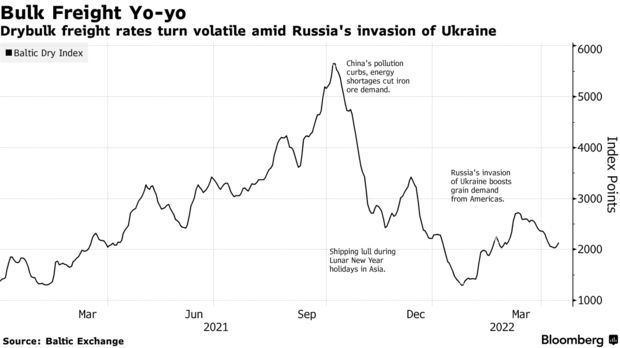
The Baltic Dry Index, the widely watched benchmark for bulk freight rates, has whipsawed in the past year, surging to a 13-year high in October on production shortages of raw materials, and then plunging as China’s curbs on factory pollution weakened iron ore demand. The gauge has climbed 65% from a low in January.
In addition to the situation in Ukraine, freight rates are also being affected by China’s efforts to battle the spread of Covid-19. Hundreds of bulk ships are facing delays off China’s coast as authorities in cities including Shanghai lock down cities.
Latest Stories
-
Prudential Life settles GH¢100,000 medical bills under its PRUCares Valentine Experience Initiative
2 hours -
Wa West Picnic: Peter Lanchene Toobu champions peace, health and unity in landmark celebration
3 hours -
Dr Mensah Market flooded after downpour in Kumasi
3 hours -
Armed men reportedly storm Adjen Kotoku Onion Market amid tensions
4 hours -
Tecco Mensah writes: Why football fans must look beyond statistics
4 hours -
Police recover stolen Honda CR-V in Kumasi within 48 hours
5 hours -
Apetorku Gbodzi 2026 Festival opens in Dagbamete with development focus
5 hours -
President Mahama arrives in Lyon to co-chair One Health Summit
5 hours -
Beverly View Plus Hotel draws crowds amid coastal Easter rush in Volta
5 hours -
Maiden Zongo Festival held in Wa amid calls to tackle drug abuse among the youth
6 hours -
FDA warns of fake HIV test kits on Ghanaian market
6 hours -
Africa urged to build resilient health systems as donor support tightens
6 hours -
Easter gesture: Ablakwa settles medical bills for 85 North Tongu constituents
8 hours -
Africa must harness its population strength—Titus-Glover
8 hours -
Visa-free access doesn’t mean unlimited stay – Lom Ahlijah
8 hours