

Audio By Carbonatix
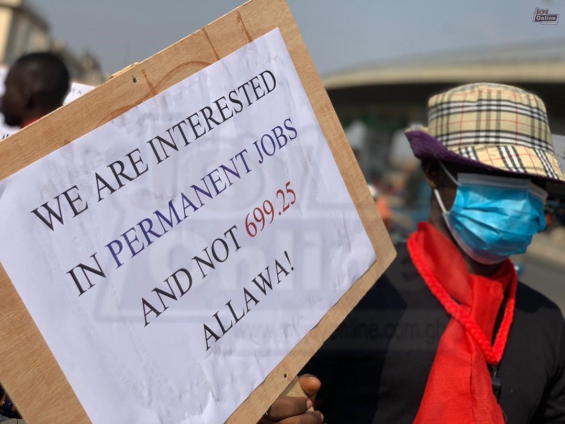
Unemployment in Ghana has become one of the country’s most pressing socio-economic challenges, with young people bearing the greatest burden. What was once viewed as a gradual concern has evolved into a national crisis that threatens the future of an entire generation. Every year, thousands of graduates enter the job market with hope and ambition, only to face limited opportunities and an uncertain future.
According to the Ghana Statistical Service (GSS), youth unemployment remains persistently high. Although exact figures vary depending on the methodology used, recent estimates indicate that youth unemployment and underemployment combined affect well over half of Ghana’s young population in one form or another. National unemployment rates have generally ranged between 13 and 15 percent in recent years, but these statistics alone fail to reveal the full extent of the problem.
The reality is that many young Ghanaians who are officially classified as “employed” are engaged in low- paying, unstable, or informal jobs that neither reflect their qualifications nor provide sustainable livelihoods. Employment should not simply be measured by whether someone has a job, but by whether that job offers dignity, security, and opportunities for growth.
A Generation at Risk
If current trends continue, Ghana could face an even more troubling reality in the years ahead. University graduates, including those with postgraduate qualifications, may increasingly find themselves accepting jobs that require little or none of the skills they spent years acquiring.
While there is nothing dishonourable about any form of honest work, it is deeply concerning when highly educated individuals are forced into positions far below their qualifications because suitable opportunities simply do not exist. Today, such cases remain relatively limited, but there is a growing risk that they could become increasingly common if meaningful interventions are not implemented.
The consequences extend beyond individual disappointment. When education no longer translates into opportunity, public confidence in higher education and national development begins to erode.
Leadership Must Move Beyond Promises
Employment creation has long been a central feature of political campaigns in Ghana. Successive governments have pledged to tackle unemployment through various initiatives, yet many young people believe that the pace of implementation has fallen short of expectations. Addressing unemployment requires more than campaign promises. It demands consistent, long-term policies that encourage industrialisation, support entrepreneurship, attract investment, strengthen small and medium-sized enterprises, and create an environment where the private sector can flourish. Sustainable job creation cannot be achieved through short-term political measures alone.
More Than an Economic Challenge
The impact of unemployment extends far beyond lost income. Prolonged joblessness affects mental health, self-esteem, family stability, and overall social cohesion. It can leave young people feeling discouraged despite years of hard work and academic achievement.
A nation that cannot provide meaningful opportunities for its educated youth risks increasing inequality, slowing economic growth, and losing valuable talent to migration. Ghana cannot afford to allow its young workforce to become disillusioned or underutilised.
The Way Forward
Ghana possesses immense human potential. Unlocking that potential requires deliberate investment in industries capable of creating jobs, improved support for entrepreneurs, stronger partnerships between academia and industry, and educational reforms that align graduates’ skills with the evolving needs of the labour market.
Equally important is creating an enabling environment for businesses to grow, innovate, and employ more people. The private sector must be empowered to become a stronger engine of employment while government provides the policies and infrastructure necessary for sustainable economic growth.
A National Responsibility
The unemployment crisis is not merely a statistic; it represents the aspirations of millions of young Ghanaians seeking the opportunity to contribute meaningfully to their country’s development. Addressing this challenge requires collective commitment from government, the private sector, educational institutions, civil society, and citizens alike.
The warning signs are already visible. If decisive action is delayed, unemployment and underemployment will continue to undermine the nation’s progress, forcing many talented young people to settle for opportunities far below their potential.
THE TIME TO ACT IS NOW. GHANA’S FUTURE DEPENDS ON IT.
Latest Stories
-
The illusion of a good deal: Why some everyday money-saving habits may be costing you more
12 minutes -
Family seeks autopsy, police investigation into death of student 12 days after Abomosu SHS enrolment
20 minutes -
Trade Minister urges employers to leverage industrial opportunities to create jobs
27 minutes -
Asantehene plants trees to commence Jimi Watercourse Rehabilitation destroyed by galamsey
51 minutes -
15 arrested, 6 trucks impounded over sandwinning activities on Kumasi-Accra Expressway
51 minutes -
OFFICIAL: Vinicius will miss El Clásico, suspended four games
55 minutes -
Prayer vigil held after four arson attack murders
1 hour -
GRA fully recovers $154k legacy debt owed by foreign entities between 2022 and 2024
1 hour -
Kwesi Pratt Jr warns bus preachers are adding to passengers’ stress with accident prophecies
1 hour -
MTN Ghana to spend $1.1bn in 3 years, build 500 new sites as MoMo hits 44% Growth
1 hour -
I have no regrets joining Assemblies of God – Mahama
1 hour -
Starlink restrictions in Ukraine war linked to political situation, Zelensky aide says
1 hour -
Furniture boost for Techiman North schools as MP donates to 20 institutions
1 hour -
Assemblies of God to loan 10,000-seater dome for Ghana@70 celebrations
1 hour -
Government to audit 2,016 community network sites – Communications Minister
1 hour