

Audio By Carbonatix
The Ghana Statistical Service has described as worrying the growing consumption of sachet water as its previous studies reveal significant faecal contamination in a number of the packaged water on the market.
The Service indicates that consumption of sachet water by households in Ghana has quadrupled in the last decade, from 9% to 37.4%.
However, its multiple indicator cluster survey in 2017 revealed that 34.1% of households had their sachet water contaminated with an appreciable amount of Escherichia Coli.
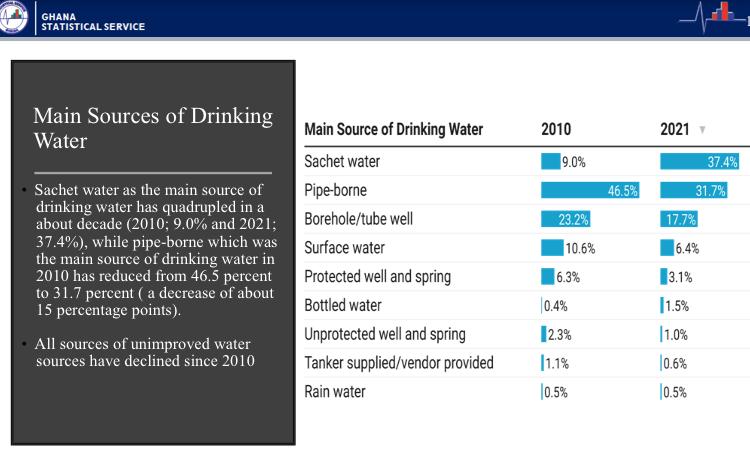
In 2010, pipe-borne water was pegged as the main water drinking source in most homes in Ghana.
But, the figure is reported to have reduced from 46.5% to 31.7% over the last decade with sachet water becoming the preferred source of drinking water.
According to the 2021 Population and Housing Census, about 37% of the 8.3 million households in Ghana consume packaged-sachet water as their main source of drinking water.
The figure represents a quadruple increase from 9% in 2010.
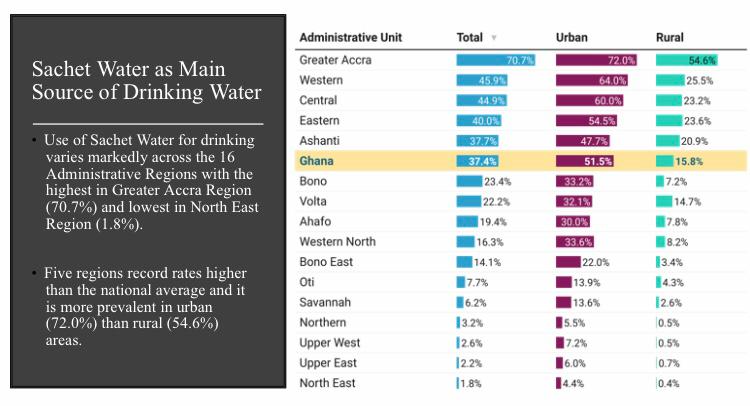
The consumption of sachet water is said to be prevalent in urban areas (72%) with five regions cumulatively recording higher rates than the national percentage points.
Greater Accra region recorded the highest (70.7%) use of sachet water for drinking while the North-East region was the lowest (1.8%).
However, the Ghana Statistical Service is worried the figure poses a public health threat as a number of water sources for packaged water production have been found to contain faecal matter.
Assistant Chief Statistician with the Ghana Statistical Service, Dr. Peter Takyi Peprah, was speaking at a stakeholder engagement in the Water, Sanitation and Hygiene Sector.
“We need to pay attention to those who are in the production of sachet water. In 2017, a multiple indicator cluster survey was conducted which we didn’t just collect information about the source of drinking water but we tested the quality of these drinking water sources for a household. We realized 34.1% of household drinking water sources have faecal contamination. Faecal contamination simply means we have toilet in our water,” he said.
The engagement in Kumasi was to keep stakeholders in the WASH sector abreast of the findings from the census to inform policy.
Dr. Takyi Peprah is therefore calling for thorough examination of produced sachet water on the Ghanaian market.
“The Food and Drugs Authority must embark on thorough monitoring and supervision of the production of these sachet water. They should try their best to test on regular basis the sources of water in the production of these waters. So that in case the water is contaminated they can advise them to change the source of water or close that company. They always say the water source is either spring water or underground water. Looking at the number of people drinking sachet water it can pose a public threat,” he suggested.
Latest Stories
-
Israel-bound flight diverted after fight between pilots
4 minutes -
EchoWave earns praise for sound quality at 10th Women in Worship
13 minutes -
Crackdown on South Africa’s unsafe streets ordered by president to keep women safe
25 minutes -
Banks are responding to improved monetary policy conditions – John Awuah
44 minutes -
Judges’ conference forces further adjournment of Salomey Baffoe case to Oct. 5
56 minutes -
Chorkor community joins AC4NCA clean-up to tackle marine and coastal pollution
1 hour -
GRA assures Tullow of collaboration to settle $393m tax liability without disrupting its petroleum operations
1 hour -
South Korea demands apology from Pyongyang for landmine blasts that injured three
1 hour -
Carlos Queiroz not the sort of coach Black Stars need – Nii Lante Vanderpuye
2 hours -
AFCON 2027Q: ‘Our Black Stars team is gone’ – Former Sports Minister
2 hours -
Prof. Prempeh calls for public review of draft constitutional reform bills
3 hours -
AFCON 2027Q: ‘I have never seen a poor performance from Black Stars like against Gambia’ – Nii Lante Vanderpuye
3 hours -
Bawumia backs insurance sector reforms after engagement with IBAG
3 hours -
Nigeria set to launch National Digital Address System 9 years after Ghana showed the way
3 hours -
Policy rate decision takes time to reflect in lower lending rates – BoG
3 hours