

Audio By Carbonatix
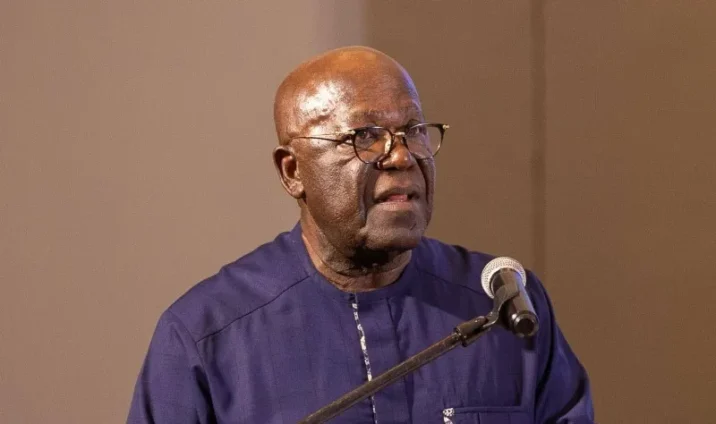
Famous business magnate Sir Sam Jonah has delivered a proposal for Ghana to re-prioritise Science, Technology, Engineering, and Mathematics (STEM) education, asserting that no nation achieves prosperity in the modern world without it at its core.
Speaking on Saturday, June 7, 2025, at the Academic City University's commencement ceremony, Sir Sam, the Chancellor of the University of Cape Coast (UCC), implored Ghana to emulate global powerhouses that have placed STEM at the heart of their national development policies.
Addressing graduates from a university with a "bold and unapologetic focus on STEM and entrepreneurship", Sir Sam, the Executive Chairman of Jonah Capital, an equity fund based in Johannesburg, South Africa, emphasised that "the future is not imagined — it is engineered."
He presented compelling international case studies:
- China, now the world’s second-largest economy, produces over 4 million STEM graduates each year. This massive output is coupled with a deliberate philosophy where "almost every modern Chinese leader has been trained in STEM", fostering systematic problem-solving and rapid solution-building.
- India, overcoming colonial poverty, sees nearly 3 million students graduate in STEM fields annually. Their global dominance in IT services, pharmaceuticals, and space science is a direct "result of sustained national strategy". India's IT sector alone contributes over $200 billion to its economy annually, employing millions.
- In the United States, over half of international students are in STEM fields, highlighting how Silicon Valley's innovation ecosystem was built on substantial government investment in research, a culture of innovation, and future-oriented educational policies.
- Singapore, a resource-poor fishing port at independence, transformed into one of the richest countries per capita through sustained investment in STEM since the 1970s. Institutions like NUS and NTU gained global reputations, making it a hub for biotech and electronics, with its electronics industry alone contributing over $100 billion to its GDP.
- Israel, similarly resource-scarce, invested early in STEM to become a world leader in tech startups per capita, producing vast numbers of engineers and computer scientists and attracting billions in venture capital.
By stark contrast, Sir Sam highlighted a critical gap: "Sub-Saharan Africa produces less than 10% of our graduates in STEM, despite having the youngest and fastest-growing population."
This alarming statistic underscores the region's challenge in harnessing its demographic dividend for technological advancement.
Reflecting on Ghana's own history, Sir Sam lauded President Kwame Nkrumah's "unmatched foresight" at independence, making STEM education a national priority.
Dr Nkrumah "incentivised" science and engineering students with financial support, rewarded graduates in these fields with higher salaries in public service, and instilled "prestige attached to technical competence", viewing STEM as a "patriotic duty".
However, Sir Sam lamented, "Sadly, over time, that national prioritisation waned."
He now called for an urgent return to this focus, not through mere slogans, but through "deliberate action":
- Providing significant financial incentives and scholarships for STEM students.
- Building world-class laboratories in every region to enhance practical learning.
- Rewarding STEM teachers with attractive career pathways and public respect.
- Integrating STEM graduates centrally into national development planning, not as "afterthoughts".
While acknowledging the need for all professions, Sir Sam stressed the current imperative to prioritise STEM.
He quoted former Governor Richard Lamm: “All we know about the new economic world tells us that nations which train engineers will prevail over those which train lawyers. No nation has ever sued its way to greatness.”
Sir Sam concluded with a powerful vision: "A nation's greatness is achieved through technological innovation and expertise, particularly in the field of engineering. Let us be that nation."
His address served as a clarion call for Ghana to strategically invest in its scientific and technological human capital to secure its future prosperity.
Latest Stories
-
Mahama announces 60-Hectare irrigation project to boost tomato production
53 seconds -
WPL: Hasaacas Ladies win on last day to set up final with Ampem Darkoa
2 minutes -
Chisora beaten by Wilder in captivating bout
25 minutes -
One dead, six maimed as bloody land feud tears Krachi Nchumuru apart
49 minutes -
Missing service member rescued by US forces after jet downed in Iran, Trump announces
1 hour -
Gomoa Easter Carnival: Sarkodie, Kuami Eugene, Tinny, set festival ablaze as Day 3 ends on high note
2 hours -
“Feels amazing” – Antoine Semenyo reveals after Manchester City dismantle Liverpool
2 hours -
Mahama calls for emergency cabinet meeting over rising fuel prices
3 hours -
Asante Gold reports US$345million loss for 2025
4 hours -
Prof. Naana Jane Opoku-Agyemang provides update on Women’s Development Bank
4 hours -
‘It’s not easy’ – Mother of late Dr Omane Boamah breaks silence
5 hours -
Gov’t making progress in clearing $1.7bn power debt – Mahama
5 hours -
Justice is the engine of growth – Chief Justice
5 hours -
Meet us halfway – Trade Minister tasks private sector with AfCFTA success
6 hours -
After more than 14 years at Atletico Madrid, what next for Simeone?
6 hours