

Audio By Carbonatix
A major hurdle has emerged for the former leadership of the Ghana Infrastructure Investment Fund (GIIF) under trial, as three former board members have independently filed witness statements at the Accra High Court unanimously denying ever approving any funding for the contentious Sky Train project.
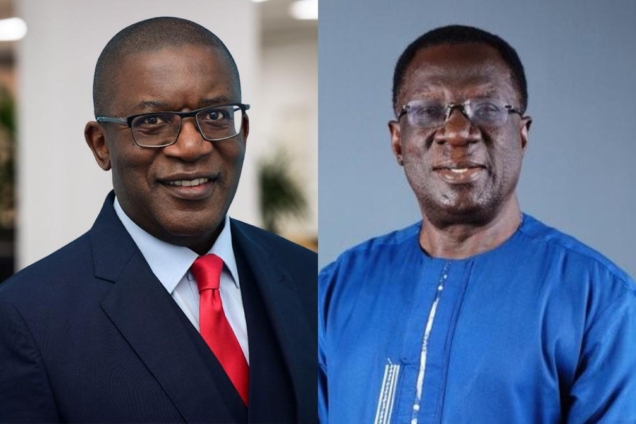
These damning testimonies could significantly bolster the Attorney-General’s prosecution of Solomon Asamoah, former GIIF Chief Executive Officer; and Professor Christopher Ameyaw Akumfi, former Board Chairman, for allegedly causing financial loss to the state to the tune of $2million.
The criminal proceedings centre on a project that has long been shrouded in mystery and public scepticism.
The Sky Train concept, first proposed around 2017-2018, envisioned a massive 200km urban rail network across major cities, with an ambitious estimated cost ranging from $2.6 billion to $3.2 billion.
Despite the grand promises of urban decongestion and modern transport, tangible progress on the ground has remained conspicuously absent after the payment of $2million.
Witness statements in court reveal a consistent narrative across the former GIIF board members' tenures, challenging any claim of official endorsement for the project's funding.
Yvonne Odoley Sowah, who served on the GIIF Board from 2017 to 2021, explicitly declared in her statement dated May 28, 2025, that during her time, former CEO Solomon Asamoah "did not submit any document to the Board for the approval of the Sky Train project."
She further confirmed that "the Board never approved the Sky Train Project, nor did it approve the disbursement of any monies under this project."
Her account was corroborated by Nana Afua Kyerewaa Ababio, a banker from Ashanti Mampong and a GIIF Board member from 2017 to 2020.
In her statement dated May 30, 2025, Ms. Ababio asserted that her review of board documents showed "no formal request from GIIF management to the Investment Committee, a sub-committee of the Board, for consideration of the Sky Train project."
Consequently, she concluded, there was no recommendation from the Investment Committee to the full Board for its approval, nor any formal presentation or resolution, leading to no disbursement of funds during her service.
Adding to this unified denial, Cecilia Gambrah, a native of Fumesua, Ashanti Region, who also sat on the GIIF Board from 2017 to 2020, unequivocally stated in her June 2, 2025, witness statement: "To the best of my recollection, the Board did not approve any funding for the Sky Train project during the period of my service."
All three former board members have appended "statements of truth" to their testimonies, legally affirming the veracity of their recollections.
Their collective and independent denials suggest a potential circumvention of the stringent governance and financial protocols expected of an institution like GIIF, established in 2014 to meticulously manage and mobilise funds for Ghana's critical infrastructure.
The high-stakes trial is poised to unearth more details surrounding the mysterious funding of the Sky Train concept that, despite years of public discussion, has yet to materialise.
Background
The Attorney-General’s Office formally charged Mr. Solomon Asamoah and Prof. Christopher Ameyaw-Akumfi in May for their roles in the controversial Accra Sky Train project, which allegedly cost the state $2 million without authorisation.
The charges, filed on May 13 at the Accra High Court (Criminal Division), include wilfully causing financial loss to the state under the Criminal Offences Act, conspiracy to commit a crime through intentional dissipation of public funds, and intentional dissipation of public funds under the Public Property Protection Decree.
Prosecutors allege that in February 2019, the accused authorised a $2 million payment from GIIF to Africa Investor Holdings Limited for preliminary work on the Sky Train project – a system that was never built.
The payment was reportedly made without proper board approval.
The Sky Train project, initiated in 2018 as a public-private partnership for an urban rail system in Accra, involved a memorandum of understanding between the Ministry of Railways Development, Africa Investor Holdings, and GIIF.
However, investigations revealed the $2 million disbursement lacked proper due diligence and violated GIIF's governance protocols.
This prosecution forms part of the government's broader crackdown on financial malfeasance, following earlier warnings of pending charges in the SkyTrain and NSS ghost names scandals.
Latest Stories
-
Keep the money in Ghana – Gov’t enforces local cargo insurance
1 hour -
US Army veteran charged with leaking classified information to journalist
1 hour -
Dr. Dre joins Forbes billionaires list as second-richest hip-hop artist with $1 billion fortune
1 hour -
Trump administration cannot nix legal status of 5,000 Ethiopians, US judge rules
2 hours -
Libya announces new oil and gas discoveries with three major energy companies
2 hours -
Oil rises as investors remain wary US-Iran ceasefire will open supply flow
2 hours -
Police arrest suspect over church threat video
4 hours -
Eight appear in court as police intensify crackdown on illicit drugs in Tamale
4 hours -
Motorist remanded in custody for hitting four-year-old girl
4 hours -
Mobile money vendor robbed at Ziope
4 hours -
Benin’s Finance Minister Wadagni seeks his own mandate in election
4 hours -
GNFS retrieves body of unidentified man from Asylum Down drain
5 hours -
CAF’s Motsepe to visit both Senegal and Morocco amid AFCON fallout
5 hours -
Edmond Boateng takes up secretary role at Honorary Consular Corps of Ghana
5 hours -
Armed men kill 20 and abduct others in northwestern Nigeria villages
5 hours