

Audio By Carbonatix
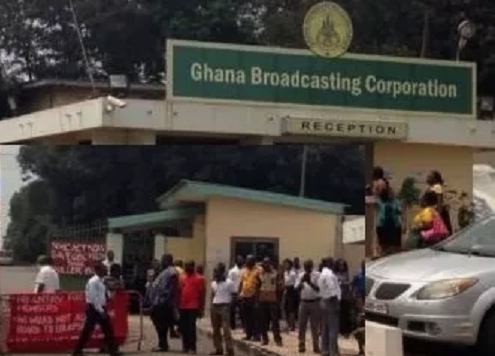
The Ghana Broadcasting Corporation (GBC) is fighting for its financial life, with soaring electricity tariffs forcing the state broadcaster to decommission two of its main studios and severely curtail the operational hours of others.
Management of GBC has revealed that despite a strategic shift towards solar energy, it is now paying a staggering GH¢100,000 weekly to the Electricity Company of Ghana (ECG) to avoid being cut off.
The crippling utility costs were brought to light during a visit by the Parliamentary Committee on Communication and Information.
The GBC's Director-General, Professor Amin Alhassan, painted a grim picture of the operational challenges, noting that the financial strain has forced the GBC to implement drastic power-saving measures.
“So, even this studio, when it became critical, management decided that it should be on only from 6 a.m. to 10 a.m. and shut down for 4 hours a day. The rest of the day, we don’t want it on,” Prof. Alhassan disclosed.
He recounted instances where management had to overrule staff requests to use the studio beyond its mandated four-hour window due to financial constraints.
“They would sometimes come to plead that they really need to do some work here. We overrule them because of the cost of electricity,” he said.
The move to solar energy, while a step in the right direction, has not been enough to offset the massive bills.
GBC has already migrated 30% of its operations at the Adjankote Transmission Line and 50% of its Takoradi branch operations to solar power.
Prof. Alhassan revealed plans to extend the use of solar energy to the GBC's head office at Kanda in a desperate bid to cut down costs and sustain operations.
The Director-General also highlighted the deep-rooted issue of underfunding, stating that GBC has not been able to acquire new, capital-intensive broadcasting equipment for decades, relying instead on foreign aid.
“The major capital-intensive broadcast equipment has always been provided by the central government, by government. But we’ve seen that in the last 20 years, we’ve seen a response that says that we don’t have the resources,” he stated.
He added that the cost of such equipment, which runs into millions of dollars, is far beyond what GBC can generate from its own internal sources of revenue (IGF).
“This type of equipment cannot be purchased from our IGF because, I mean, that runs into millions of dollars, and it is not within our means. That is because the Japanese came to our aid, and we will need a similar gesture to keep the other studio on, and we don’t have it. We only use it for 4 hours a day, and we shut it off,” he lamented.
The GBC Director-General concluded by stressing that their only viable solution to the skyrocketing electricity bills has been to reduce consumption.
“So the only way if you can’t pay your bill, you reduce your consumption, isn’t it? That’s exactly what we are doing.”
Latest Stories
-
TTAG raises alarm over proposed recruitment of 7,000 teachers, demands national posting roadmap
18 minutes -
Civilians feared killed after reports of air strike on Nigerian market
28 minutes -
Bishop Simon Kofi Appiah installed as new Jasikan Diocese Bishop
29 minutes -
Trump’s Strait of Hormuz blockade threat raises risks and leaves predicaments unchanged
31 minutes -
US Court backs extradiction of former MASLOC CEO Sedina Tamakloe-Attionu’s to Ghana
50 minutes -
Seven arrested as NAIMOS dismantles illegal mining camp, seizes firearms at Boin River
52 minutes -
Fire erupts at Madina Ritz Junction, destroys multiple wooden structures and containers
1 hour -
Daniel-Kofi Kyereh returns from long-term injury, registers assist for Freiburg U23
1 hour -
Knifeman calling himself ‘Lucifer’ slashes three at NYC’s Grand Central
2 hours -
Brands are built from within to without
2 hours -
Matriculants urged to pursue excellence as gov’t reaffirms support for Maritime education
2 hours -
See the areas that will be affected by ECG’s planned maintenance on Monday, April 13, 2026
2 hours -
GPL 2025/26: Salim Adams double fires Medeama back to summit after Kotoko rout
2 hours -
Two robbery suspects convicted following violent gold dealer attack in Obuasi
2 hours -
Supreme Court @150: Fanfare meets reflection as nationwide activities roll out
2 hours