

Audio By Carbonatix
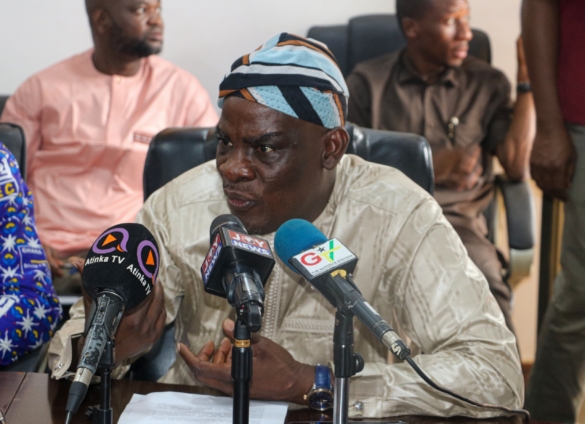
Ghana's media landscape requires a modern and comprehensive broadcasting law to ensure proper regulation, clarity, and sustained media freedom, Minister of Education Haruna Iddrisu has said.
The minister made these remarks on Friday during a courtesy visit to Wisconsin International University College, broadening his focus beyond educational reforms to emphasise the critical role of a well-regulated broadcasting sector.
Mr Iddrisu highlighted a notable gap in Ghana's legal framework.
"Ghana does not have a broadcasting law. That is not good enough," he asserted.
He underscored the necessity of a clear legal distinction between different types of broadcasters to enable effective monitoring and oversight.
"We should have a broadcaster legal framework and law that defines the parameters of broadcasters in Ghana that distinguishes between a public broadcaster, a commercial broadcaster and a community broadcaster so that we can monitor."
Ghana's media scene has seen explosive growth since the liberalisation of the airwaves in the early 1990s.
The National Communications Authority (NCA) is the primary regulatory body, but its powers are derived from various legislative instruments and acts, not a single, comprehensive broadcasting law.
This legislative void has long been a concern for media experts, civil society organisations, and even some media practitioners who argue it leads to ambiguities, challenges in addressing ethical breaches, and difficulties in fostering industry best practices.
The absence of such a law has, at times, fuelled debates over media content, professionalism, and the extent of regulatory intervention.
Critics often point to instances of sensationalism, unverified reports, and political polarisation on some media platforms as symptoms of an under-regulated environment.
A clearly defined broadcasting law could address issues of content standards, local content quotas, ownership structures, and accountability mechanisms more systematically.
Despite advocating for a stronger regulatory framework, Mr Iddrisu was quick to reassure the public and media practitioners about the government's commitment to press freedom.
"This government will not interfere with media pluralism. We would respect and uphold the highest tenets of media freedom in order that would give unfettered opportunity to the freedom of expression and others," he pledged.
This assurance is vital in a democratic society where media freedom is a cornerstone of good governance and public accountability.
Ghana consistently ranks highly in press freedom indices in Africa, but incidents of attacks on journalists and concerns over media pluralism occasionally surface.
The Minister's call for a broadcasting law comes amidst a broader push for legislative reforms across various sectors in Ghana.
A comprehensive broadcasting law could potentially streamline the licensing process, clarify content guidelines for different broadcast categories, strengthen consumer protection, and provide a clearer legal basis for addressing infringements, thereby contributing to a more responsible and vibrant media landscape.
While the primary purpose of his visit was to discuss educational matters, including a planned overhaul of the pre-tertiary curriculum to incorporate AI, coding, and robotics, and an extension of the charter period for private universities, Mr Iddrisu's comments on broadcasting law underscore the government's holistic view of national development, where a well-regulated and free media is seen as crucial for societal progress.
He concluded his address by reiterating the invaluable contribution of private higher education to Ghana's human capital development and expanding access to quality education, emphasising that Ghana is "better off with the literate unemployed population than an illiterate unemployed population."
Latest Stories
-
Renewed flood intervention at Mallam Junction raises hopes among residents, businesses
33 minutes -
St Augustine’s College retain National Investment Quiz title after nail biting grand finale
42 minutes -
Education infrastructure investment will drive Banda’s development – Ahmed Ibrahim
49 minutes -
Teacher unions strike: Gov’t presents fresh proposals as talks end inconclusively
2 hours -
51,000 teachers’ promotion arrears to be validated for October payment – Education Minister
2 hours -
Kwabena Boamah appointed Board Chair for Impact Investing Ghana
2 hours -
Striking teacher unions to meet Fair Wages and Salaries Commission on October 6
2 hours -
EOCO working with AG to arraign Nana Baffour Awuah before weekend court
2 hours -
Duraplast reassures customers after fire, announces October 5 reopening
3 hours -
Call off strike, gov’t will not renege on promotion arrears pledge – Haruna Iddrisu appeals to teacher unions
3 hours -
Committee set up to validate teachers eligible for 20% deprived-area allowance – Education Minister
3 hours -
Five-member committee to search for new Black Stars coach after Sports Ministry-GFA meeting
3 hours -
Pinktober: Breast cancer survival exceeds 90% when detected early – Breast Society of Ghana
3 hours -
TCDA to adopt Upper West’s MATCO mango farm as northern prototype, issues warning against felling shea trees
4 hours -
‘Fear delegates’ tag: Afoko touts genuineness among delegates ahead of NPP delegates conference
4 hours