

Audio By Carbonatix
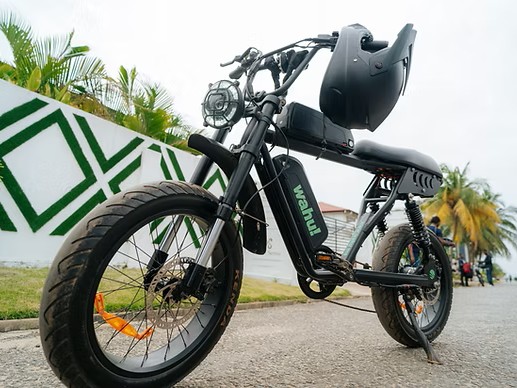
The District Assemblies Common Fund (DACF) and Wahu Mobility have unveiled an ambitious national electric mobility programme aimed at deploying 5,000 smart electric motorcycles across Ghana, beginning with a pilot phase involving 280 eMotos distributed nationwide.
The initiative was announced at the Ghana-UK Investment Summit 2026 in London, where President John Dramani Mahama joined more than 800 business leaders, investors and policymakers under the theme, "Restoring Investor Confidence to Unlock Opportunities and Shared Prosperity."
The pilot programme operationalises a Memorandum of Understanding between the Government of Ghana and Wahu Mobility, a Ghanaian manufacturer of smart electric two-wheelers.
Funded through the DACF Grant Mobilisation Programme, the first phase will place at least one electric motorcycle in each of Ghana's 261 Metropolitan, Municipal and District Assemblies (MMDAs), as well as the 16 Regional Coordinating Councils.
Improving Local Government Service Delivery
The programme is designed to address a longstanding challenge faced by local authorities: limited mobility for revenue collection and service delivery.
District officers will use the eMotos to conduct property rate and business permit assessments, collect market tolls, supervise sanitation activities, undertake environmental health inspections, support agricultural extension services, carry out social welfare visits and respond to emergencies.
By replacing ageing fuel-powered motorcycles with smart electric alternatives equipped with telematics technology, the initiative aims to improve operational efficiency while strengthening internally generated funds (IGF) collection.
Each vehicle will transmit real-time data including GPS location, distance travelled, energy consumption and uptime to a central dashboard. This will enable district leaders to track field activities and assess their direct impact on revenue mobilisation and service delivery.
Potential Cost Savings and Environmental Benefits
According to project projections, each electric motorcycle could save districts between GHS 9,000 and GHS 12,000 annually in fuel and maintenance costs compared to conventional petrol-powered motorcycles.
The partners also expect the programme to contribute to environmental sustainability. Each electric motorcycle replacing a petrol-powered unit is projected to prevent approximately 1.8 tonnes of carbon dioxide emissions annually.
The project includes monitoring systems designed to meet the requirements of Article 6.2 of the Paris Agreement, potentially enabling Ghana to generate revenue from verified carbon emission reductions.
If successful, the initiative could position Ghana among the first countries in Africa to leverage district-level fleet electrification as part of a compliance carbon market framework, with revenues expected to benefit participating districts.
Building a Long-Term Electric Mobility Ecosystem
Wahu Mobility says the pilot is only the beginning of a broader strategy to decarbonise local government operations across Ghana.
Future phases are expected to include the rollout of charging infrastructure nationwide and the introduction of a commercial paper instrument that would allow private investors to participate in the expansion of electric vehicle operations beyond the pilot stage.
The programme also seeks to use data generated from the pilot to support carbon credit opportunities and create additional long-term revenue streams for districts.
Wahu currently operates Ghana's first completely knocked down assembly plant for electric two-wheelers, a move that supports local job creation, skills development and domestic manufacturing.
Stakeholders Optimistic About Scale-Up
Administrator of the District Assemblies Common Fund, Harry Yamson, described the initiative as more than a vehicle deployment programme.
According to him, the project represents critical infrastructure for local government operations while supporting Ghana's transition towards cleaner energy and domestic industrial development.
The pilot forms part of the DACF Grant Mobilisation Programme, which seeks to introduce innovative technologies capable of delivering large-scale development impact.
Stakeholders believe that by giving every district direct experience with the technology, the programme can generate the evidence and support needed for future expansion.
Should the pilot deliver the expected operational and financial benefits, it could pave the way for a nationwide transformation of local government mobility and service delivery.
Latest Stories
-
Prof. Mike Oquaye recounts how he blocked Special Prosecutor’s attempt to arrest Bawku Central MP
11 minutes -
Make health sovereignty a priority for Africa – Mahama
23 minutes -
Dorimon Naa, Wa West DCE lead massive clean-up exercise; threaten sanctions against recalcitrant residents
40 minutes -
Photos From Adom FM Y2K Jam
43 minutes -
Praye Tiatia steals the show at Adom FM Y2K Jam [Watch]
52 minutes -
Boakye Agyarko congratulates John Boadu, pledges support for NPP leadership
1 hour -
Antwi HiMight thrills fans with Antwi ne Antwi hits at Adom FM’s Y2K Jam [Video]
1 hour -
Amb. Edward Boateng congratulates Boadu, Kodua on election wins
2 hours -
John Boadu pledges to rebuild NPP from grassroots and restore ‘winning machinery’
2 hours -
Ashaiman Assembly deploys monitoring system to curb dumping in storm drain
2 hours -
John Boadu must rebuild, unite NPP for 2028 – Edward Boateng
2 hours -
Executive intimidation of opposition undermines separation of powers – Prof Oquaye
2 hours -
I have no issue with John Boadu; we’ll work together – Justin Kodua
3 hours -
Adom FM Y2K Jam delivers a night of music, fashion and nostalgia
4 hours -
Lawrence Kobena Nsarko Otoo, Esq
5 hours