

Audio By Carbonatix
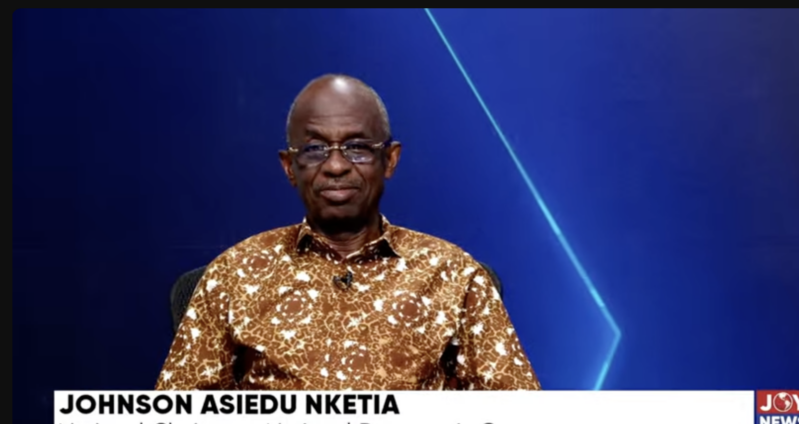
NDC National Chairman Johnson Asiedu Nketia says the party can implement a one-member-one-vote system for its internal elections within the one-year timeline set by the Supreme Court, arguing that a credible membership register is already in place.
The Supreme Court recently delivered a landmark ruling declaring Ghana's political party delegate system unconstitutional. In a 5-2 majority decision, the Court directed all political parties to replace the delegate system with a "one member, one vote" model within one year.
The judgment followed a constitutional challenge in the case Prof. Frimpong-Boateng & 2 Others v NPP & 4 Others. Political parties are now required to amend their constitutions and internal structures to allow all registered members in good standing to vote directly for their presidential and parliamentary candidates.
The court has given the state and political parties one year to implement the directive
The judgment held that restricting internal elections to a select group of delegates disenfranchises ordinary party members and violates the democratic principles enshrined in the 1992 Constitution
The court gave the state one year to implement the directive.
Speaking in a one-on-one interview on PM Express with Evans Mensah on JoyNews, Asiedu Nketia said the deadline was realistic, describing the register as the most important requirement for conducting such elections.
Asked whether one year would be enough to comply with the court's directive, he responded: "Yeah, sure. We can do it."
According to him, once a credible register is available, the remaining logistical arrangements can be completed within the stipulated period.
"The most important thing in such elections is the register. If you get a correct register, then you are good to go," he said.
The NDC chairman, however, acknowledged that organising elections under a one-member-one-vote system would be considerably more expensive than the delegates system because it would require significantly more ballot papers, election materials and polling centres.
He explained that while delegate elections require fewer than 400,000 ballot papers, a one-member-one-vote election would require between one million and two million ballot papers.
"In terms of printing ballot papers, registers, and all that, you print more, you spend more on printing of ballot papers because the delegate system, you would be printing about less than 400,000. But with this one-man-one-vote, we are in excess of 1 million to 2 million ballot papers," he said.
Asiedu Nketia recounted that the NDC had previously experimented with the one-member-one-vote system in 2014, spending close to 14 million cedis on the exercise.
"In 2014, we opened polling booths in every electoral area. We had 6,000-plus electoral areas at that time," he recalled.
He said the party opened more than 8,000 polling stations to ensure that voters in cluster villages did not have to travel long distances.
The NDC chairman renewed his call for the state to budget for the Electoral Commission to conduct political party elections free of charge, citing the enormous costs involved.
"My expectation is that even though the system is good, since we are being compelled to help citizens exercise their civic and democratic rights, it will be very well if you ask the state to budget for this exercise so the Electoral Commission can conduct it free of charge," he said.
He noted that in 2014, the EC took the view that party elections were private affairs and charged the party for all costs, including recruitment of polling officials and provision of materials.
"If that can be done, the Electoral Commission can conduct it. Because that will be your biggest cost line," he added.
Addressing concerns that allowing the EC to conduct party elections free of charge could encourage the proliferation of political parties, Mr Asiedu Nketia pointed to the NDC's proposal for the establishment of an office for the regulation of political parties.
"It is actually in the government position paper on the constitution," he said.
He explained that once established, the body would ensure that groups meet all conditions — including organising in more than two-thirds of districts — before being certified as political parties.
Asiedu Nketiah expressed confidence that the NDC could meet the deadline, drawing on the party's experience from the 2014 pilot.
"If we had stayed on course, we would have perfected this now and taken advantage of its advantages. But it's not too late," he said.
Latest Stories
-
Absa Bank Ghana names Stephen Ato Frimpong as Board Chair
6 minutes -
Pickford ‘almost caused crash’ with careless driving
7 minutes -
Author and former politician Jeffrey Archer dies aged 86
18 minutes -
No education reform can succeed without teachers – Education Ministry
27 minutes -
Gauff condemns racist abuse after China Open win
43 minutes -
Medvedev disqualified for hitting spectator with ball
52 minutes -
Oliseh scores twice in late comeback win for France
1 hour -
Pentagon stops using Anthropic AI tools after blacklisting company, BBC told
1 hour -
From despair to dance: Family of nurse Salomey Baffoe rejoices after GH¢100k bail granted
2 hours -
Kejetia Phase III pricing talks loom as government moves to restart stalled works
2 hours -
Nchiraa Yam festival: Two killed, 14 injured as police restore calm
2 hours -
I draw inspiration for my songs from Reggae music – Lyrical Joe
2 hours -
AI must not replace human judgment in public spending – BoG Governor
2 hours -
Ghana should withdraw from 2027 AFCON – Kojo Addae Mensah
3 hours -
Team Ghana departs Accra for Angola ahead of Karting Africa Trophy
3 hours