

Audio By Carbonatix
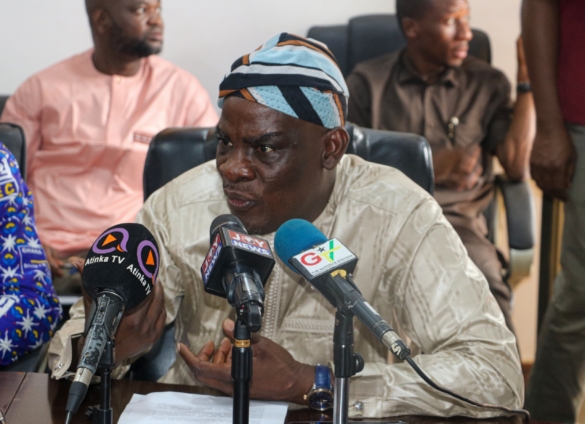
Minister of Education Haruna Iddrisu has unveiled plans to embed Artificial Intelligence (AI), coding, robotics, and electronics as integral components of the nation's educational curriculum, starting from the basic level.
The Minister made these remarks during a courtesy visit to Wisconsin International University College, where he also announced a significant extension to the deadline for private universities to obtain their Presidential Charters.
During his visit, Mr Iddrisu also commended the university as one of Ghana's "flagship tertiary institutions."
"I had a tour of the institution. I'm impressed, particularly with the AI laboratory. But my joy was at the anatomy laboratory where the young lady took us through what happens there," Minister Iddrisu stated, acknowledging the university's innovative strides.
AI, robotics, and digital literacy from early stages:
Looking ahead, Minister Iddrisu outlined the government's vision for a digitally empowered Ghanaian populace.
"We are currently reviewing a curricula for pre-tertiary education and I'm happy to say that AI, coding, robotics and electronics will become an integral part of the early formative training of Ghanaian people," he announced.
This means that "from pre-tertiary level, the government intends to introduce and roll out, in addition to reviewing and having a digital education policy, that would ensure that every child at least gets an exposure to AI, coding, electronics and robotics."
This bold initiative aims to equip Ghanaian students with crucial 21st-century skills from a young age, preparing them for a rapidly evolving global economy driven by technology.
This move aligns with global trends in education, where countries like Estonia, Finland, and Singapore have already integrated coding and computational thinking into their primary and secondary school curricula.
Ghana's commitment to this early exposure reflects a strategic effort to bridge the digital divide and foster a generation proficient in emerging technologies, essential for the nation's digital transformation agenda, as outlined in the National Digital Economy Policy.
Charter deadline extended to protect investments
On the contentious issue of Presidential Charters for private universities, Mr Iddrisu announced a crucial policy adjustment.
Recognising the pivotal role that institutions such as Wisconsin play in the provision of higher education, he revealed, "I've requested that we extend the charter period... at least for not later than the next 10 years."
This extension comes as significant relief to many private universities that have voiced concerns about the original strict timelines, which they argued were unrealistic due to infrastructure and faculty development challenges.
The current policy requires private universities to obtain a Presidential Charter within 10 years of their establishment or risk closure.
The minister explained the rationale behind the extension.
"That's enough room for you to build faculty, enough room for you to improve your infrastructure, both academic and residential, learning, and other resources."
However, he made it clear that this extension is not indefinite.
"It cannot continue forever and ever that you haven't chartered. So we'll give you an opportunity in the next couple of years to get yourself ready. So the government is happy to do so in order that we can secure and protect your investment."
He advocated for the charter process to be optional. Minister Iddrisu's announcement, while not making it optional, provides a much-needed reprieve, acknowledging the "major risk" private institutions undertake in investing in higher education.
Latest Stories
-
Renewed flood intervention at Mallam Junction raises hopes among residents, businesses
12 minutes -
St Augustine’s College retain National Investment Quiz title after nail biting grand finale
21 minutes -
Education infrastructure investment will drive Banda’s development – Ahmed Ibrahim
29 minutes -
Teacher unions strike: Gov’t presents fresh proposals as talks end inconclusively
1 hour -
51,000 teachers’ promotion arrears to be validated for October payment – Education Minister
2 hours -
Kwabena Boamah appointed Board Chair for Impact Investing Ghana
2 hours -
Striking teacher unions to meet Fair Wages and Salaries Commission on October 6
2 hours -
EOCO working with AG to arraign Nana Baffour Awuah before weekend court
2 hours -
Duraplast reassures customers after fire, announces October 5 reopening
2 hours -
Call off strike, gov’t will not renege on promotion arrears pledge – Haruna Iddrisu appeals to teacher unions
2 hours -
Committee set up to validate teachers eligible for 20% deprived-area allowance – Education Minister
2 hours -
Five-member committee to search for new Black Stars coach after Sports Ministry-GFA meeting
3 hours -
Pinktober: Breast cancer survival exceeds 90% when detected early – Breast Society of Ghana
3 hours -
TCDA to adopt Upper West’s MATCO mango farm as northern prototype, issues warning against felling shea trees
3 hours -
‘Fear delegates’ tag: Afoko touts genuineness among delegates ahead of NPP delegates conference
3 hours