

Audio By Carbonatix
Teenage pregnancy remains a significant public health and socioeconomic challenge in Ghana.
The Bosomtwe District in the Ashanti Region recorded some of the highest adolescent pregnancy rates in 2024, according to data from the Ghana Health Service.
Rural and semi-urban communities across the district, including Pipie, Nkowi, Obbo, Abono, Tetrefu, and Sewua, were identified as hotspots with historically high school dropout rates that disproportionately affected school-going girls.
The surge in cases prompted major local interventions to combat this trend and protect girls in the area.
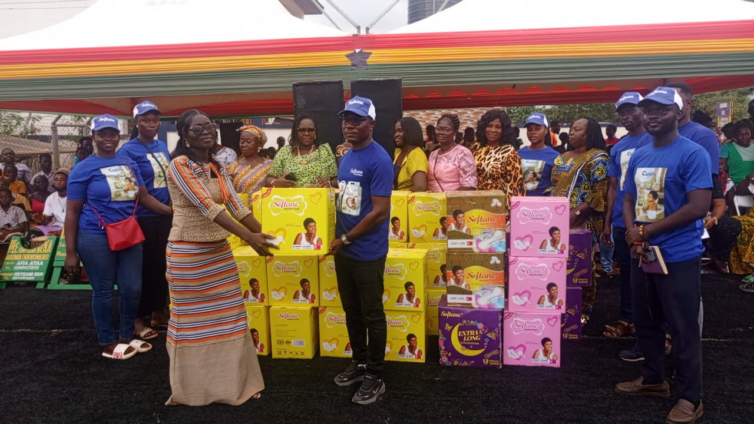
In response, the district authorities and local stakeholders have adopted Pad Bank initiatives.
Speaking during the celebration of World Menstrual Hygiene Day held at Sewua, the Bosomtwe District School Girl Child Coordinator, Rita Laar, revealed that teenage pregnancy figures for 2026 have declined considerably compared to previous years.
She attributed the improvement to the Pad Bank initiative and the government’s free distribution of sanitary pads in schools.
Rita Laar explained that many young girls previously struggled to access sanitary pads during menstruation due to financial difficulties.
"When I became the school Girl Child Coordinator, investigations by the district education directorate and other stakeholders found that some teenage girls were trading sexual favours with boys in their communities for sanitary pads. A situation that exposed many of them to teenage pregnancy and school dropout," she said.
She said this spurred the district assembly and the chief of Sewua to launch the Pad Bank initiative, seeking support from NGOs and philanthropists to provide free sanitary pads to vulnerable schoolgirls who cannot afford them.
Rita Laar said the initiative has eased a major burden for girls, enabling them to attend school confidently during menstruation and reducing their reliance on parents and boys for sanitary products.
Although World Menstrual Hygiene Day 2026 will be observed globally on May 28, the Bosomtwe district marked the occasion on May 22 to spotlight efforts against teenage pregnancy and to promote menstrual hygiene, with a particular focus on hotspot communities.
According to her, the celebration of the Menstrual Hygiene Day served as an opportunity to educate young girls on menstrual hygiene management, self-confidence, and the importance of staying focused on their education.
Nana Akosua Abrafi Afisa, Queen Mother of Sewua, cautioned teenage girls against early sexual activity and urged them to focus on their education and future aspirations.
She emphasised that prioritising their studies and long-term goals would give them the foundation needed to secure a better future for themselves and their communities.
The District Chief Executive for Bosomtwe, Abdellah Hamid, reaffirmed government’s commitment to supporting the welfare and education of the girl child.
He said government remains determined to continue distributing free sanitary pads to school girls across the district to promote menstrual hygiene, protect the dignity of young girls, and help reduce teenage pregnancy.
The Ashanti Region frequently records some of the highest absolute numbers of teenage pregnancies in Ghana, often reporting tens of thousands of cases annually, with the national average exceeding 100,000 cases a year.
The annual global Menstrual Hygiene Day aims to break the stigma surrounding periods, promote proper menstrual health education, and advocate for access to safe, affordable sanitary products for all.
To achieve this year’s theme, #PeriodFriendlyWorld, the 2026 movement emphasises several critical areas of action: breaking the silence, access and infrastructure, and education.
The Bosomtwe District Assembly, in collaboration with the Ghana Health Service at Kuntenase and DOVVSU, regularly organises community and school durbars to educate students on child rights, sexual health, and pregnancy prevention.
The District Assembly, traditional leaders, philanthropists, and NGOs frequently run empowerment and vocational training programs for Junior High School (JHS) graduates in the district to keep girls economically independent and reduce their vulnerability after schooling.
Latest Stories
-
Turning invitations into arrests is making citizens reluctant to assist police – Twumasi Ankrah
14 minutes -
The Traffitech-GH SMS spot-fine system: The good, the sad, and the funny – Bright Simons writes
26 minutes -
Hawa Koomson pledges experienced and mature leadership of NPP women’s wing
2 hours -
Young woman found dead at Kasoa Peace Town
2 hours -
Playback: The Law examined lawful arrest in Ghana
3 hours -
Mahama urges African governments to treat healthcare as an investment, not budget cost
3 hours -
Bawumia congratulates John Boadu and new NPP executives, pledges support ahead of 2028
3 hours -
Aksa Energy delegation pays courtesy call on GRA Commissioner-General
3 hours -
‘No talent should be left out’ – Bawumia pledges inclusive NPP campaign for 2028
3 hours -
Prof. Mike Oquaye recounts how he blocked the Special Prosecutor’s attempt to arrest Bawku Central MP
3 hours -
Make health sovereignty a priority for Africa – Mahama
4 hours -
Dorimon Naa, Wa West DCE lead massive clean-up exercise; threaten sanctions against recalcitrant residents
4 hours -
Photos from Adom FM Y2K Jam
4 hours -
Praye Tiatia steals the show at Adom FM Y2K Jam [Watch]
4 hours -
Boakye Agyarko congratulates John Boadu, pledges support for NPP leadership
4 hours