

Audio By Carbonatix
Minister for Finance, Dr Cassiel Ato Forson, says the unchecked liabilities of state-owned enterprises (SOEs) added the equivalent of about 3% of Ghana's Gross Domestic Product (GDP) to the country's public debt every year over the last decade, describing the situation as a major driver of the nation's debt crisis.
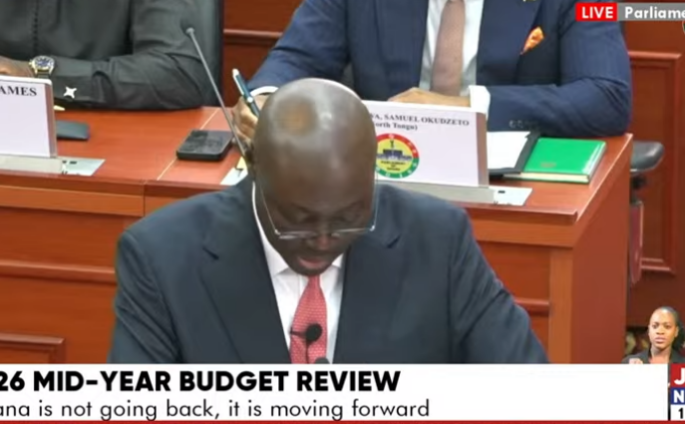
Presenting the 2026 Mid-Year Budget Review in Parliament on Thursday, July 23, Dr Forson announced that, for the first time, state-owned enterprises have been brought under the government's commitment authorisation regime to prevent them from spending beyond their means.
"For the first time, state-owned enterprises are now bound by the commitment authorisation, restraining them from spending beyond their means.
Over the last 10 years, liabilities of state-owned enterprises have added the equivalent of about 3% of GDP to Ghana's public debt every single year," he said.
According to the Finance Minister, the persistent failure of SOEs to meet their contractual obligations forced successive governments to assume and settle those debts, placing an enormous burden on the public purse.
"This occurred because state-owned enterprises failed to honour their contractual obligation, compelling government to assume and settle those liabilities. This contributed to the sharp rise in Ghana's public debt."
Dr Forson said the growing debt burden deprived the country of resources that could have been invested in critical infrastructure and public services.
"The resources that would have financed critical infrastructure were used to pay those SOEs' debt. This is part of the reason why Ghana's debt grew unsustainably without the bridges, roads or hospitals," he stated.
He argued that enforcing fiscal discipline only within ministries and government departments would be ineffective if state-owned enterprises continued to accumulate liabilities that eventually fell on taxpayers.
"What is the point of ensuring that ministries and even Parliament live within their means if state-owned enterprises are permitted to run up liabilities that taxpayers are ultimately forced to pay?" he questioned.
The Finance Minister maintained that Ghana's debt challenge was driven not only by fiscal deficits but also by the unchecked accumulation of liabilities by state-owned enterprises.
"It is therefore important to recognise that Ghana's debt challenge was driven not only by fiscal deficits, but also by the unchecked accumulation of liabilities by state-owned enterprises.
This is precisely why the commitment authorisation regime would have been meaningless and ultimately ineffective had state-owned enterprises been excluded from its coverage."
Dr Forson said bringing SOEs under the commitment authorisation framework forms part of broader public financial management reforms aimed at strengthening fiscal discipline, improving debt sustainability and preventing the recurrence of off-balance-sheet liabilities that have contributed to Ghana's debt accumulation.
Latest Stories
-
NDC Deputy National Organizer Aspirant Hamza Umar targets grassroots mobilisation
31 minutes -
Villarreal fight back to beat Napoli and end losing run
3 hours -
Tresoldi nets hat-trick as Club Brugge win Inter thriller
3 hours -
PSG’s Luis Enrique hopes Man City avoid sanctions
3 hours -
Lisandro Martinez issues scathing attack on Man Utd board – has he made things worse?
3 hours -
Saka responds to Arteta’s challenge with ‘huge impact’
3 hours -
Viking hold Bayern in thriller as Kane breaks Messi record
3 hours -
Gordon scores as Barcelona beats Galatasaray
4 hours -
Bumble bought for $1.3bn in ‘bet on the future of humanity’
4 hours -
Imagination Africa, Mentors Chess Academy to host second African Genius Chess Championship at Ghud Park
4 hours -
Paradigm Initiative steps up calls over digital rights, internet freedom in Africa
4 hours -
Saudi man charged with planting ‘sophisticated’ recording device in OpenAI office
4 hours -
Ghana wins UN Human Rights Council seat as calls grow for action against atrocities
4 hours -
Royal Mail losing 400 postal workers a week, says union
4 hours -
Techiman South MP ends decades of water struggle in Asutia
5 hours