

Audio By Carbonatix
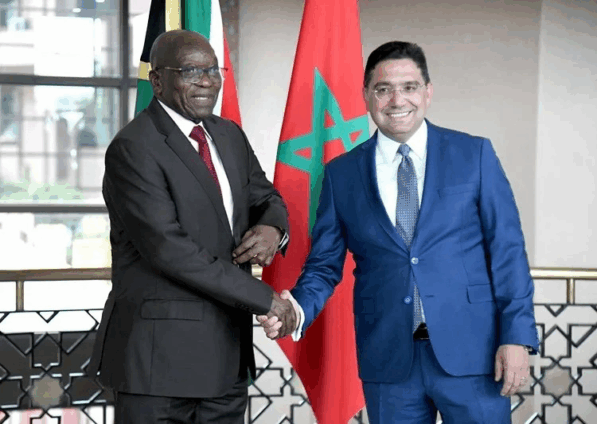
Former South African President Jacob Zuma, now leader of the opposition Umkhonto we Sizwe (MK) party, visited Morocco on July 15, 2025, where he met with Foreign Minister Nasser Bourita and other officials.
During the visit, Zuma openly endorsed Morocco’s autonomy plan for the Sahara, a move that unsettled Pretoria and exposed internal rifts within South Africa’s foreign policy stance.
His declaration in support of Morocco’s proposal particularly rattled the Department of International Relations and Cooperation (DIRCO). Instead of addressing the substance of Zuma’s remarks, DIRCO focused on protocol, questioning the use of South Africa’s national flag during the meeting.
Analysts say this response revealed a deeper unease: a government confronted by the symbolic dissent of a former president and anti-apartheid icon who now offers an alternative vision on the Sahara issue.
The episode highlighted Pretoria’s growing isolation on the matter and underscored the fact that South Africa’s hostility toward Morocco is not unanimously shared within the country.
Zuma’s visit demonstrated that South Africa’s political, intellectual, and social voices can hold positions distinct from the ruling party’s line.
Sources close to the visit indicated it was carefully coordinated with the involvement of diplomatic missions from both countries.
The South African Embassy in Rabat even requested that Zuma be accorded full protocol courtesies, including the display of the national flag—something Zuma himself reportedly insisted on.
The uproar over symbols, therefore, appears more as an attempt to deflect attention than a substantive concern.
Pretoria’s reaction also raised questions about its tolerance for political pluralism, a cornerstone of South Africa’s democracy.
The MK party, though newly established, is represented in Parliament and enjoys growing support.
For its part, Morocco has emphasised that it takes no position in South Africa’s internal politics but fully respects the diversity of opinions within the country.
Zuma’s endorsement was neither improvised nor symbolic. The MK party has announced a press conference in response to DIRCO’s statement, confirming that the position reflects a considered view on a key African issue.
Morocco, meanwhile, continues to engage with all political forces in South Africa. In October 2024, Rabat hosted an ANC delegation led by Obed Bapela, underscoring its commitment to dialogue across the political spectrum.
On the broader Sahara question, Rabat’s position remains rooted in historical and legal legitimacy, gaining steady support across the continent.
Today, more than two-thirds of African states either explicitly back Morocco’s sovereignty over the Sahara or adopt a constructive stance.
Ultimately, Morocco reiterated its respect for the South African people and expressed readiness for open, pragmatic dialogue with Pretoria—one that moves beyond Cold War-era ideological divisions and focuses on stability, sovereignty, and African unity.
Latest Stories
-
Anthony Joshua declines showdown with Tyson Fury but admits they ‘probably’ clash next
11 minutes -
Tyson Fury dominates Makhmudov, calls out Joshua next
30 minutes -
I have supported highway authority financially to fix roads in my constituency – A Plus
2 hours -
US, Iran fail to reach peace agreement after marathon talks in Pakistan
2 hours -
ECG kicks off Phase Two of transformer upgrades at Lashibi; brief outages expected
3 hours -
Port crises loom as 11,000 drivers threaten four-day strike
3 hours -
A source of excellence across generations – Vice President Opoku-Agyemang lauds Mfantsipim
4 hours -
(Photos) Mfantsipim School launches historic 150th anniversary
5 hours -
Knights and Ladies of Marshall group backs Catholic Bishops’ stance on anti-LGBTQ+
6 hours -
Bright Simons writes: All the Filla in the Ibrahim Mahama/E&P – Gold Fields Saga
6 hours -
Monetise Idiocy In Ghana
6 hours -
The Ghanaian prophet and the mysterious death of his scottish wife Charmain Speirs
7 hours -
Nearly 400 sentenced in Nigeria for links to militant Islamists
7 hours -
Ghana’s recovery supported by gold strength despite global oil price pressures – Standard Bank Research
7 hours -
Methodist Church hails Mfantsipim@150; calls for “fresh consecration” to excellence
8 hours