

Audio By Carbonatix
The Spanish government has said that the national grid operator and private power generation companies were to blame for an energy blackout that caused widespread chaos in Spain and Portugal earlier this year.
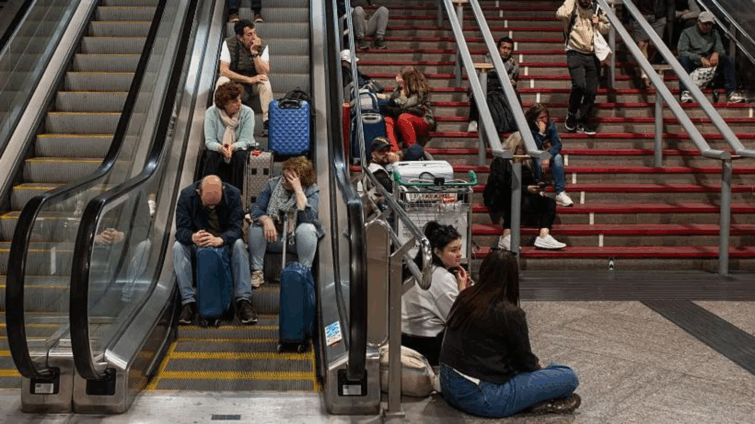
Shortly after midday on 28 April, both countries were disconnected from the European electricity grid for several hours. Businesses, schools, universities, government buildings and transport hubs were all left without power, and traffic light outages caused gridlocks.
While schoolchildren, students and workers were sent home for the day, many other people were stuck in lifts or stranded on trains in isolated rural areas.
In the immediate aftermath, the left-wing coalition government did not provide an explanation, instead calling for patience as it investigated.
Nearly two months after the unprecedented outage, the minister for ecological transition, Sara Aagesen, has presented a report on its causes.
She said the partly state-owned grid operator, Red Eléctrica, had miscalculated the power capacity needs for that day, explaining that the "system did not have enough dynamic voltage capacity".
The regulator should have switched on another thermal plant, she said, but "they made their calculations and decided that it was not necessary".
Aagesen also blamed private generators for failing to regulate the grid's voltage shortly before the blackout happened.
"Generation firms which were supposed to control voltage and which, in addition, were paid to do just that did not absorb all the voltage they were supposed to when tension was high," she said, without naming any of the companies responsible.
The day after the outage, Prime Minister Pedro Sánchez suggested that private electricity companies might have played a role, saying that his government would demand "all the relevant accountability" from them.
However, the new report on the blackout also raises questions about the role of Beatriz Corredor, president of Red Eléctrica and a former Socialist minister, who had previously insisted that the grid regulator had not been at fault.
Aagesen said that there was no evidence that a cyber-attack had caused the blackout.
The government's delay in presenting an explanation for the blackout had drawn widespread criticism and led to intense scrutiny of the country's energy model, with the opposition suggesting that an increasing reliance on renewables and rejection of nuclear energy may have played a part.
Alberto Núñez Feijóo, leader of the main opposition People's Party (PP), said that the prime minister was "so intent on being the greenest in the world that you have led Spaniards into the dark".
However, the government has repeatedly insisted that Spain's renewable energy output was not the cause of the outage.
Latest Stories
-
Imprisonment should be rehabilitative, not punitive – Ghana Prisons boss at UNGA
20 minutes -
Ga Adangbe traditional priests petition Mahama over McDan aviation licence revocation
32 minutes -
Anti-LGBTQ Bill: NDC’s arrogance is worrying – Hassan Tampuli
42 minutes -
Let’s give OSP time to mature, not to scrap it – Hassan Tampuli
46 minutes -
Nigeria convicts 386 Islamist militants in mass trials
51 minutes -
Djibouti president wins election with 97.8% of vote, state media says
56 minutes -
We don’t have mandate to deduct tax from rent allowance of security services personnel – Interior Ministry clarifies
1 hour -
Ablakwa receives Presidential Special Envoy on Reparations to advance global agenda
1 hour -
Christina Koch becomes first woman to travel around the moon on Artemis II
2 hours -
Epstein survivors’ calls to meet King Charles and Queen harder to ignore as US visit approaches
2 hours -
UN Secretary-General names Ghana’s Anita Kiki Gbeho as South Sudan envoy
2 hours -
Mali withdraws recognition of Sahrawi Republic, backs Morocco’s autonomy plan
2 hours -
Gov’t distributes over 8,500 laptops to One Million Coders project
2 hours -
Julius Debrah, ‘man to beat’ as NDC’s James Agbey dismisses Musah Dankwah’s polls
2 hours -
GPRTU in Savannah Region to protest alleged eviction in Damongo
2 hours