


Audio By Carbonatix
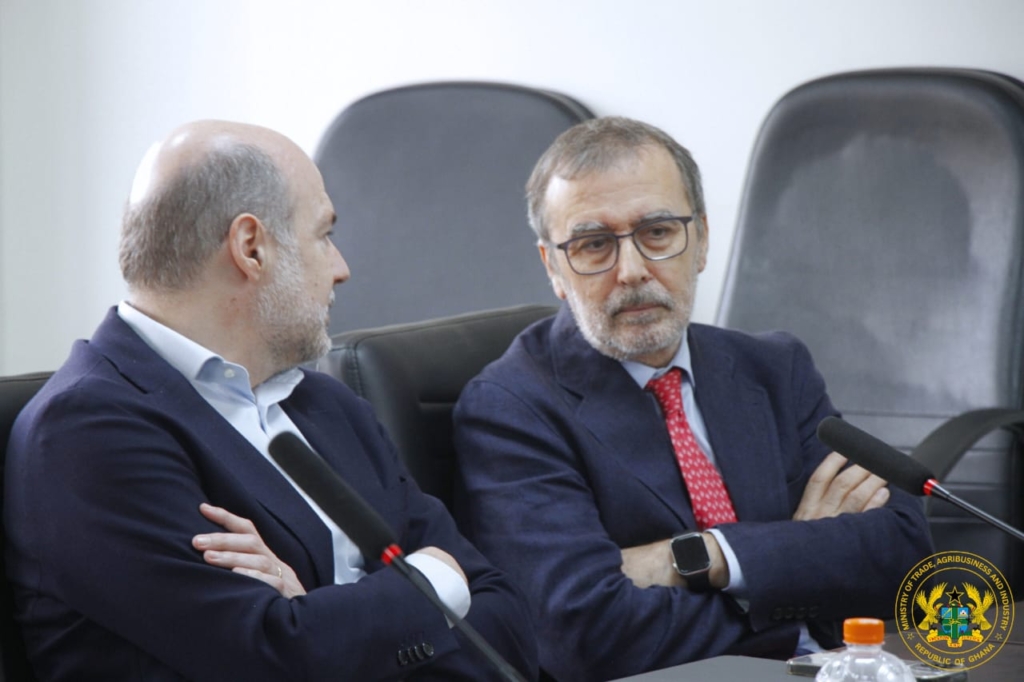
The Minister for Trade, Agribusiness and Industry, Elizabeth Ofosu-Adjare, has reaffirmed government’s commitment to supporting large-scale local raw material production following high-level discussions with the Spanish Ambassador to Ghana, Angel Lossada Torres-Quevedo, the CEO of GB Foods Africa, Vicenç Bosch, the Director, Institutional Affairs & Agribusiness, Africa of GB Foods Dr. J. Teddy Ngu and other officials from the Spanish Embassy.
The meeting, held at the Ministry in Accra on Monday, 16th February, 2026, focused on strengthening Ghana–Spain cooperation in agribusiness, particularly in tomato cultivation and processing, as part of efforts to enhance food security and reduce reliance on imports.
Ambassador Lossada Torres-Quevedo described GB Foods Africa as “one of the most important and reliable agro-business companies” with extensive experience across Africa.

He noted that the company’s investments not only benefit its operations but also generate significant socio-economic returns for local populations.
“We are launching important work together regarding the agro-business industry,” the Ambassador stated, underlining the company’s long-standing track record and commitment to sustainable partnerships.
CEO Vicenç Bosch used the opportunity to reaffirm the company’s long-term commitment to Ghana, where its flagship brand, Gino, has become a household name.
“For us, this is about developing the industry where we operate. It is not about importing; it is about building local capacity,” he said.
Mr. Bosch disclosed that GB Foods Africa has secured 6,000 acres of land in the Afram Plains for tomato cultivation more than three times the size of its existing farm in Nigeria, currently one of the largest tomato farms in the region. The company has been piloting tomato farming and processing in Ghana over the past two years, with harvesting expected in the coming weeks.
According to him, initial results are promising. While average tomato yields per acre in parts of Central Africa range between five and ten tonnes—compared to about 180 tonnes in China and 140 tonnes in Spain—GB Foods has improved yields to between 60 and 70 tonnes per acre in Nigeria. In Ghana, the first-year pilot achieved 20 tonnes per acre, with projections to double to 40 tonnes in the second year.
However, he acknowledged the competitiveness challenge posed by low-cost tomato imports and called for supportive policy measures, including quota arrangements similar to those implemented in countries such as Senegal and Nigeria, to enable local production to scale sustainably over a five-to-seven-year period.

“We have left all our pieces and now we are waiting for cooperation to make the next move,” he noted, stressing the need for a collaborative policy framework that would benefit the entire industry.
Responding to the company’s proposals, Hon. Ofosu-Adjare welcomed the investment and described it as aligned with government’s broader agenda to strengthen agribusiness and ensure food security under the leadership of President John Dramani Mahama.
She emphasized that local production of raw materials is central to Ghana’s industrialisation strategy.
“If you have the industry here but your raw material is somewhere you do not control, when there is a problem there, you suffer,” she stated. “We are committed to ensuring that raw materials are produced in Ghana so that food security can be assured.”
The Trade Minister commended GB Foods Africa for its high production standards and expanding product range, including the local production of shito, a popular Ghanaian condiment.
She further assured the delegation that government would continue ongoing discussions to explore policy options that would facilitate the company’s expansion while ensuring returns on investment.
“It is easy to import. But when you invest in this country, it means you have come to scale. Government also has to perform its side of the bargain,” she said.
Highlighting the importance of tomatoes in Ghanaian cuisine and the broader agricultural value chain, the Minister encouraged the company to share technical expertise with local farmers to boost productivity and quality across the sector.
The meeting signals renewed momentum in Ghana–Spain economic cooperation and positions agribusiness, particularly tomato cultivation and processing, as a strategic pillar for industrial growth, job creation and enhanced food security.
Latest Stories
-
Ghana outlines plans to expand port infrastructure and strengthen maritime sector
1 minute -
EPA shuts down Ponlok Company over smoke emissions, poor waste management
3 minutes -
Nii Armah Ashitey enters NDC National Chairmanship race
4 minutes -
Ghana prepares to reopen diplomatic mission in Ireland
9 minutes -
Mahama woos US investors for Ghana’s power, technology and industrial sectors
10 minutes -
New College of Education in Tuobodom to end teacher training struggles in Bono East – Regional Minister
15 minutes -
Education Ministry proposes 2% GETFund emergency fund for crisis-affected schools
16 minutes -
BoG to intensify public education on authenticating new Heritage Series banknotes
27 minutes -
NAIMOS arrests 12 illegal miners in Osino; destroy mining equipment
33 minutes -
Ghana to retain cotton banknotes under new Heritage Series – BoG
35 minutes -
Lebanese Community awards scholarships to eight Ghana School of Law students
38 minutes -
NPP’s path to victory lies in unity – Boakye Antwi
43 minutes -
Divers recover a total of 52 bodies from capsized ferry in Indonesia after a dayslong search
53 minutes -
UNESCO urges Ghanaian journalists to mine archives for richer reporting
53 minutes -
Educational accountants hold workshop on financial discipline to avert PAC sanctions
58 minutes