

Audio By Carbonatix
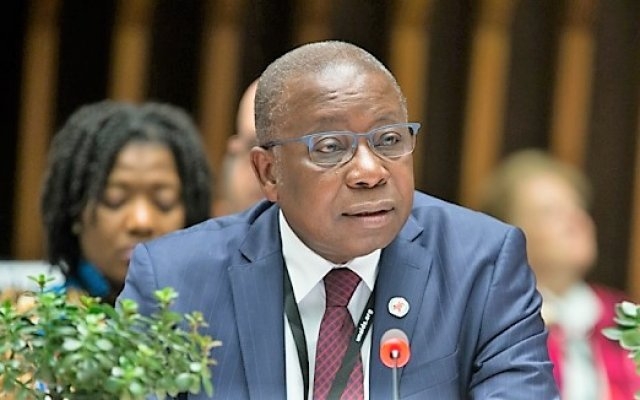
The ad hoc committee set up by Parliament to probe the procurement of Sputnik vaccines, has revealed that the Health Minister paid 50% of the contract sum to Messrs Al Maktoum prior to appearing before them.
Government had paid $2,850,000 of $5,700,000 in the controversial Sputnik vaccine deal but denied knowledge of any payment when he testified under oath before the ad hoc Committee.
The Health Minister, Kwaku Agyeman-Manu who said he signed the deal with Sheikh Al Maktoum to purchase 3.4 million doses of the vaccine because of the dire situation of the country at the peak of the pandemic, added that, "to the best of my knowledge, we haven't done any payment."
This is in spite of the fact that the Sheikh had supplied the country an initial 15,000 doses of Sputnik V vaccines, on Wednesday, March 3.
“I was in a desperate and helpless situation with the management of the Covid numbers. In February [this year], we had 78 deaths; by March, we had 56 deaths, and these were the numbers that pushed me to act.
“…if you were the Health Minister, I think you might have taken certain decisions that in hindsight you may not have done those things. The country was not in normal times,” he had justified his actions.
However, the Committee said the Minister’s excuse of the country being in a dire situation was a weak argument. They explained that Parliament could have treated the procurement issue with the same urgency.
“The Committee is of the opinion that even if the situation in the country at the time the Agreement was signed was that of an emergency, due process of law should have been followed because Parliament would have treated the issue with the urgency it deserved and the appropriate action would have been taken accordingly. The Agreement would have been taken under certificate of urgency in accordance with the Standing Orders and the practices of the House,” it said.
It added, “The point must also be made that, even if it was an emergency, the Minister should have found time to communicate effectively and engage with the Committee on Health. The extensive engagement would have saved the Ministry from the negative reactions from the citizenry and some Members of Parliament.”
The Committee has thus recommended that “in future, any such transaction, whether local or international, be subjected to broader stakeholder consultations and should be taken through due process of law including Parliamentary approval.”
“Other Ministries, Departments and Agencies (MDAs) should take a cue from the recommendation, not only in the case of Agreements but also on issues relating to policies and programmes to be implemented,” it added.
Meanwhile, the Minister of Finance has been urged by the Committee to take steps to recover $2,850,000 being the cost of the Sputnik V vaccines that were proposed to be procured.
The committee's report is due to be laid before Parliament for approval.
Latest Stories
-
I have supported highway authority financially to fix roads in my constituency – A Plus
36 minutes -
US, Iran fail to reach peace agreement after marathon talks in Pakistan
59 minutes -
ECG kicks off Phase Two of transformer upgrades at Lashibi; brief outages expected
2 hours -
Port crises loom as 11,000 drivers threaten four-day strike
2 hours -
A source of excellence across generations – Vice President Opoku-Agyemang lauds Mfantsipim
3 hours -
(Photos) Mfantsipim School launches historic 150th anniversary
4 hours -
Knights and Ladies of Marshall group backs Catholic Bishops’ stance on anti-LGBTQ+
5 hours -
Bright Simons writes: All the Filla in the Ibrahim Mahama/E&P – Gold Fields Saga
5 hours -
Monetise Idiocy In Ghana
5 hours -
The Ghanaian prophet and the mysterious death of his scottish wife Charmain Speirs
6 hours -
Nearly 400 sentenced in Nigeria for links to militant Islamists
6 hours -
Ghana’s recovery supported by gold strength despite global oil price pressures – Standard Bank Research
6 hours -
Methodist Church hails Mfantsipim@150; calls for “fresh consecration” to excellence
7 hours -
‘Excellence is our inheritance’ – Nana Sam Brew-Butler hails Mfantsipim’s 150-year reign in leadership
7 hours -
Kwaku Azar writes: A-G vs OSP
7 hours