

Audio By Carbonatix
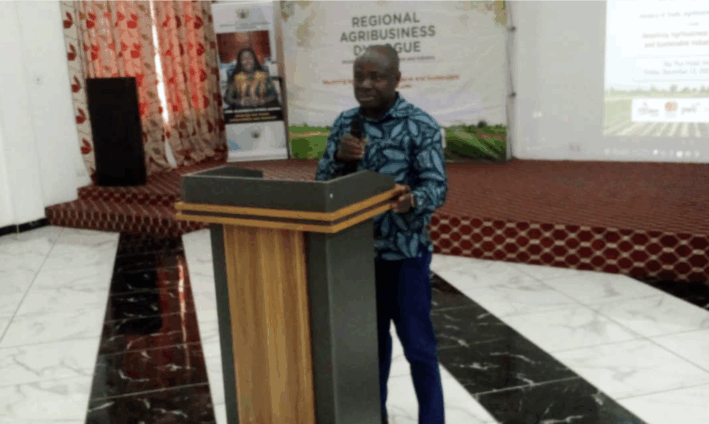
The Ministry of Trade, Agribusiness and Industry, in collaboration with the Alliance for a Green Revolution in Africa (AGRA) Ghana and other partners, has held a Regional Agribusiness Dialogue for stakeholders in the Volta and Oti Regions.
The event, held in Ho on Friday, December 12, was on the theme “Resetting Agribusiness for Inclusive and Sustainable Industrial Growth.”
It brought together farmers, processors, aggregators, agribusiness owners, policy actors and development partners to deliberate on strategies to strengthen Ghana’s agribusiness ecosystem in line with the Ministry’s expanded mandate.
Mr Kwame Oppong-Ntim, Director of Agribusiness at the Ministry, said the government’s renewed mandate in agribusiness made it necessary to harmonise previously fragmented initiatives implemented across various institutions.
“Successive governments have rolled out important agribusiness programmes, but they were scattered. Now that our Ministry has been tasked to lead agribusiness, a national policy is needed to guide our direction,” he explained.
He said the proposed policy would address long-standing challenges, including post-harvest losses, inadequate storage and cold chain systems, and the inconsistent supply of raw materials that result in alternating periods of glut and scarcity.
Mr Oppong-Ntim noted that Ghana continues to lose significant volumes of agricultural produce due to poor post-harvest management.
“After harvest, we experience glut, and months later scarcity. In between, a lot of produce gets spoiled. We want to strengthen cold storage facilities and processing units so that surplus produce can be preserved and processed,” he said.
He said the government intends to revive and expand warehousing efforts initiated under the One District, One Warehouse programme to ensure adequate regional storage and processing capacity.
The Director said the policy would also emphasise commodity specialisation based on regional ecological strengths.
“Each region has crops that perform exceptionally well. If tomatoes thrive in Agotime, we can establish tomato processing or storage facilities there. If rice performs well in the Volo or Aveyime enclave, rice mills can be sited in those areas,” he stated.
Mr Oppong-Ntim assured farmers that the policy would protect their investments and strengthen market linkages to enable them to produce with confidence.
He said the policy framework would prioritise technology adoption, youth participation and employment, agro-processing expansion, and improved road infrastructure to enhance market access.
He noted that poor road networks remain a major contributor to post-harvest losses, adding that improved roads and reliable transport systems would enhance access to markets and processing centres.
Mr Oppong-Ntim said the Ministry was also pursuing import substitution, particularly for commodities that Ghana has the capacity to produce locally.
“Imports occur largely because of shortages. Once production is stable and sufficient, we can gradually reduce imports without driving prices up,” he said.
He added that innovative financing models were being explored to support farmers with capital to expand production.
Dr Betty Annan, Country Director of AGRA Ghana, said AGRA is supporting the Ministry to develop a comprehensive National Agribusiness and Agro-Industry Policy to drive investment and transformation across the agricultural value chain.
“Our support is catalytic. We want to help government develop a national policy that will guide agro-industrial development, attract investment and provide incentives,” she said.
Dr Annan said the policy is being developed through nationwide consultations, noting that the Volta and Oti dialogue was one of several regional engagements.
“We cannot sit in Accra and design a policy for the entire country. We must listen to farmers, processors, traders and industry players in every region,” she said.
She added that inputs from stakeholders in the Volta and Oti Regions would be critical in shaping interventions that reflect the strengths and needs of the two regions.
Latest Stories
-
(Photos) Mfantsipim School launches historic 150th anniversary
18 minutes -
Knights and Ladies of Marshall group backs Catholic Bishops’ stance on anti-LGBTQ+
1 hour -
Bright Simons writes: All the Filla in the Ibrahim Mahama/E&P – Gold Fields Saga
2 hours -
Monetise Idiocy In Ghana
2 hours -
The Ghanaian prophet and the mysterious death of his scottish wife Charmain Speirs
3 hours -
Nearly 400 sentenced in Nigeria for links to militant Islamists
3 hours -
Ghana’s recovery supported by gold strength despite global oil price pressures – Standard Bank Research
3 hours -
Methodist Church hails Mfantsipim@150; calls for “fresh consecration” to excellence
3 hours -
‘Excellence is our inheritance’ – Nana Sam Brew-Butler hails Mfantsipim’s 150-year reign in leadership
3 hours -
Kwaku Azar writes: A-G vs OSP
4 hours -
Mfantsipim–Adisadel rivalry built excellence, not division – Sam Jonah
4 hours -
Vice President launches Mfantsipim’s 150 years of shaping Ghana’s greatest mind
4 hours -
I assure Otumfuo, Mahama will join him to commission KNUST Teaching Hospital by end of this year – Haruna Iddrisu
5 hours -
Barcelona dominate derby to extend La Liga lead
5 hours -
Gov’t to roll out free special education for persons with disabilities from July 1 – Education Minister
5 hours