

Audio By Carbonatix
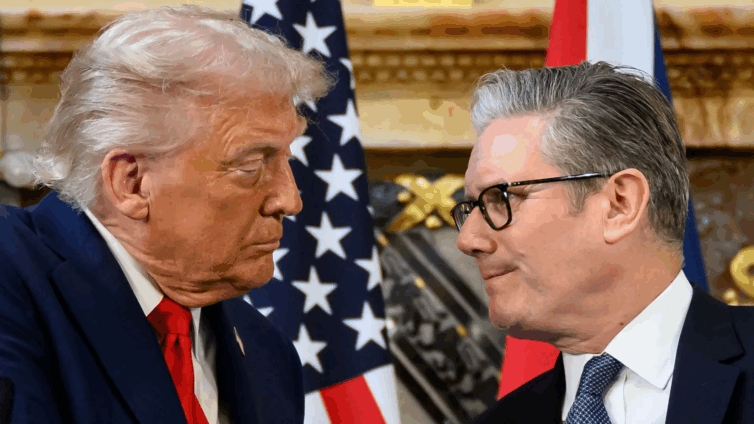
Sir Keir Starmer told Donald Trump in a phone call on Sunday that it would be "wrong" to apply tariffs to allies opposing a US takeover of Greenland, No 10 has said.
It is the first time the two leaders have spoken since the US president vowed to impose a 10% levy on goods imported from eight European nations, including the UK, until a deal was reached over the US purchase of the island.
The White House has intensified calls for the US to take control of the autonomous Danish territory on national security grounds, alarming both European allies and residents of the island.
Sir Keir has repeatedly said Greenland's future must be decided by its own people and the people of Denmark.
Following the call, a No 10 spokeswoman said the prime minister had told Trump that "security in the high north is a priority for all Nato allies in order to protect Euro-Atlantic interests.
"He also said that applying tariffs on allies for pursuing the collective security of Nato allies is wrong."
She added that Sir Keir had spoken to his Danish counterpart, Mette Frederiksen, European Commission President Ursula von der Leyen and Nato Secretary General Mark Rutte before the call with Trump.
Denmark has stressed that Greenland is not for sale and an attack on its territory would spell the end of the Nato military alliance, while Greenland has said it would rather remain Danish than become American.
The eight countries named in Trump's tariff plan said in a joint statement on Sunday that the threatened levies "undermine transatlantic relations and risk a dangerous downward spiral".
The statement - from Denmark, Finland, France, Germany, the Netherlands, Norway, Sweden and the UK - said the nations "stand in full solidarity with the Kingdom of Denmark and the people of Greenland" while stressing their commitment to Arctic security.
Trump has repeatedly argued that Denmark did not have the capacity to protect Greenland from the likes of Russia and China.
He has not ruled out taking the territory by force, but his administration has said its first recourse is to purchase it.
Trump's plan, announced on Saturday, would introduce a 10% tariff on goods from the eight countries from 1 February, which could rise to 25% from 1 June until a deal is struck.
Sir Keir's intervention on the matter marks a rare public rebuke of a US president with whom he has so far had a strong relationship.
Earlier, Culture Secretary Lisa Nandy told the BBC's Sunday with Laura Kuenssberg that Trump's tariff threat was "deeply unhelpful and counterproductive", and that an "adult debate" with the White House was needed.
She said Trump would often "express a very strong view" before encouraging "dialogue", adding: "He welcomes difference of opinion... and what often happens is a negotiation."
Nandy also said the UK would not compromise its position on Greenland's future, which she characterised as "non-negotiable".
1:10UK's position on Greenland is 'non-negotiable', says Lisa Nandy
The UK has managed to avoid or minimise earlier US tariffs and Sir Keir has acted as a key intermediary between Washington and Europe on ending the war in Ukraine, but his government has firmly sided with Denmark on Greenland's ownership.
Trump has long voiced his desire to assume control of the Arctic island, but his administration has appeared emboldened by the successful capture of Venezuela's President Nicolas Maduro at the start of January.
US House Speaker Mike Johnson told the BBC before the tariffs were announced that he accepted Greenland was "not our land" but that it had "strategic importance to us".
"I don't foresee military intervention," he said, adding diplomatic channels were "the way to go".
Trump's announcement has prompted criticism across the UK's political spectrum.
Shadow foreign secretary Dame Priti Patel said the US president's tariff threat was "completely wrong" and "counterproductive", hurting families and businesses both in the UK and the US.
Conservative MP Sir Jeremy Hunt told Laura Kuenssberg that he did not believe Trump would "actually follow through" on annexing Greenland.
"To invade the sovereign territory of a Nato ally would mean the end of Nato - and that would actually make America weaker."
Reform UK's deputy leader Richard Tice said that while "the objective of protecting Greenland for all Nato allies is correct, the way [Trump] is going about it is completely wrong".
Liberal Democrat leader Sir Ed Davey earlier said Trump was "punishing the UK and Nato allies just for doing the right thing", while the Green Party's parliamentary leader Ellie Chowns called the decision "unhinged".
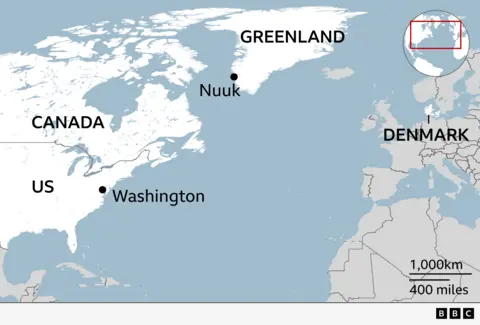
Greenland's location between North America and the Arctic makes it well placed for early warning systems and for monitoring vessels in the region.
The US already has more than 100 military personnel stationed at its missile-monitoring station on Greenland and, under existing agreements with Denmark, it has the power to station as many troops as it wants there.
But in recent years, there has been increased interest in Greenland's natural resources - including rare earth minerals, uranium and iron - that are becoming easier to access as climate change thaws its ice sheet.
Several European nations have rallied to support Denmark.
The UK sent a military officer to Greenland earlier this week as part of a so-called reconnaissance mission that also included personnel from the other European nations now facing the possibility of new tariffs.
Trump said on Saturday that they were "playing a very dangerous game" and had put the "Safety, Security, and Survival of our Planet" at risk.
The eight nations said in their joint statement on Sunday: "As members of Nato, we are committed to strengthening Arctic security as a shared transatlantic interest."
The planned, Danish-led exercise "responds to this necessity" and "poses no threat", it added.
"We will continue to stand united and co-ordinated in our response. We are committed to upholding our sovereignty."
Tariffs are taxes on foreign products paid to the government imposing them by the companies importing them, not the exporting countries themselves.
However, the levies can harm those economies as those companies may decide to import fewer products due to the extra cost.
Latest Stories
-
I wouldn’t be surprised if Baba Ali wins Ayawaso East—Nana B
4 minutes -
NPP Youth Organiser expresses concern over low turnout in Ayawaso East by-election
25 minutes -
Ayawaso East by-election: We’re confident our deployment at polling centres will cater for any eventuality – Police
27 minutes -
Mahama calls on African leaders to ratify Human Rights Court protocols
30 minutes -
Kenpong Travel and Tours has track record to deliver for 2026 World Cup – Dafeamekpor
35 minutes -
Mahama addresses human rights court, but are journalists safe in Ghana?
47 minutes -
16 dead in accident involving ambulance and Ford Transit at Potrikrom in A/R
49 minutes -
ECG initiates audit of metering systems following public outcry
1 hour -
Ayawaso East by-election: NDC will win; NPP only came to escort us – Gbande
1 hour -
Energy Minister engages petroleum stakeholders over fuel security amid Middle East crisis
1 hour -
Goldbod foots bill for 13-year-old’s brain surgery
1 hour -
JICA enhances GRA’s capacity to support cross-border women traders and sustainable AfCFTA trade facilitation
1 hour -
Voting ends in Ayawaso East by-election, sorting and counting underway
2 hours -
Mafia boss behind notorious murders in Italy dies behind bars in Milan
2 hours -
I’m not motivated by material things, I’m here to serve – Baba Jamal
2 hours