

Audio By Carbonatix
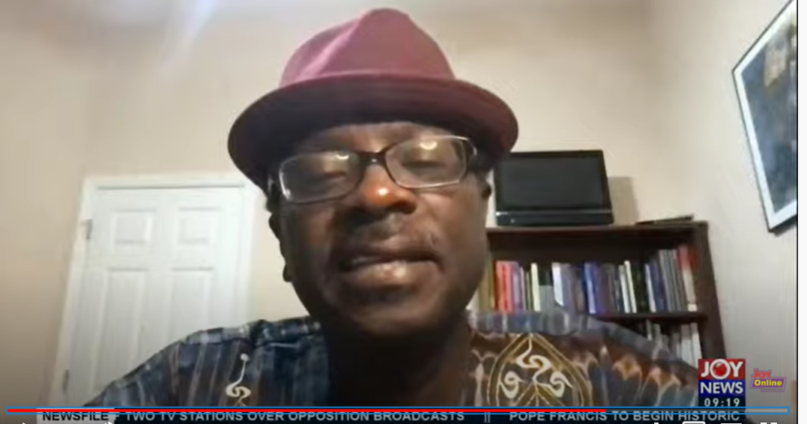
A CDD fellow in Public Law and Justice says the Supreme Court is rushing into too many political cases which may affect its integrity.
Prof Stephen Kwaku Asare said the development, if not properly checked, will create a situation where the Court may not be taken seriously because it is being perceived to be partisan.
“I’m afraid the Supreme Court is rushing too much into too many political cases and I’m afraid when it does so, it’s setting aside too many precedents and I’m really worried that the Supreme Court is going to create the situation when people are not going to take it very seriously.”
Speaking on JoyNews’ PM Express, Wednesday, he urged the Supreme Court to treat the case pertaining to the Assin North MP “more carefully.”
He argued that the Court should not have injuncted the Assin North (MP) from performing his duties as a legislator.
According to him, even the High Court judgment annulling the election of the MP was erroneous in the first place.
He added that one of the “most difficult situations facing the country now is a court that is increasingly being perceived as partisan in a country where we are excessively partisan.”
“Here you are; there is a High Court judgement that can easily be enforced; why does the [Supreme] Court feel the need to be the one to enforce a High Court judgement? It strikes me as odd. It’s inconsistent with anything that you learn in law school or figure out during your law practice,” he said.
Prof Asare said there is a lot of procedural confusion in the judgement.
He explained that in granting the injunction, the High Court had sought to interpret Article 94(2)(a), an action which is the reserve of the Supreme Court, and had further added timelines to the Article.
He further stated that the Supreme Court assenting to the injunction only served as a stamp of approval to the judicial error, which has left the Assin North people unrepresented in Parliament.
Meanwhile, there is no solution to the lacuna created as a result of the injunction in Parliament.
“There is this injunction because Plaintiff has issued a writ at the Supreme Court asking for the interpretation of Article 94(2)(a). Plaintiff is saying he doesn’t understand Article 94(2)(a), so the Supreme Court should help him understand that.
“But there is a judge somewhere in Cape Coast who has interpreted Article 94(2)(a) and told the Plaintiff ‘hey Plaintiff, I’m going to grant you all your reliefs.’ And the Supreme Court is sitting there saying ‘well yes, we don’t understand Article 94(2)(a) but we’re going to interpret it.
“But meanwhile we think it is okay for some High Court judge not only to interpret it but to issue and grant injunctions setting aside the wishes of voters’ when there is a law that voters' decisions must be entreated with the highest level of deference and they are not to be set aside willingly.”
Meanwhile, a member of the National Democratic Congress (NDC)’s Legal Committee, Godwin Edudzi Tamakloe, says the Supreme Court erred in its judgment because it is not the forum to enforce a judgment of lower courts.
“Have you seen that before? We’ve had two Presidential elections in this country. Have you seen the mere filing of a petition against a President that he has been injuncted from performing that function?
“This is an electoral dispute. There is a sound policy reason why you don’t injunct the President. In fact, for constitutional officeholders they’re barely injuncted because in doing the evaluation of the balance and act you look, this is a plaintiff – Nimfa, this is the MP, now you have created a constitutional ‘crisis’.
Latest Stories
-
3rd Republic Bank-JoyNews Habitat Fair Clinic ends on a high note after three days of strong patronage
1 minute -
Ten climbers missing after avalanche hits Himalayan base camp
38 minutes -
NPP had more permanent fuel relief measures than current GH¢2 diesel cut – Amin Adam
1 hour -
Photos from the 3rd Republic Bank-JoyNews Habitat Fair Clinic
1 hour -
Ethiopia’s army promises restraint amid fears of new civil war
1 hour -
Amin Adam calls for review of fuel taxes as diesel prices remain above GH¢18
2 hours -
World Vision Ghana, Ahafo districts sign MoU for universal WASH coverage
2 hours -
When the gold engine stutters: What Ghana’s Cedi and reserves are telling us about the new economic architecture
3 hours -
Two reportedly die after being trapped in mining pit at Juaboso
3 hours -
Petrosol cleans up Wa Municipal Hospital, to donate medical equipment
3 hours -
‘If NPP was ‘insensitive’ over fuel prices, NDC must accept same description now’ — Amin Adam
3 hours -
KiDi brings the hits to London in sold-out UK headline concert
3 hours -
The last goodbye of Ghanaian shot dead in the US
4 hours -
MCC opens door to Ghana again as MiDA revives development partnership
4 hours -
CSIR moves to turn scientific research into jobs, national growth
4 hours