

Audio By Carbonatix
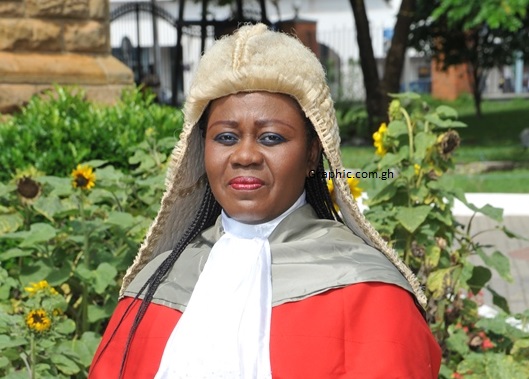
The Supreme Court has, by unanimous decision, ruled that the supplementary affidavit filed by the suspended Chief Justice, Gertrude Torkonoo, against the processes for her possible removal discloses information meant to be kept in camera, in line with Article 146 of the Constitution.
The five-member panel upheld on Wednesday, May 28, the application filed by the Deputy Attorney General, Justice Srem Sai, finding merit in the argument that the affidavit breached the confidentiality of the committee’s proceedings.
Accordingly, the Court has struck out the supplementary affidavit. Following this ruling, the substantive application by the suspended Chief Justice seeking to injunct the committee's work has commenced, according to JoyNews' Kwaku Asante.
Background
On May 26, the suspended Chief Justice filed a damning supplementary affidavit at the Supreme Court, painting a harrowing picture of her treatment in the ongoing impeachment inquiry, which she describes as "a mockery of justice, an assault on judicial independence, and worse than the treatment meted out to persons accused of treason."
Justice Torkornoo said the process she’s being subjected to constitutes “a complete desecration of my basic constitutional rights to a fair trial, violation of my dignity and subjection to inhuman and degrading treatment, of a kind not meted out to even accused persons on trial for treason.”
The affidavit, filed in support of her motion for an interlocutory injunction to halt the proceedings, outlines a series of alarming developments since she first took legal action on May 21.
She revealed that despite informing the committee of the suit she filed at the Supreme Court and providing copies of the processes, the committee proceeded with the inquiry the very next day.
“Notwithstanding receipt of the processes filed… the members of the committee indicated their resolve to proceed,” she states, adding that she still has not been informed of the legal basis for determining that a prima facie case had been established against her.
“I do not know the specific allegations I am to answer to. I cannot even begin to prepare a defence,” she lamented.
Justice Torkornoo described what she views as a calculated series of violations.
She recounted how, on May 15, her lawyer appeared before the committee in her absence, only to be ignored and sidelined by the same committee that had served him with hearing notices a day earlier.
“The committee shockingly refused to recognise my counsel… and proceeded to fix subsequent hearing dates without involving him,” she said.
Even more troubling, according to her affidavit, is the committee’s decision to allow the petitioners to call third-party witnesses instead of testifying themselves.
She argues that this undermines the principle of direct accountability and flies in the face of rules that require petitioners to testify under oath and be subjected to cross-examination.
“This is completely offensive to known rules of procedure,” she insists.
But the procedural irregularities are not the only focus of her protest.
Justice Torkornoo speaks of deeply personal humiliations—body searches, denial of access to phones and laptops for herself and her legal team, while allowing full access to petitioners’ counsel.
Her husband and children, she adds, were barred from entering the hearing room.
She also denounced the venue of the hearings—the Osu Castle, a high-security zone—as intentionally intimidating.
“All Article 146 proceedings, with the exception of the one I am being subjected to, have been held in a judicial facility. The location of proceedings affecting me in a cordoned high-security facility boggles the mind,” she wrote.
The Chief Justice warns that what is playing out is not just a personal attack but an institutional crisis.
“The persistent violations of my constitutional rights show that the whole proceedings… are a mockery of justice and a ruse to unjustifiably remove me from office,” she declared, calling on the Supreme Court to intervene immediately.
In her plea, she argued that this case was not merely about her survival in office, but about protecting the constitutional independence and security of tenure for all judges of the superior courts.
Latest Stories
-
CUTS International urges gov’t to halt sachet water price hike pending cost review
3 minutes -
Chief Justice: Efficient Judiciary essential to reducing business costs
6 minutes -
Bayern grabs 99th-minute winner to cap superb fightback
6 minutes -
Ahmed Ibrahim urges Ghanaians to reflect Easter values in nation-building
10 minutes -
ECG inefficiencies undermining power supply -Mahama outlines reforms
11 minutes -
Lewandowski scores as Barca fight back to defeat Atletico
12 minutes -
Lack of private sector consultation undermining economic growth – Jerry Ahmed Shaib
16 minutes -
Real Madrid seven points adrift after Muriqi’s late Mallorca winner
17 minutes -
Ghana must lead AfCFTA implementation by example – Trade Minister Ofosu-Adjare
21 minutes -
Strong Judiciary key to business confidence – Chief Justice Baffoe-Bonnie
25 minutes -
Mahama announces 60-Hectare irrigation project to boost tomato production
32 minutes -
WPL: Hasaacas Ladies win on last day to set up final with Ampem Darkoa
33 minutes -
Chisora beaten by Wilder in captivating bout
56 minutes -
One dead, six maimed as bloody land feud tears Krachi Nchumuru apart
1 hour -
Missing service member rescued by US forces after jet downed in Iran, Trump announces
2 hours