

Audio By Carbonatix
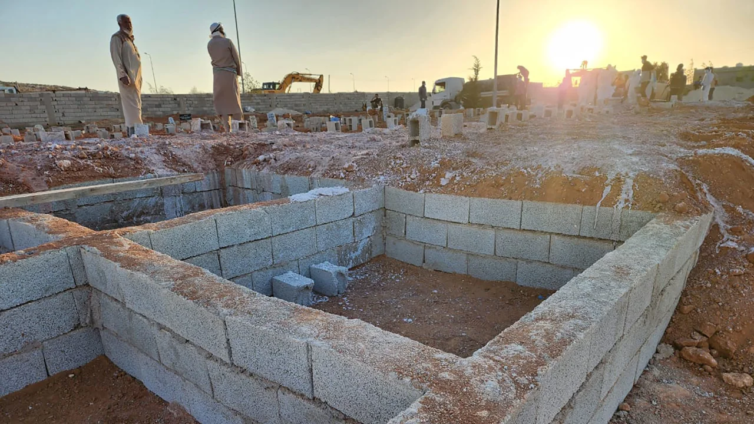
It’s quiet at the Martoba cemetery outside the Libyan city of Derna, despite the presence of dozens of volunteers. Men in white hazmat suits pour lime over the brown soil to seal the graves. Cement bricks jutting out of the heaps of dirt are the only signs of the hundreds of bodies buried underneath.
Behind them, rows of trenches several meters long were dug by excavators in anticipation of the bodies that are yet to come.
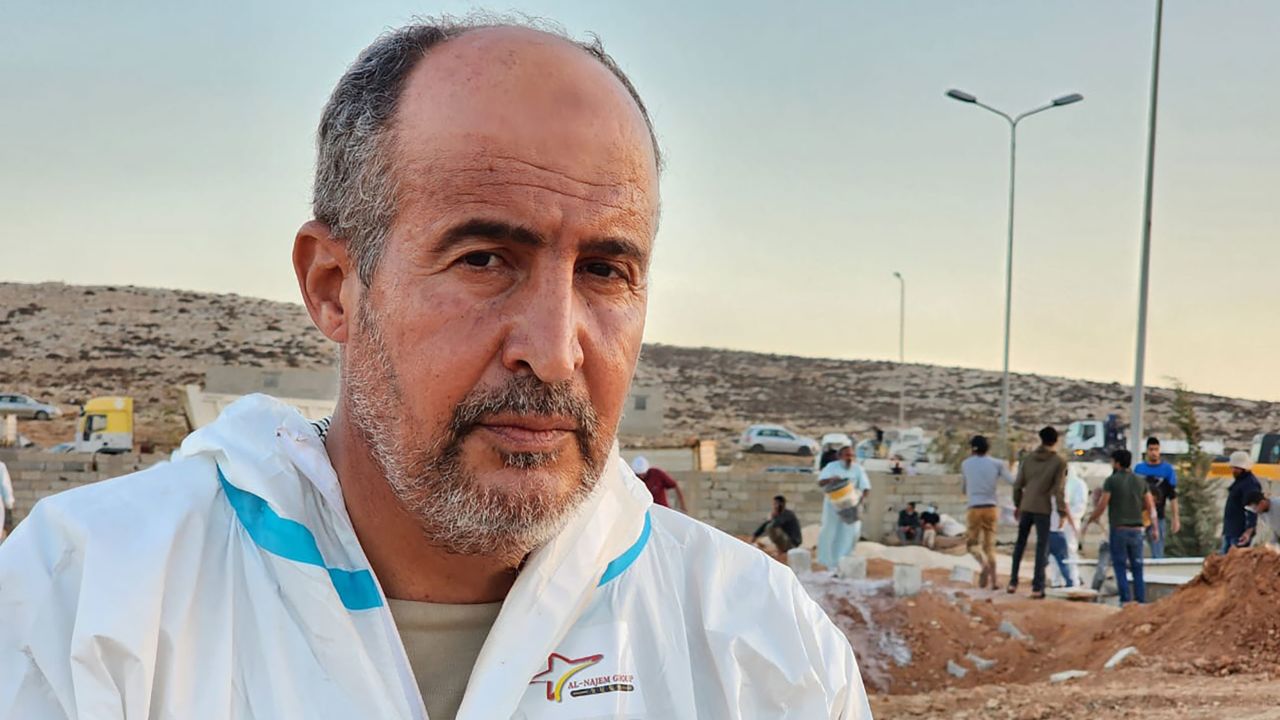
“We are preparing the place according to the figures that we are hearing, according to the number of the dead and the number of the missing. The missing are presumed dead. We can only hope that these numbers are not correct,” one of the men, Mohamed el-Sharwy, tells CNN.
The school principal volunteered at his town’s cemetery after the floods struck Derna last week.
Close to 4,000 people have perished in Derna after heavy rainfall and two collapsed dams caused ferocious floods, according to WHO figures. Thousands are still unaccounted for.
“Our proximity to Derna means that I have friends there, school friends, work colleagues,” he says. And on the first days, he says, he recognized their faces among the bodies he was tasked with burying.
“At the beginning, the bodies brought here were not covered and I was shocked to see my friends. It was extremely difficult,” he recalls.
More than 2,500 people were buried in the first three days after the disaster, in a rush to avoid infections and diseases, health officials said. The city’s hospitals and morgues were overwhelmed, unable to cope with the influx of the dead.
Martoba, one of three cemeteries designated for the flood victims, took in more than 1,000 bodies in the first week. The dead were initially buried in graves compartmented by cement bricks, each holding six or seven bodies. Later, bodies retrieved from the sea and mud-filled debris arrived decomposed and bloated. Each compartment would only hold three.
The volunteers soon realized that they needed bigger mass graves, especially once visual identification became impossible. Officials now take DNA samples ahead of burials. Bodies buried without such tests in the early days will be exhumed later for DNA testing, officials said.
The arrival of two trucks in Martoba turns the place into a hive of activity, although still quiet and solemn. Under the setting sun, dozens of men perform funeral prayers for victims only identified by numbers.
Then they lie the white body bags into a freshly dug hole, big enough to hold the consignment of 35 bodies. Men line its edge, shovelling in dirt before the excavators fill the hole.
“We can’t comprehend this. I can’t sleep at night. There is no sleep. It’s only a brief rest so I can resume work the following day,” Sharwy says.
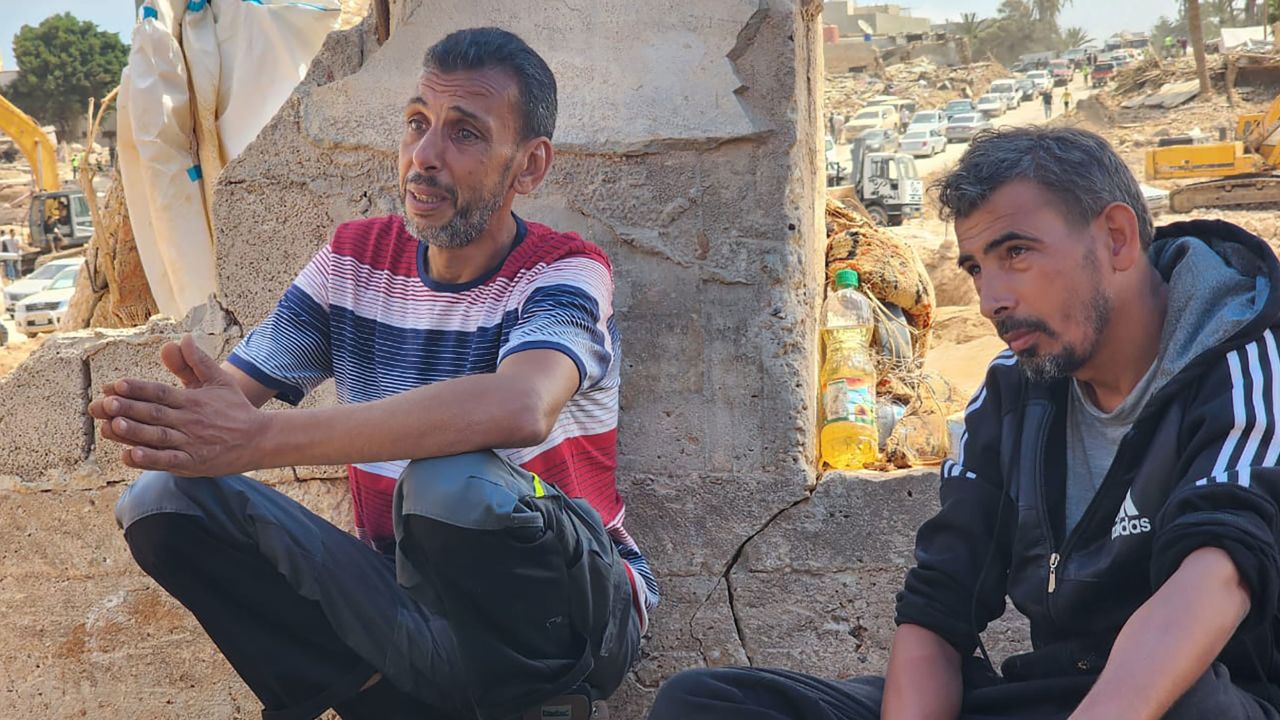
Amid the rubble of a ruined neighbourhood in Derna, the same profound trauma and loss weigh down the air. Akram al-Kawwash, 54, sits on the pile of dirt that was once his brother’s house. His eyes are reddened by a stream of tears.
“I lost my brother and his kids. This house was his. I lost them all. I lost my neighbours. I lost my entire world. This is his house. We are sitting on top of it,” he says, holding a handful of dirt and resting his back against the remains of a collapsed wall.
He tries to remember the last call he had with his brother, two days before the floods, and bursts into loud sobs. He covers his face with his hand, his fingers squeezing his eyes.
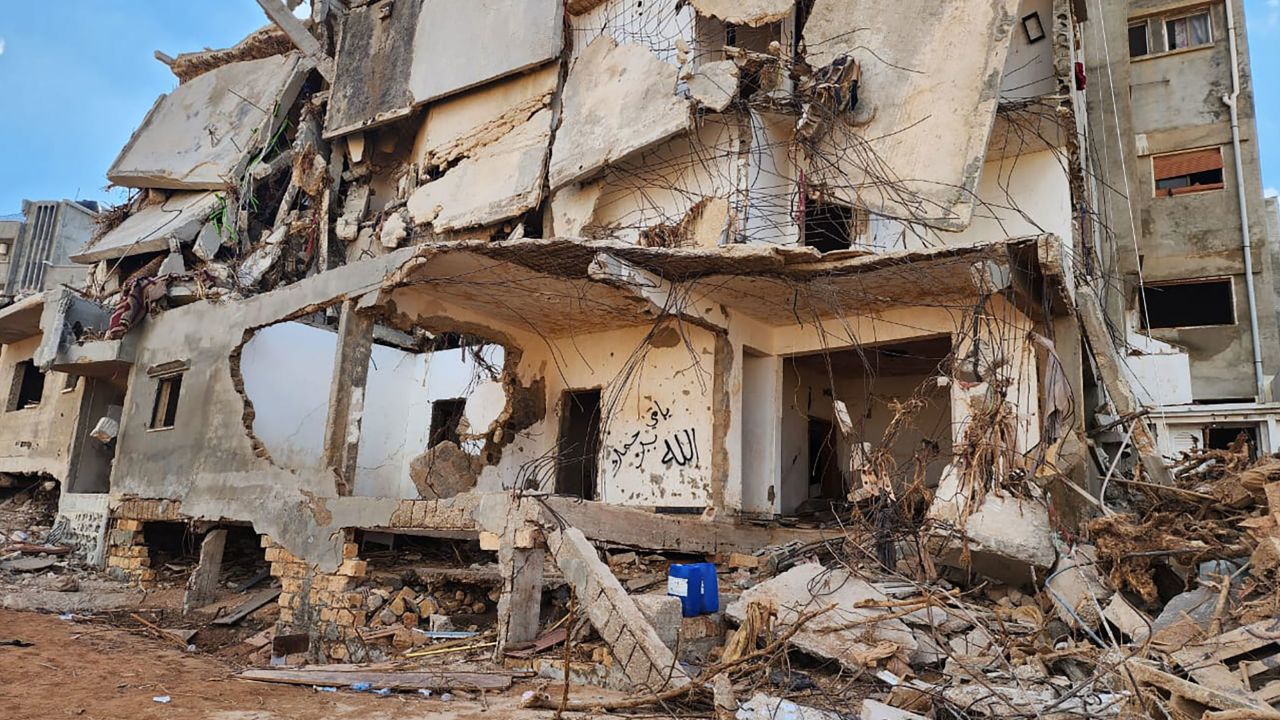
He is surrounded by survivors who are also looking for their families. They sit under a makeshift tent in front of collapsed buildings. Graffiti is one of the few ways to say goodbye here. “Rest in peace, mom,” the writing on one wall says.
“I lost 25 members of my family. We only found four of their bodies,” Abdallah al-Sheikh, 48, says. His face is expressionless, numb from the shock.
“The dead son I found at the hospital. The one still alive I took out myself. But no one else. Not my wife, not my mother, not my siblings, not my nephews, not my neighbours,” he says.
When the floods overwhelmed his neighbourhood, he carried his 10-year-old son and jumped from one rooftop to the next, he says. After the water subsided, he went looking for the rest of the family.
“There was no one to help. It was just the neighbours helping each other,” he says. He searched the wreckage, hoping to find his family members, but he found only the bodies of neighbours and a few survivors.
“This is God’s will. It’s a cruel one. But we accept it,” Kawwash says. Like Sheikh, he has yet to find the bodies of his family.
Latest Stories
-
Lands and Mines Watch Ghana commends Armah-Kofi Buah for transparent Damang Mine Lease Transition
2 hours -
GTVETS announces resumption of work as PSWU strike is called off
2 hours -
AratheJay brings “The Odyssey” to life with stunning live performance release
2 hours -
Gender Minister engages unemployed persons with disabilities
2 hours -
Formal education is a key to success, not the only path – Klef Carter
2 hours -
Why Africa’s creators must lead the movement To build Africa’s 1.5 Billion-consumer single market
2 hours -
IMANI-Africa flags ‘decade and a half of policy failure’ as SIM card re-registration returns
2 hours -
9th Africa Business Tourism & Mice Masterclass to spearhead regional integration and infrastructure readiness
3 hours -
South Africa’s premier sustainable tourism province to welcome Pan-African tourism industry leaders
3 hours -
Photos: Mahama leads wreath-laying ceremony honouring enslaved Africans in New York
3 hours -
Sulemana Braimah urges probe into ‘Big Push’ contracts
3 hours -
Honda Football Championship 2026 officially launched
3 hours -
Salah to leave Liverpool at end of season
3 hours -
Photos: President Mahama’s high-level session on reparatory justice at United Nations
4 hours -
‘Likely to cause financial loss’ – Minority demands OSP, CHRAJ probe into old BoG office contract
4 hours