


Audio By Carbonatix
Ghana’s roads are claiming more lives as the number of crashes rise marginally. The latest provisional data from the National Road Safety Authority (NRSA) covering January to September 2025 paints a worrying picture where deaths are up by 20 percent, even though pedestrian knockdowns and overall crashes have reduced over the same period in 2024.
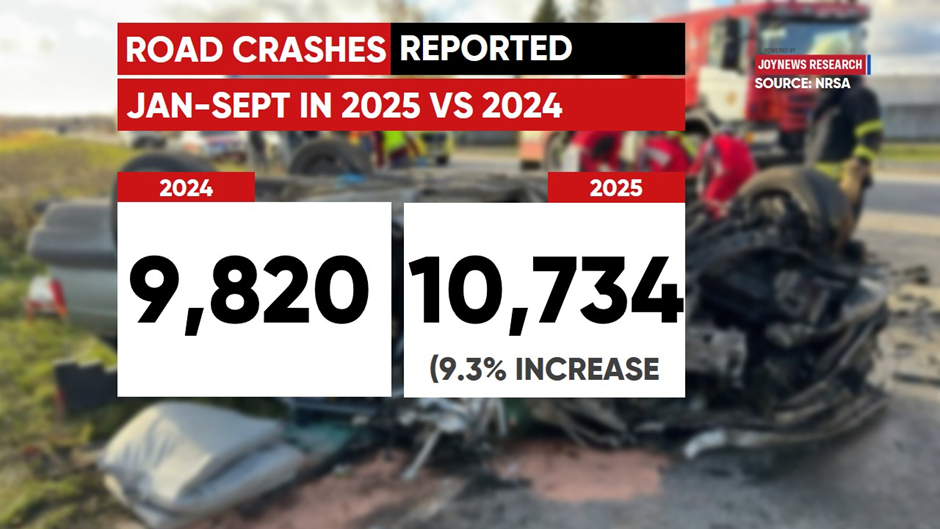
Analysing the provisional data on Road Traffic Crash & Casualty Situation revealed that 2,180 people died in road crashes between January and September 2025 — up from 1,817 deaths during the same period in 2024. The country also recorded 10,734 crashes, involving more than 18,000 vehicles of all types, from private cars and commercial vehicles to motorbikes and tricycles.

While the number of crashes rose by 9.3 percent, the jump in fatalities was much sharper, 20%, suggesting that Ghana’s roads are becoming deadlier per crash.
More crashes don’t always mean more deaths — but 2025 is different
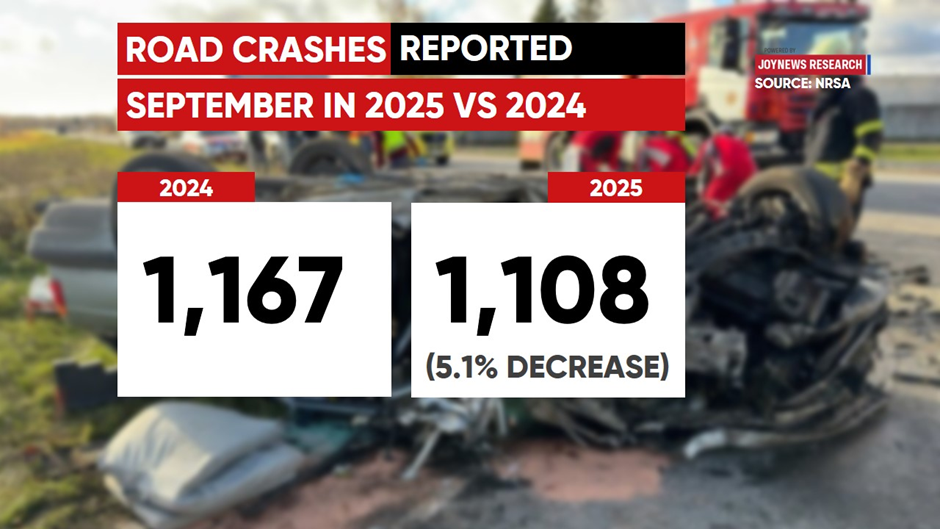
In September alone, the number of reported road crashes dropped by 5.1 percent compared to the same month last year. Yet, deaths surged by nearly 20 percent. This widening gap points to more severe crashes, poor emergency response, and the growing dominance of high-risk road users such as motorcyclists.
The data also shows that pedestrian knockdowns fell by 14.5 percent over the period. A sign of some success in awareness and urban traffic control but that progress has not translated into safer roads for drivers and passengers.
Deadliest seasons
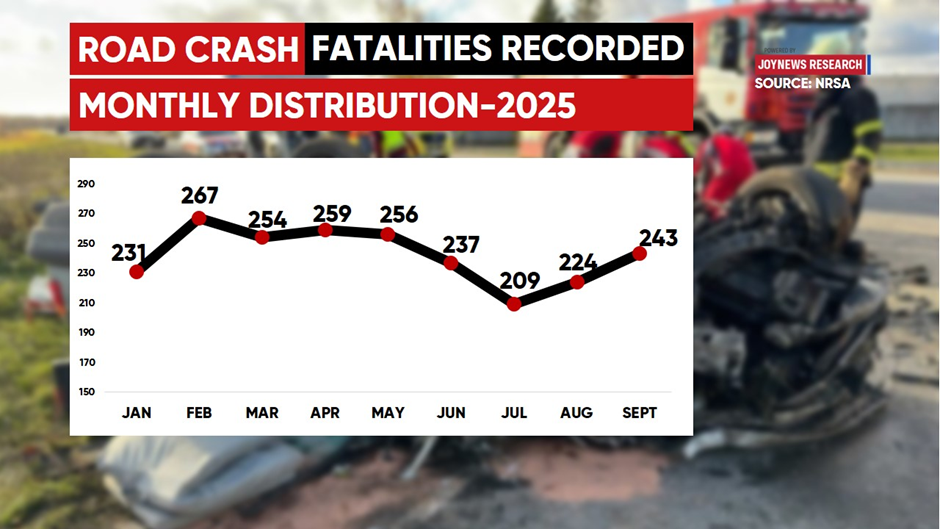
February remains the deadliest month of 2025 so far, with 267 deaths, followed by May, which recorded the highest number of crashes (1,332). Both months coincide with high mobility periods — one after school reopening and the other at the start of the rainy season.
Overall, Ghana’s road crash burden continues to rise despite years of awareness campaigns and improved data systems. The NRSA concludes that the Ashanti, Eastern, and Greater Accra Regions remain the country’s critical injury and death zones.
Better post-crash emergency response, stricter motorcycle regulation, and targeted enforcement in high-risk regions may aid curb the issue. Until then, the numbers suggest a grim truth that Ghana’s roads carry a deadlier cost.
Latest Stories
-
Potsin: Fuel tanker explodes into massive blaze as thick smoke billows into the sky
24 minutes -
Ghana’s external reserves rise to $14.5bn as macroeconomic outlook improves – BoG Governor
47 minutes -
GOIL sources up to 30% of petroleum products locally – CEO
57 minutes -
World Bank urges gov’t to urgently to tackle looming youth employment crisis
1 hour -
Malta Guinness honours National Chief Imam in a show of unity this Ramadan
1 hour -
Police arrest suspect over unlawful entry, stealing at Spintex
1 hour -
24-Hour Economy risks becoming ‘another slogan’ – GNCCI CEO warns
1 hour -
National Chief Imam calls for sanity on roads ahead of Eid celebrations
2 hours -
I inherited $110m debt owed to BP as GOIL CEO – Edward Bawa
2 hours -
SSNIT is a ‘sure banker’ — Deputy D-G
2 hours -
National Security seizes ‘sukudai’ chemicals in Kumasi crackdown
2 hours -
Stakeholders urged to strengthen cashew industry in Savannah Region
2 hours -
Parliament, World Bank, others boost journalists’ capacity for financial reporting
2 hours -
Minority Caucus meets IMF officials to discuss economic developments
2 hours -
Monetary Policy Committee reviews policy rate amid global uncertainty
2 hours