

Audio By Carbonatix
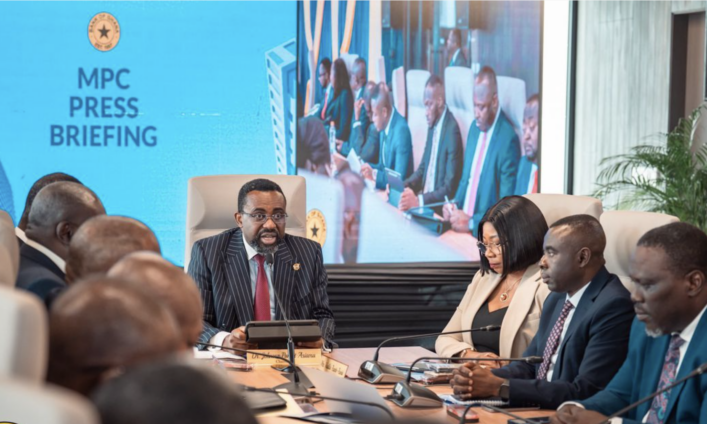
The Monetary Policy Committee (MPC) of the Bank of Ghana has begun its 129th meeting to decide on the policy rate amid declining inflation and heightened global economic uncertainty.
The three-day meeting, which began on March 16 and ends on March 18, will conclude with the announcement of the policy rate, the benchmark interest rate used by the central bank to influence borrowing costs, control inflation and guide economic activity.
Dr Johnson Pandit Asiama, Chairman of the MPC and Governor of the Bank of Ghana, opening the meeting in Accra, said the Committee faced a complex policy decision despite improvements in key economic indicators.
He noted that the decision environment contrasted with the relatively cautious stance adopted during the January MPC meeting.
Dr Asiama said the meeting was “not meant to ratify good news but to make judgment under conditions that have become more encouraging and at the same time more uncertain.”
He said inflation had fallen to 3.3 per cent in February, below the country’s medium-term target band of six to 10 per cent, describing it as a significant reversal from the crisis conditions experienced about two years ago.
The Governor said Ghana’s international reserves had increased to about US$14.5 billion, equivalent to 5.8 months of import cover, up from US$13.8 billion recorded at the January meeting.
He said the improvement positioned Ghana more favourably to withstand potential external shocks.
Dr Asiama said fiscal consolidation had also exceeded expectations, with the country recording a primary surplus of 2.6 per cent of Gross Domestic Product (GDP) at the end of 2025, compared with a deficit of 3.9 per cent a year earlier.
He said real sector activity had shown strong momentum, with the composite index of economic activity growing by 8.4 per cent year-on-year at the beginning of 2026.
Dr Asiama, however, cautioned that the external environment had changed significantly since January 2026.
He cited the escalation of conflict in the Middle East as a key concern, noting that it had disrupted major energy and shipping corridors and increased volatility in global oil markets.
“For Ghana, transmission channels are clear. The sustained oil price increases could raise the risk of imported inflation, and it could also tighten global financial conditions,” he stated.
Governor Asiama said geopolitical uncertainty could also support gold prices and potentially strengthen Ghana’s trade balance due to the country’s reliance on gold exports.
“Taken as a whole, the net balance of risks from this external shock could be inflationary,” he said.
Dr Asiama said the Committee would focus on four key areas during its deliberations: inflation developments, geopolitical risk channels, the Ghana Accelerated National Reserve Accumulation Policy (GANRAP), and the role of the banking sector in transmitting monetary policy.
He urged members to assess whether the current policy stance remained appropriate in the evolving macroeconomic environment and whether the low inflation rate provided room for policy accommodation.
The BoG Governor noted that external risks had become more pronounced compared with the situation in January 2026.
“Back then, the principal risk was complacency in the face of success. But today there is a live external threat to the disinflation trajectory,” he said.
Dr Asiama also urged the Committee to consider policies that would support the country’s ambition of raising international reserves to 15 months of import cover by 2028 under the Ghana Accelerated National Reserve Accumulation programme.
He said the banking sector remained sound, profitable and well capitalised, with improving asset quality, although credit growth remained subdued.
The BoG Governor said the Committee would need to examine whether the constraints to credit expansion were due to supply factors such as banks’ risk appetite, capital requirements and non-performing loan concerns, or weak borrower demand.
“In January, this Committee was asked to exercise discipline in the face of improvement, to resist the temptation to declare victory prematurely. That discipline proved appropriate, but today the discipline required is more complex,” he noted.
Dr Asiama reminded members that central banking involved managing both crises and success, urging decisions that would sustain the progress achieved through disciplined policy measures.
Latest Stories
-
NPP had more permanent fuel relief measures than current GH¢2 diesel cut – Amin Adam
10 minutes -
Photos from the 3rd Republic Bank-JoyNews Habitat Fair Clinic
13 minutes -
Ethiopia’s army promises restraint amid fears of new civil war
22 minutes -
Amin Adam calls for review of fuel taxes as diesel prices remain above GH¢18
54 minutes -
World Vision Ghana, Ahafo districts sign MoU for universal WASH coverage
1 hour -
When the gold engine stutters: What Ghana’s Cedi and reserves are telling us about the new economic architecture
2 hours -
Two reportedly die after being trapped in mining pit at Juaboso
2 hours -
Petrosol cleans up Wa Municipal Hospital, to donate medical equipment
2 hours -
‘If NPP was ‘insensitive’ over fuel prices, NDC must accept same description now’ — Amin Adam
2 hours -
KiDi brings the hits to London in sold-out UK headline concert
2 hours -
The last goodbye of Ghanaian shot dead in the US
3 hours -
MCC opens door to Ghana again as MiDA revives development partnership
3 hours -
CSIR moves to turn scientific research into jobs, national growth
3 hours -
More patrons troop in as 3rd Republic Bank-JoyNews Habitat Fair clinic enters final day stretch
3 hours -
German, Russian foreign ministers hold rare talks amid rising tensions
3 hours