

Audio By Carbonatix
Eleven people have been killed in Israeli strikes in southern Lebanon, authorities say, in one of the deadliest days of attacks since an agreement aimed at reducing hostilities was announced in June.
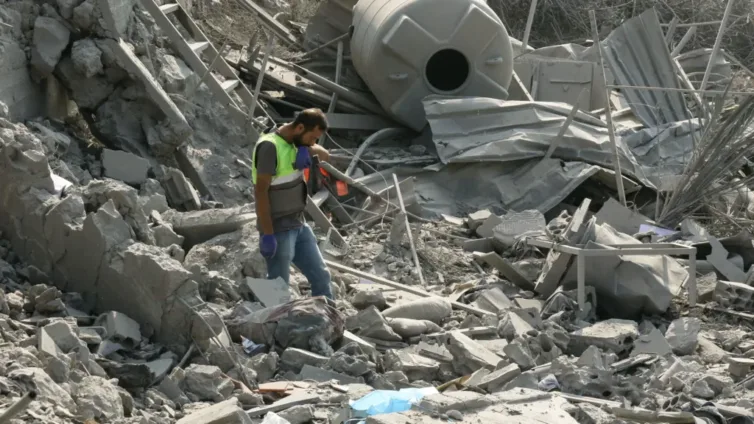
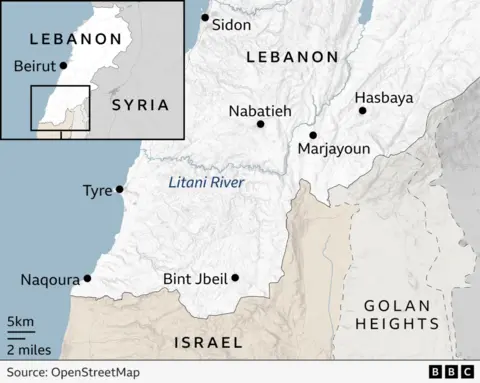
Lebanon's prime minister said seven people were killed in a strike on a house on the outskirts of Ansar, 70km (43 miles) south of the capital, Beirut. State media reported three children and two women were among the dead.
Israel's Defense Forces (IDF) said it had killed a commander of Hezbollah - the Iran-backed Shia militia - following an attack against Israeli soldiers.
The commander's family "who he used as human shields" were present and "harmed", it added.
Later on Saturday, another round of strikes hit the town of Deir al-Zahrani, killing four and wounding five others, the Lebanese ministry of health said.
Lebanese authorities say the strike in Ansar at around 04:30 (01:30 GMT) occurred where displaced families were living. Footage on social media shows large plumes of smoke permeating through the streets of the village as sirens ring out.
Lebanon's Prime Minister Nawaf Salam condemned the attacks, saying the seven civilians killed were not "military infrastructure".
"Israel must halt this escalation," he said. "For the security of our people and their right to life on their land are not subject to negotiation or bargaining."
The IDF said the incident that prompted its strike on Ansar had taken place in the Ali al-Taher Ridge, a strategic high ground overlooking much of south-eastern Lebanon and one of the war's most fiercely contested positions.
A later IDF statement said Ali Samir al-Haj Hassan, who it described as a Hezbollah battalion commander in the Radwan Force unit, had been killed.
"Alongside him, several additional terrorists who were involved in advancing terror attacks against IDF soldiers were eliminated," it added.
"The strike was specifically directed at Hassan, who was a lawful target under international law, not at his family members who he used as human shields - hiding alongside them inside the military HQ," the IDF said.
The office of Israeli Prime Minister Benjamin Netanyahu also issued a statement, defending the IDF strike.
It said the Hezbollah attack had seriously injured three soldiers and the response had struck "the Hezbollah terror headquarters which ordered the attack".
"Only later did the IDF learn that Hezbollah deliberately put civilians in that military compound," the statement added, before saying "Hezbollah is willing to do anything, including using its own civilians as human shields, to falsely accuse Israel of deliberately targeting civilians, which the IDF clearly did not".
Hezbollah dismissed Netanyahu's "false claims" and said Lebanese civilians "were deliberately targeted in their homes, many of whom were reduced to human remains, followed by claims that the locations were military sites".
Lebanon was drawn into the war between Israel, the US and Iran on 2 March, when Hezbollah - the armed group affiliated with Iran - launched rockets into Israel in retaliation for a strike that killed Iran's supreme leader.
Israel responded by launching a bombing campaign across Lebanon and invading a significant part of the country's south. Its forces continue to occupy roughly 5% of Lebanese territory.
The June ceasefire framework calls for Hezbollah to disarm, Israeli forces to withdraw gradually from southern Lebanon and the Lebanese army to deploy across the area.
Lebanon's President Joseph Aoun condemned the Israeli strikes that had killed an entire family in Ansar and its "repeated violations" of the framework, which he said sent a "clear message" to the US-led negotiations.
Hezbollah was not involved in the agreement and has rejected direct negotiations.
The IDF says it will continue to remove threats to Israeli citizens and soldiers operating in the security zone - the 10km-deep military buffer in southern Lebanon occupied by Israel.
Despite a reduction in fighting following the June agreements, Israeli strikes and demolitions in southern Lebanon have continued.
Lebanese and Israeli negotiators are set to meet for an eighth round of negotiations in September, but a final date has not been set.
Latest Stories
-
We have been scammed by NDC, government is only doing PR – Abanga Fuseini
1 minute -
Republic Bank–JoyNews Habitat Fair opens in Ho today
3 minutes -
BoG pledges stability to attract investment, urges stronger Africa–Asia partnerships
6 minutes -
Amin Adam warns treasury bill dependence could expose Ghana to refinancing risks
6 minutes -
Ghana better placed to withstand commodity price shocks – IMF
9 minutes -
GAPTE intensifies efforts to increase bus availability for Aayalolo contra-flow
11 minutes -
Amin Adam warns cedi depreciation could reverse Ghana’s debt relief gains
15 minutes -
Fiscal discipline crucial for pension fund investments – Finance Minister
15 minutes -
BoG Governor rallies IMF to back Africa’s digital sovereignty
20 minutes -
Amin Adam questions government bond pricing as short-term yields fall below inflation
26 minutes -
Five new telephony cell sites to be activated in October 2026 – Sam George
31 minutes -
Amin Adam raises sovereign-bank nexus concerns as banks hold GH¢190bn in government debt
36 minutes -
Government to increase Free SHS feeding allowance in 2027 Budget – Haruna Iddrisu
41 minutes -
Nadowli-Kaleo NCCE engages women’s groups on rule of law, corruption fight
42 minutes -
Mahama visits factories in Afienya/Tema
47 minutes