

Audio By Carbonatix
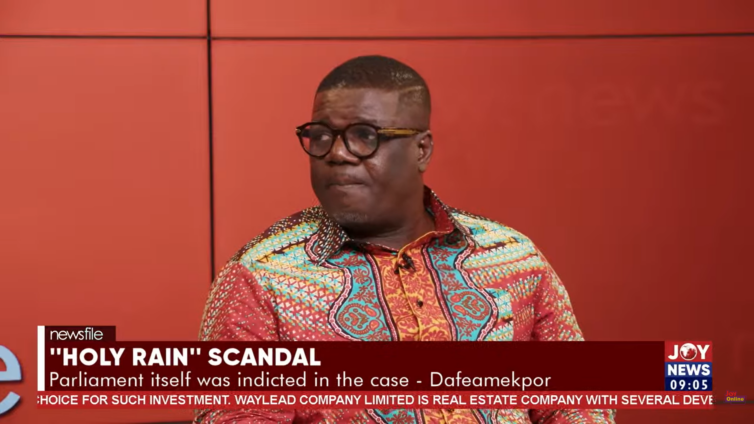
Majority Chief Whip Rockson-Nelson Dafeamekpor has challenged Ghana to demonstrate that accountability does not expire when public officials leave office, calling for renewed investigations into the AKSA power deal and appropriate sanctions where breaches are established.
Speaking on JoyNews’ Newsfile on Saturday, August 15, the South Dayi MP said the central issue should not be which political or prosecutorial institution leads the investigation but whether the facts are established and appropriate action follows.
His intervention comes as a US criminal case involving former Goldman Sachs banker Asante Kwaku Berko has revived questions in Ghana about alleged payments to public officials in connection with a power project with the Turkish energy company Aksa Enerji.
The Majority Chief Whip said Ghana should not simply rely on proceedings in the United States to determine what happened in a transaction involving Ghanaian institutions and officials.
He said the Office of the Special Prosecutor (OSP) had indicated that it provided substantial investigative assistance to US authorities, suggesting that Ghanaian institutions already have knowledge and information relevant to the case.
“My point is that the OSP indicated that they have offered tremendous assistance in terms of investigations from here to back the prosecution of the case in the US,” Dafeamekpor said.
For him, that involvement strengthens the case for a Ghanaian inquiry capable of establishing the domestic dimension of the allegations.
“Let us all agree that we need to do a further inquiry on our own and to bring out the true facts, and if anybody is guilty, the law must take its course,” he added.
His argument is significant because the allegations concern a transaction that passed through Ghana's own governmental and parliamentary processes.
The US case may determine the criminal liability of the accused before an American court, but Dafeamekpor believes Ghana must independently determine whether its own laws were breached and whether any Ghanaian actors should face consequences.
The AKSA controversy dates back to the mid-2010s, when Aksa Enerji was seeking to develop a power plant in Ghana.
US prosecutors allege that Berko, then a Goldman Sachs banker involved in securing and managing financing for the project, participated in a scheme to bribe Ghanaian officials to obtain and retain business for the Turkish energy company. Berko was charged in the United States with violations of the Foreign Corrupt Practices Act and money laundering.
The allegations had already emerged publicly in 2020, when the US Securities and Exchange Commission filed a civil enforcement action against Berko. The SEC alleged, among other things, that payments were made through an intermediary in connection with the power project and that some of the funds were intended for Ghanaian government officials.
Berko has denied the allegations, saying in 2020 that claims that he had bribed Ghanaian government officials or MPs were false.
The criminal case has now brought the controversy back into international focus. In July 2026, US prosecutors told a federal jury in Brooklyn that Berko and associates outside Goldman Sachs had allegedly paid more than US$1 million in bribes to high-ranking Ghanaian officials in connection with the power project.
The allegations remain allegations unless and until established in court.
Dafeamekpor also questioned the NPP's stated lack of confidence in the Attorney-General as the institution to lead any fresh Ghanaian investigation.
He described that position as “very interesting”, pointing out that the controversy has existed for more than 10 years.
“The matter has been with us for the past 10 years or more,” he said.
He suggested that the Attorney-General's Office may previously have taken the view that it was prudent to wait for a final determination in the US before proceeding further in Ghana.
But with the US proceedings now providing renewed information and scrutiny, Dafeamekpor believes the time has come for Ghana to act.
Perhaps the strongest aspect of Dafeamekpor's intervention was his criticism of Ghana's broader approach to public accountability.
He argued that the country frequently discusses allegations of corruption and misconduct at length but fails to impose sufficiently meaningful sanctions when wrongdoing is established.
“We are not punishing some of these things well enough, and so we all speak about it and we leave it,” he said.
That, in his view, creates a cycle in which public controversies generate headlines and political arguments but do not necessarily result in institutional consequences.
He argued that leaving public office should not automatically protect an individual from accountability for decisions made while in office.
“Even if you left office 10 years ago and some breaches and impropriety have been found as part of your work when you were in office, you can be recalled back,” he said.
He warned that unless public officials and former office-holders are made genuinely accountable for wrongdoing, future generations will have little reason to take the country's institutions seriously.
“Until we begin to do those things and demand proper accountability, our future generations won't take us serious,” he said.
The argument places the AKSA controversy within a much larger debate about Ghana's anti-corruption architecture.
For Dafeamekpor, however, institutional structures must ultimately be judged by whether they produce results.
It is against that background that Dafeamekpor insisted that Ghana's response must not be allowed to lose momentum.
“So me, I am in favour of the call, and the investigations must be pursued with alacrity,” he said.
“This matter must not slack; we must pursue it with purpose and speed and dispatch.”
Dafeamekpor also outlined what he sees as the logical end point of the process.
The investigation, he said, should establish the facts, produce a report and make recommendations. Where those recommendations establish grounds for criminal action, prosecution should follow.
“The report will be prepared, recommendations will come out, we proceed on the recommendations if any, and then we prosecute if any,” he said.
Latest Stories
-
Politicisation could undermine parliamentary probe into cocaine seizures – Dr Osae-Kwapong
4 minutes -
EOCO chases MP: Can Section 41 cure lacuna in EOCO Act? – Inusah Fuseini asks
7 minutes -
GNFS, GWL inspect fire hydrants in Ministries enclave; 23 found faulty
12 minutes -
Gov’t directs release of 50,000 bags of grain to ECOWAS
14 minutes -
Ghana, Germany deepen cooperation on railways, labour mobility
19 minutes -
Huge crowds greet Pope in Paris for open-air Mass
30 minutes -
‘I never said I’ll declare a state of emergency’ – President Mahama on galamsey
1 hour -
Bobby Banson condemns EOCO’s attempted arrest of Nana Agyei Baffour Awuah
2 hours -
When Kumasi begins to look like somebody is in charge
2 hours -
Parliamentary probe into cocaine seizure would be a waste of time – Inusah Fuseini
2 hours -
Cocaine seizure: Focus on Ghana’s reputation, not partisan blame – Osae-Kwapong
2 hours -
Two Invitations, Three Interrogations: Did Baffour Awuah tell the whole story?
2 hours -
Drug cartels may be seeing Ghana as easy route – Lenin Anane Agyei
3 hours -
Ghana risks gaining notoriety as drug-trafficking hub – Bobby Banson
3 hours -
Government dismissed my drug trafficking warning, then tried to arrest me – Ntim Fordjour
3 hours