

Audio By Carbonatix
Who really wins an election, the politician, the prophet, or the ordinary Ghanaian voter?
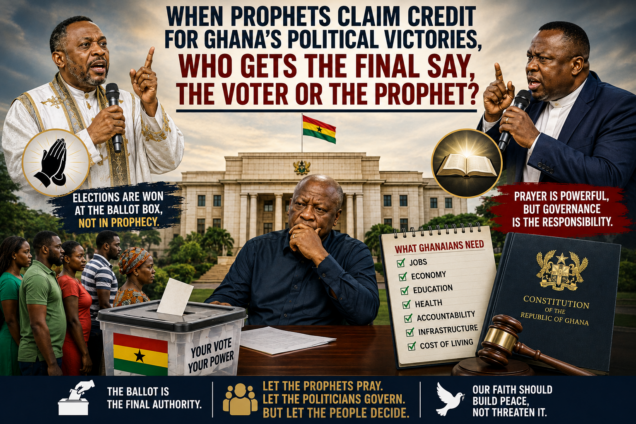
That question has become increasingly difficult to ignore following competing claims from two Ghanaian prophets about the spiritual forces behind the NDC’s decisive victory in the 2024 general elections.
Prophet Isaac Owusu Bempah has reportedly attributed part of the NDC’s victory to his prayers and spiritual intervention. Prophet Bismark Bison, however, has challenged that account, reportedly maintaining that his own spiritual direction and prayers played a significant role.
Two prophets. Two claims. One election.
But beneath the drama is a serious question about Ghana’s democracy: where does the voter fit into all of this?
Ghana’s elections are not won by prophecy alone. They are won through ballots cast by eligible citizens. Millions of Ghanaians went to polling stations, stood in queues, endured the heat and made choices based on their personal experiences and expectations for the country.
They considered inflation.
They considered unemployment.
They considered the economy.
They considered education, healthcare, corruption, jobs and the cost of living.
They made their decisions and placed their votes.
That is the foundation of Ghana’s democratic system.
There is nothing wrong with praying for a political party or believing that prayer can influence national affairs. Religious leaders, like every other citizen, have the right to express their views within the law.
But when competing spiritual claims begin to overshadow the role of the electorate, Ghana must pause and reflect.
Who really owns the victory?
The prophet?
The political party?
Or the people who cast the ballots?
Ghana belongs to all its citizens. It does not belong to political parties, politicians or religious personalities.
And that distinction becomes even more important when political leaders are warned that their future electoral fortunes could depend on whether they consult particular prophets.
Prophet Owusu Bempah is reportedly warning that if the NPP fails to consult him, the party may struggle to return to power after his departure.
That is a powerful claim.
But can one prophet determine the political destiny of an entire political party?
Can prophecy replace political organisation?
Can prayer replace good governance?
Can spiritual consultation replace the confidence of the electorate?
The answer should concern every Ghanaian.
Then comes another extraordinary claim from Prophet Bismark Bison, who has reportedly warned President John Mahama about what he describes as “indebted angels,” suggesting that failure to fulfill certain obligations could result in spiritual consequences for the government.
Saayooo! President John Dramani Mahama!
Mr President, perhaps it is time to check the spiritual mailbox!
On one side, there is prophetic support.
On the other, there appears to be a warning about debt-collecting angels.
But beyond the humour is an important lesson for political leadership.
A government cannot govern successfully by relying solely on spiritual predictions or political endorsements. It must deliver measurable results to the people who gave it the mandate.
The Ghanaian struggling to afford food needs more than prophecy.
The unemployed graduate needs a job.
The struggling entrepreneur needs access to capital.
The farmer needs markets and better production support.
The teacher needs resources.
The healthcare worker needs equipment.
The taxpayer needs accountability.
These are the realities that should dominate the national conversation.
The Voter Must Remain at the Centre
Ghana's democracy must therefore remain firmly anchored in the people.
Our political leaders may listen to prophets, pastors, traditional leaders and religious advisers. There is nothing wrong with seeking counsel.
But ultimately, the citizen must remain at the centre.
Because when the next election arrives, prophets will not stand behind the ballot box.
Ghanaians will.
And when the votes are counted, the Electoral Commission will not announce that “Prophet A has won” or “Prophet B has won.”
It will announce the candidate who has received the mandate of the electorate.
So, Mr President, respect the prayers.
Listen to the prophets.
But never forget the people.
Because without the voter, there is no election.
Without the election, there is no mandate.
And without the mandate, there is no government.
The prophets may claim spiritual influence. Politicians may claim political strategy. Parties may claim superior organisation.
But ultimately, the Ghanaian voter holds the ballot.
And that ballot is the instrument through which citizens exercise their constitutional power.
Perhaps, therefore, the greatest lesson from this unusual spiritual debate is simple:
Let the prophets pray. Let the politicians govern. But let the people decide.
Because the recorder may be off, but words spoken publicly can remain recorded in the memories and sometimes the history of a nation.
Saayooo!
So, Mr President, you may have spiritual backing on one side and spiritual warnings on the other.
But watch the people.
Because their ballots, not prophecies, are what ultimately determine who occupies Jubilee House.
Latest Stories
-
Ghana targets $5bn in annual economic gains from AI – Sam George
53 seconds -
From childhood dreams to future careers: Ecobank’s Big Pitch seeks to promote early savings and investment
3 minutes -
Public office demands make party work difficult for NDC appointees – Mahdi Gibril
4 minutes -
AI could deepen rural-urban inequality without better connectivity – Sam George
8 minutes -
One of six inmates who escaped from Konongo police cells rearrested
12 minutes -
Sam George cautions ministers against reading unverified AI-generated speeches
16 minutes -
Ghanaian entrepreneur Mary Nyamekye Asamoah wins Africa Travel 100 award
19 minutes -
Obuasi SHTS abuse: Sanction all officials who failed to act – Moving Masculinity
24 minutes -
Lucy Agyepong honoured for excellence in engineering education at maiden GAAS Women’s Awards
27 minutes -
Harriet Afia Konadu Asiedu
34 minutes -
AFCON 2027: Sports Minister ‘convinced’ Black Stars will qualify despite losing opening two games
35 minutes -
CUTS welcomes VAT collection on cross-border digital services, urges fair treatment of Distance Learning students on overseas programmes
39 minutes -
Leave the Chiefs and fix the Galamsey Problem: Dr Solomon Owusu Advises President Mahama
42 minutes -
Pay attention to teachers and give them what is due – Ho District GNAT tells government
46 minutes -
Authorities knew of abuse allegations against Obuasi headmaster months before suspension – JoyNews investigation
51 minutes