

Audio By Carbonatix
Ghana has a long tradition in lottery and is recognised for that across West Africa. What is, however, the global context of this sector and what are its economic impacts?
It is important to understand that each country has a vastly different regulatory framework that determines whether lottery can be operated by competing companies or only by a state monopoly.
In Africa, some of the monopolistic countries are Ghana, Ivory Coast, Senegal, Togo, DR Congo, while Nigeria, Kenya, Cameroon and Zambia count among competitive jurisdictions.
Most countries in Europe and the Americas operate lottery via state monopolies, where the proceeds are directed towards social development and good causes and this is also the case with the monopolistic jurisdictions in Africa, such as our own Ghana.
In fact, lottery is considered in most countries as a vital tool to generate additional funds for social development – funds that are added on top of the regular state budgets. With this perspective in mind, lottery is not merely a product for entertainment, but a key social development policy tool for many governments.
Some statistics may reveal the global impact (source: World Lottery Association). In 2018, the global lottery sales amounted to $303 billion, and thereof, $86 billion were allocated to good causes. For the sake of comparison, Ghana’s total GDP for the same year amounted to $66 billion.
However, the data also reveals that only a mere 0.6% (1.8 billion USD) of the global revenues were generated in Africa and thereof only 256 million USD were allocated to good causes.
This is low, as we need to consider that Africa’s share of the world economy is 3%, and hence, this clearly indicates an under-developed sector with significant growth potential.
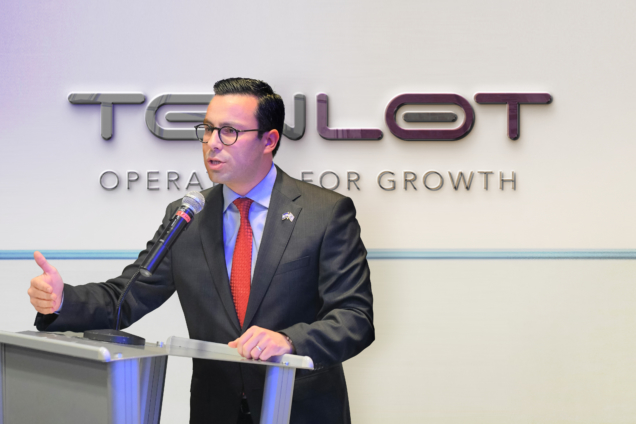
We talked with Yossi Abadi, CEO of TENLOT Group, to share his perspective on lottery in Africa. “Africa is evidently an under-developed market and we believe that many African countries have not nearly fulfilled their potential.”
TENLOT Group is a global lottery operator with a strong footprint in Africa and Latin America and is specialized in operating charity-oriented lotteries.
“I would like to point out that African governments should cease the opportunity to transform their lottery sectors into an important funding tool for good causes and social development, in addition to becoming a very important source for employment. This should be a core element within their strategic goal to go ‘Beyond Aid’”, Yossi Abadi added.
Lottery in Africa should be encouraged as a social development tool, by emulating the highly successful model of some countries in Europe, the Americas and Asia.
In order to achieve this, the public needs to be made well aware that by playing and entertaining itself, it also builds the economy and social wellbeing of the country.
Latest Stories
-
Trump declares victory after rescue but threats to US operation in Iran still loom
35 minutes -
US Secret Service investigates reports of gunfire near White House
46 minutes -
Current account stability to mitigate pressure on cedi; currency to end year at GH¢11.40 to a dollar
56 minutes -
Oil back above $110 after expletive-laden Trump threat to Iran
57 minutes -
T-bills auction: Government records 32% undersubscription; interest rates rise again
59 minutes -
Economy to remain relatively insulated from fallout of US–Iran conflict – Fitch Solutions
59 minutes -
[Watch Live] Shatta Wale, Kofi Kinaata, and others ignite the grand finale of Gomoa Easter Carnival
3 hours -
Trump issues expletive-laden threat to Iran over Hormuz Strait blockage
5 hours -
Berekum Chelsea edge Aduana FC in Bono derby to boost survival hopes
6 hours -
‘They can’t control the team’ – Ernest Thompson doubts local coaches for Black Stars role
7 hours -
Ghana-born midfielder Seidu realises ‘dream’ with Atlético Madrid debut
7 hours -
GPL 2025/26: Bubakari strikes late to hand All Blacks vital win over Dreams FC
7 hours -
Fatal crash on Kintampo–Tamale highway claims four lives
7 hours -
2025–26 FA Cup Semifinal Draw: Chelsea, Man City Learn Wembley Opponents
8 hours -
GPL 25/26: Gold Stars back on top after beating Nations FC
8 hours