

Audio By Carbonatix
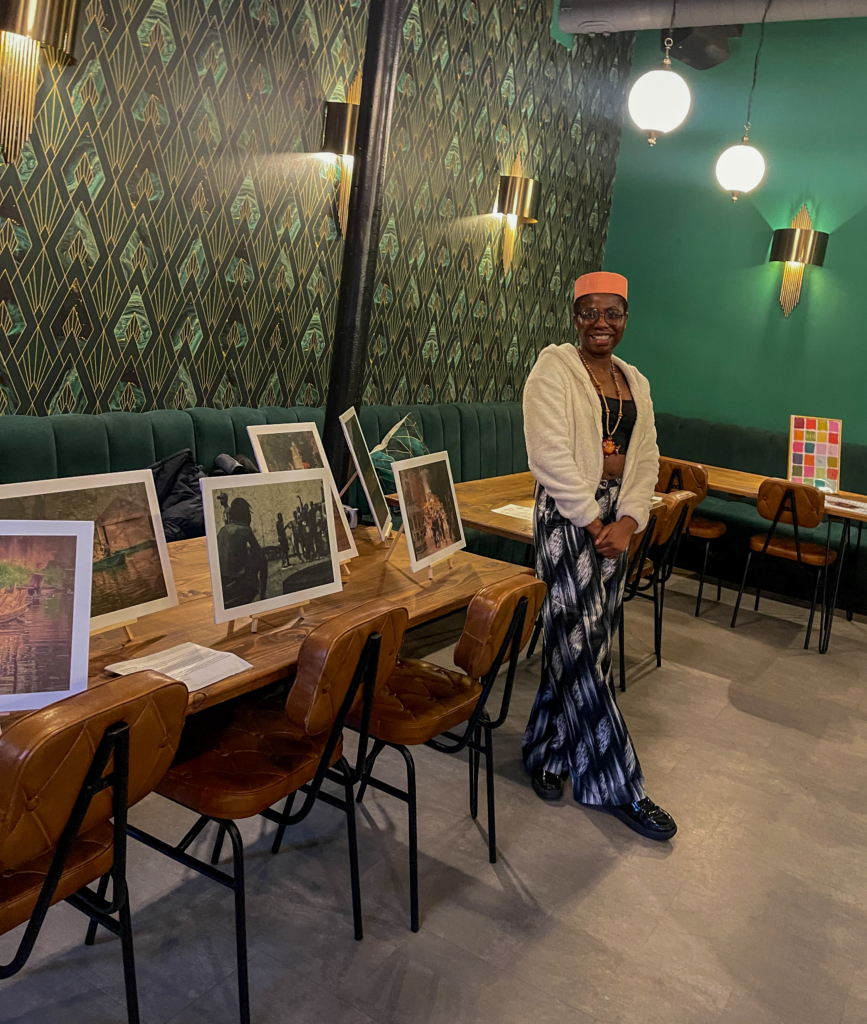
Many artworks being paraded in the art scene these days often seek attention through shock value or maximalism in their use of technology. Amidst all these, Nigerian photographer Esther Adeola Seriki lends credence to the power of "whispers.” Esther’s touring exhibition, titled "Everyday Grace," an exhibition which offers a persuasive visual argument in support of the "intentional lens," is currently touring the United Kingdom. This exhibition also recently made an appearance at the Art, Business and Creativity Conference in Lagos.
Esther, a documentary and fine art photographer, is no longer a bystander in the streets but a curator of the ordinary. Her photography embodies the concept that "the spectacle we seek in art is already present in the rhythm of everyday life," if only the artist is patient enough to wait for it.
The artwork serves as a connection point between Esther’s Nigerian heritage and her current experience in contemporary Britain. This exhibition, though, does not follow the classic “immigrant tale” using the struggle paradigm. Rather, Esther approaches these photographs with a fine art eye that categorises what would otherwise be street photographs.
Crucially, her photographs seek to overcome the “noise” of the modern media culture with the slowness of the shutter speed, both literal and figurative. There exists a depth of serenity in her compositions that resists speed. Through the recording of “simple and beautiful realities in various environments,” Esther successfully contends that grace as human experience is a universal constant, irrespective of geography.
The centrepiece of the Nigerian edition, titled "Core and Course: Cultural Echoes in Motion," serves as the project’s emotional and intellectual anchor. It marks the shift of Esther away from observation and commentary towards the personal and the symbolic.
The series centres on her mother, an African elder, as she walks through the UK streets. The contrast between images is striking. The Material: The figure is adorned with àṣọ òkè, a fabric rich in Yoruba heritage and history. The Anchor: The figure holds a Bible, symbolising a centre of unshakeable faith. The Motion: The blur of the modern world is all around her, yet she is always the steady, focused "core."
On a more critical level, this collection can be regarded as a textbook case of representation via placement. To position a black, African elderly at the centre of a Western cityscape narrative when this population tends to be relegated to either backdrop or invisibility in mainstream Western media primarily constitutes an exercise in visual recuperation. The subject of identity in this collection does not represent an object in space at a particular historical point. Identity could be defined here as an experience that is “carried.”
Esther's artistic authority is reinforced by the fact that she has a unique Open Knowledge background. This is due to the fact that she is a recognised contributor to the Wikimedia Commons and a past winner of the Wiki Loves Earth Nigeria.
This documentary approach to photography prevents Everyday Grace from merely being sentimental. There is an idea of truth to Esther’s photographs, an idea of a commitment to lived experience, that keeps her work honest. Her success internationally, such as her 8th placement in the Wiki Loves Earth competition, is a testament to a photographer who realises photography is not merely art but an archive.
The subtlety of Esther’s work requires a silence from the viewer that is ever more difficult to achieve. A “quiet meditation” is needed for the viewer to appreciate the work that has been created. A reaction to the transient qualities of digital culture has been successfully created by Esther through her fusion of the àṣọ òkə textures with the hard stone found on UK pavements. Esther’s work has created a visual statement that has reminded us that beauty is a journey, not just the destination that we find. For an audience seeking an antidote to the chaos of the present, Esther’s work is a sophisticated, serene, and essential intervention.
Latest Stories
-
“Feels amazing” – Antoine Semenyo reveals after Manchester City dismantle Liverpool
26 minutes -
Mahama calls for emergency cabinet meeting over rising fuel prices
1 hour -
Asante Gold reports US$345million loss for 2025
2 hours -
Gov’t making progress in clearing $1.7bn power debt – Mahama
3 hours -
Justice is the engine of growth – Chief Justice
4 hours -
Meet us halfway – Trade Minister tasks private sector with AfCFTA success
4 hours -
After more than 14 years at Atletico Madrid, what next for Simeone?
4 hours -
Conquering the World – Building on the foundations laid by Otto Addo
4 hours -
[Playback] Sarkodie, Kwami Eugene, Tinny, Keche and others thrill fans at Gomoa Easter Carnival
5 hours -
Gomoa Easter Carnival: Experts charge indigenes to own festival to ensure sustainability
6 hours -
Gomoa Easter Carnival: Edem Agbana and Joy Prime fans shower festival with huge endorsements
7 hours -
Gathering of Royals 2026: Empowering women, boosting tomato production
8 hours -
Gov’t to overhaul free zones into manufacturing hubs for local production – Trade Minister
8 hours -
Ghana losing $2.5bn yearly from raw exports – Trade Minister reveals
8 hours -
Mahama unveils plans for Kwahu Airport, Convention Centre
8 hours