

Audio By Carbonatix
During a visit to a local farm while working with development agency USAID, Ugandan entrepreneur Juliet Tumusiime realized that a huge amount of banana stems are left over from banana cultivation and simply discarded. Looking for a way to use the waste, she struck upon an innovative business idea.
Almost a decade later, now aged 42, Tumusiime is the chief executive and co-founder of Cheveux Organique, which manufactures hair made from banana fibers as an alternative to synthetic extensions.
Fashion trends among the younger population and growing purchasing power have boosted the market for hair extensions and wigs in the Africa and the Middle East, which could be worth $710 million by 2028, according to Research and Markets.
Extensions are typically made from human hair, or synthetic materials such as nylon, polyester, acrylic and PVC. Synthetics are popular in Uganda because they’re much cheaper, but they’re not biodegradable or easy to recycle. Some people complain that synthetic hair can irritate their scalp and a study of synthetic hair in Nigeria found the presence of potentially harmful heavy metals and chemicals.
“I’ve spoken to friends, colleagues, both men and women and asked them how they dispose of their hair when they take it out,” Tumusiime says. “A lot of the time it is just thrown in the trash. The level of awareness is really low - most people don’t realize that they are wearing plastic on their head which can irritate the skin and cause pollution.
“Our mission is to transform the beauty industry by providing alternatives that benefit their health and the environment. We want to empower women to make informed decisions about what hair they use and what’s best for them.”
Tumusiime says that, unlike synthetic hair, her product is biodegradable, durable and can be easily styled, treated and colored. It can also be rewashed with warm water and conditioned with detangling cream. When dry, the hypoallergenic hair can be oiled and can withstand dryers and heat up to 400 degrees, lasting weeks longer than synthetic alternatives, according to Tumusiime.
Since it’s made from discarded banana stems, she adds, it’s also a way to help curb that waste.
Uganda is Africa’s largest producer and consumer of bananas, producing about 10 million metric tons of bananas per day. Ugandans consume almost one kilogram of the fruit per person, per day, with more than 75% of the population relying on bananas as a staple food, according to the World Economic Forum.
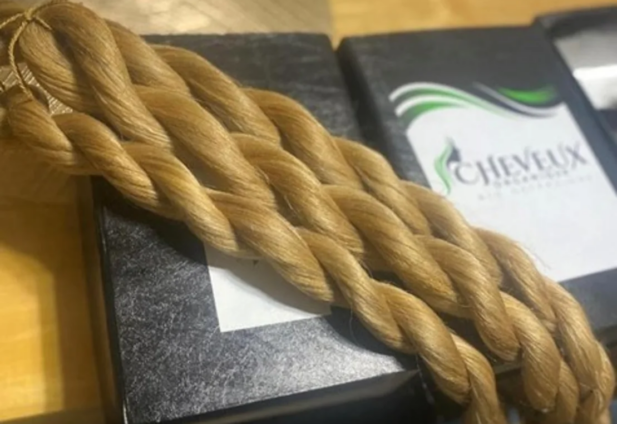
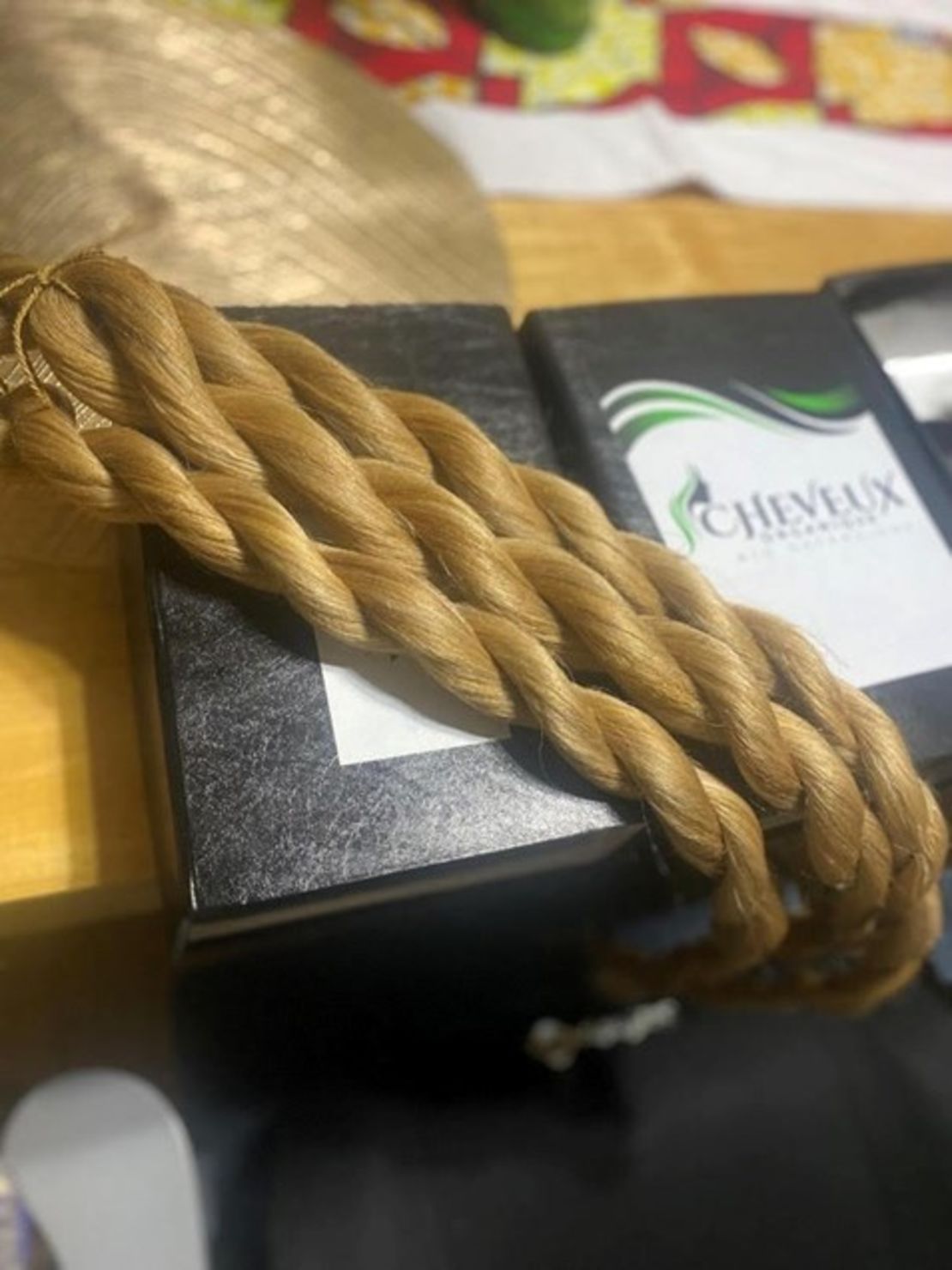
Cheveux Organique works closely with local banana farmers, buying stems that would otherwise be discarded. The stems are split and the fibers extracted by machine. The extracted fibers are then dried and treated, before being combed out, resulting in the hair-like texture.
The “hair” is dyed into three shades: Cheveux Black, Cheveux Brown and Cheveux Blonde. Tumusiime says it has a natural sheen, is soft to the touch and can be used for braiding and styling. It’s also suitable for warm and humid climates, she notes.
The company isn’t unique in creating plant-based hair. In the US, St.Louis-based Rebundle also sells hair extensions made from banana fibres, while Nourie Hair offers a hair alternative for braiding made from Ginseng root extract and rosemary.
However, turning banana waste into a premium product does not come without challenges for Cheveux Organique. “The labor-intensive process, from picking the stems, transporting them to the facility, extracting the stems, treating them and the power needed to use this – it causes the product to become pricey,” Tumusiime says.
Cheveux Organique sells its plant-based hair in Uganda, and as fair afield as the US, France and the UK. It retails for $50 for 150 grams (5.3 ounces), which Tumusiime says is cheaper than a typical $185 for a similar amount of human hair. But synthetic hair can be bought for as little as $1 for a bundle.
“This is something that we are hugely concerned about, and we are trying to find ways to mechanize the business and produce volumes of hair whilst continuing to break even,” Tumusiime says. “The people paying these prices are getting a premium product at the end of it – and it’s about the long-term benefits that this product brings.”
Tumusiime says her startup, which currently employs 25 permanent staff members and 100 part-time workers for waste gathering, is in the process of creating regional hubs, which will function as extraction centers, as well as an education point for young people. The hubs will train future generations on the positive impacts of waste management, as well as giving young people skillsets – such as extraction and machine operation – that will equip them for future careers.
“We want to make sure that this brand is a household name,” Tumusiime says. “We want to become leaders in this industry despite challenges. But I’m passionate about what I’m doing. I’m not about to give up. I do everything possible to make sure that I achieve my objectives and achieve the vision for which I started this organization.”
Latest Stories
-
I will give marriage a second chance – Juliet Ibrahim
3 hours -
King Charles reflects on ‘pressures of conflict’ in Commonwealth message
4 hours -
Rapper-politician Balendra Shah unseats Nepal’s ex-PM as he heads for victory
4 hours -
Mayor Sadiq Khan invites embattled AI firm Anthropic to expand in London
5 hours -
T-bills auction: Investor interest remains high; interest rates fall to 4.8%
5 hours -
Iran names Khamenei’s hardline son Mojtaba as new supreme leader
5 hours -
US-Iran conflict: Supply chain impacts will be felt globally
5 hours -
Interest rates declined by 23% since January 2025, but market pressures likely to resurface – Report
5 hours -
Explosion at US embassy in Oslo may have been terrorism, Norway police say
5 hours -
Zoomlion MD Doris Adjei honoured with Ghana Women of Excellence Gold Award for Environmental Sustainability
6 hours -
President Mahama bans foreign travel for boards of SOEs and public institutions over rising costs
6 hours -
Withdraw Ghanaian peacekeepers from Lebanon now – LACPSA-Ghana
6 hours -
Give to Gain: strengthening African media through women’s leadership
7 hours -
Chief of Staff urges genuine interpersonal relationships for national unity
7 hours -
Ghana High Commission in London opens Export Trade House
7 hours