

Audio By Carbonatix
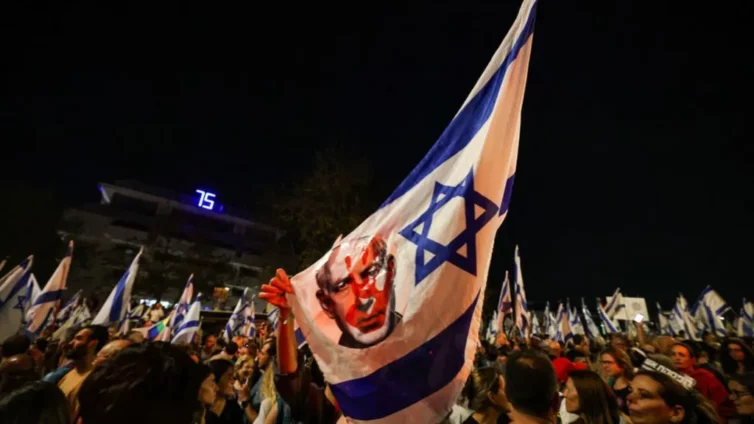
They were put to one side for a while, as shock and national unity followed the 7 October attacks by Hamas - but six months later, thousands of protesters are once again on Israel's streets.
The war has turbocharged their determination to unseat Israel's longest-serving Prime Minister Benjamin Netanyahu.
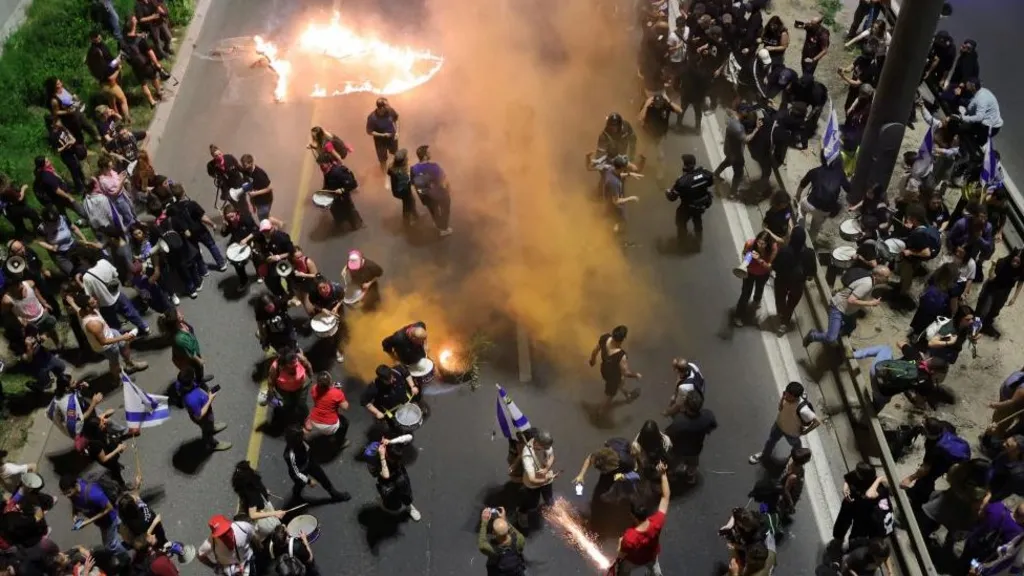
In Jerusalem, police used skunk water - a foul-smelling substance fired from water cannon - to clear protesters who had blocked the Begin Boulevard, the city's major north-south highway.
Well-worn slogans demanding his resignation and early elections were amplified by newer ones calling for an immediate deal to free about 130 Israeli hostages still held in Gaza. An unknown number of them are presumed dead.
The big fear of their families and friends, as well as the protesters, is that many more will die the longer the war drags on without a deal.
On Sunday evening, as thousands packed the broad avenues around the Israeli parliament, Katia Amorza - who has a son serving in the Israeli army in Gaza - put down her megaphone for a moment.
"Since eight this morning, I'm here. And now I'm telling Netanyahu that I would be glad to pay one way ticket, first class, for him to go out and not come back anymore.
"And I'm telling him also to take with him all those people that they put in the government that he chose one by one, the worst, the worst that we have in our society."
A rabbi crossed the road past Katia and her megaphone. It was Yehudah Glick, who campaigns for Jewish prayer in the area Israelis call the Temple Mount, the site in Jerusalem of Islam's third holiest mosque, al Aqsa.
Rabbi Glick said the protesters have forgotten that their real enemy is Hamas, not prime minister Netanyahu.
"I think he's very popular. And that's what aggravates these people. I think these people, are not willing to forgive the fact that for so long they've been demonstrating against him and he's still in power.
"And I'm calling upon them to demonstrate, to come and demonstrate, speak loud and clear what they feel, but to be careful not to cross the very thin line between democracy and anarchy."
The protesters, and Mr Netanyahu's critics in countries that otherwise support Israel, believe the enemies of democracy are already in his government, a coalition that depends on the support of ultranationalist Jewish parties.
Among them is the Religious Zionism party, led by the finance minister Bezalel Smotrich. One of its MPs, Ohad Tal, said it was "naïve" to believe anything other than more military pressure on Hamas would free the hostages.
"You don't think Hamas will bring back so easily the hostages in a deal, release everybody and then will allow us to, you know, to kill all the terrorists that we would release in such a deal...It's not as simple.
"If there was a button that you can press and bring back all the hostages and make everything okay, every Israeli would press this button. But it's not as easy as you may think."
Benjamin Netanyahu used to say he was the only one who could keep his country safe. Many Israelis believed him.
He said that he could manage the Palestinians, settle Jews on the occupied land they want for a state, without offering the concessions and making the sacrifices necessary for a peace deal.
All that changed on 7 October last year when Hamas stormed through the border wire.
Many Israelis hold him responsible for the security lapses that allowed Hamas to attack Israel with such devastating effect.
Unlike his security chiefs, who rapidly issued statements admitting they had made mistakes, Mr Netanyahu has never admitted any responsibility.
That infuriates the thousands who blocked streets in Jerusalem on Sunday evening.
Israelis must be something like 40 years old at least to remember a time when Benjamin Netanyahu was not a dominant figure in their country's politics.
After emerging as an eloquent spokesman for Israel at the United Nations, his first stint as prime minister came after a narrow victory in 1996 on a platform opposing the Oslo peace process.
Like the current American plan to make peace in the Middle East, the Oslo deals were built around the idea that allowing Palestinians to establish an independent state alongside Israel was the only hope of ending a century of conflict between Arabs and Jews over control of the land between the river Jordan and the Mediterranean Sea.
Mr Netanyahu has been a consistent opponent of a Palestinian state. He has contemptuously dismissed the US strategy of backing for Palestinian independence as part of a "grand bargain" to remake the Middle East.
His critics here say his strident rejection of President Joe Biden's plans for governance in Gaza after the war is a tool to secure the continued support of Israel's extreme right wing.
One of the protesters outside the Knesset was David Agmon, a retired Brigadier General in the Israeli army. He ran the prime minister's office when Mr Netanyahu was first elected.
"It's the biggest crisis ever since 1948. I'll tell you something else. I was the first chief of staff for Netanyahu in 1996, so I know him, and after three months I decided to leave. Because I realised who he is - a danger to Israel.
"He doesn't know how to take decisions, he is afraid, the only thing he knows is to speak. And of course, I saw he depends on his wife, and I saw his lies. And after three months I told him, Bibi, you don't need aides, you need a replacement. And I left."
While the protesters were still on the streets, Mr Netanyahu ruled out early elections and repeated his determination to mount a new offensive against Hamas forces in Rafah.
His record as a political survivor and formidable campaigner means that even if his opponents get their wish for early elections, his dwindling band of devoted followers believe he might even win.
Israelis are not divided about destroying Hamas. That war aim has overwhelming support.
But the way the war is being handled, and the failure to rescue or free all the hostages, is putting Benjamin Netanyahu under career-ending pressure.
Latest Stories
-
Government targets October 16 for first tranche of teacher arrears – Haruna Iddrisu
1 minute -
Daily Insight for CEOs: The CEO’s role in driving innovation
5 minutes -
Audit existing sanitary sites to address waste management land shortages – WasteCare CEO urges assemblies
7 minutes -
Two-bin household waste system could support waste-to-energy in Ghana – Waste Care Associates CEO
13 minutes -
Dealing with political and social media insults
16 minutes -
Essi Donkor urges stronger support for girls’ education, announces GH¢2,000 BECE reward
16 minutes -
Ghana still needs landfills but Accra should prioritise waste-to-energy – Waste Care Associates CEO
24 minutes -
Godwin Mahama declares bid for NDC Greater Accra Regional Secretary
28 minutes -
Bawumia unveils NPP plan to scout parliamentary candidates capable of winning parliamentary seats
32 minutes -
NPP Chairmanship race: How APL’s survey made a near-perfect prediction
32 minutes -
Remember Adomako-Boateng: Aduana right-back regains consciousness after collapsing during a league match
32 minutes -
Today’s front pages: Monday, October 5, 2026
33 minutes -
Families still selling homes, exhausting savings to pay for specialised care – GMTF Administrator
54 minutes -
Unity is what we need, Shatta Wale has reminded us
57 minutes -
Ghana Medical Trust Fund has exceeded expectations in first year – Health Minister
1 hour