

Audio By Carbonatix
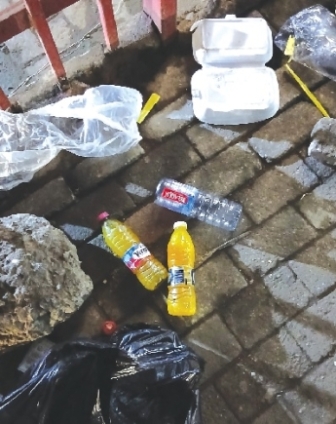
A Community Health Consultant has warned that the practice of some traders, particularly women, at the Accra Central Market, urinating into plastic water bottles and storing them at their spots until the end of the day is a serious health risk.
Others pour the urine into nearby drains or on pavements — a habit that has become disturbingly common despite rising concerns about communicable diseases.
The consultant, who is the Head of the Department of Community Health at the University of Ghana Medical School, Professor Benedict N.L. Calys-Tagoe said that such practices could expose traders and customers to diseases.
In an interview with The Mirror in Accra last Wednesday, Professor Calys-Tagoe said communicable diseases such as typhoid could be transmitted if infected urine came into contact with food, water or even the hands of traders.
He explained that containers used to store urine could serve as breeding grounds for disease-causing organisms.

“When urine is stored for long periods, it becomes a good medium for the growth of microorganisms. Although urine itself is generally not hazardous, it can pose health risks under such conditions,” he said.
“If urine leaks onto their hands and they don’t wash them properly, microorganisms can easily be transferred to food or water, creating a route for disease transmission,” he explained.
Professor Calys-Tagoe, who is also an epidemiologist and consultant public health physician, added that decomposing urine releases ammonia gas, which causes the strong odour associated with urinals and can irritate the eyes and respiratory tract, sometimes leading to coughing.
These, he said, are some of the indirect effects of improper urine disposal.
Professor Calys-Tagoe stressed the need for continuous engagement and education for traders, many of whom may not be aware of the health implications of their actions.
“Beyond education, we must provide adequate places of convenience in markets. If traders have to walk about 200 metres to find a urinal, it becomes easier for them to use bottles instead,” he observed.
Market observations
During visits to the Accra Central Market, The Mirror found some of such bottles filled with urine under tables and on pavements in areas such as the Okaishie Drug Lane, CMB and Kingsway.
Environmental effects
Professor Calys-Tagoe warned that abandoned urine bottles could contribute to eutrophication — the process by which nutrients such as those in urine enter water bodies, causing excessive algae growth.
“When urine enters drains and eventually streams, it can disrupt aquatic ecosystems, killing fish and reducing the availability of seafood for human consumption,” he explained.
He also cautioned that traces of antibiotics or medication in urine could contaminate water bodies, further harming aquatic life.
Public concerns
Some customers expressed worry about the practice.
“A trader can be urinating behind her table while transacting business,” said Osei Akoto.
Another shopper, Evelyn Ntiamoah, added that some traders reused empty water bottles as urine containers instead of visiting public urinals.
Other customers described the practice as lazy, noting that public toilets and urinals were often located within a short walking distance.
Market queen’s reaction
The CMB Market Queen, Naa Kwanuwa, confirmed the practice and condemned it as unacceptable.
“The women are just being lazy. I’ve warned them several times, but they keep doing it and apologising later,” she said.
She urged traders to prioritise hygiene and called on the media to help raise awareness.
“It costs only GH¢1 to use a urinal and GH¢5 for the toilet. There’s no excuse for such behaviour,” she added.
Latest Stories
-
Afenyo-Markin demands Interior Minister brief Parliament over security recruitment expansion
4 hours -
Felicia Boadu inspires gratitude with new song ‘Aseda’
4 hours -
Conflict of interest and the President’s use of a private jet: A constitutional perspective
4 hours -
Otto Addo names Black Stars squad for Austria and Germany friendlies
5 hours -
Rev. Stephen Wengam urges leaders to embrace ‘servant leadership’ to transform national institutions
5 hours -
Ghana Development Awards spotlight need for intentional socio-economic transformation
5 hours -
The Private Jet Debate: When generosity becomes an alleged “Scandal”
5 hours -
IGP Cyber Vetting arrests 20-year-old woman for false publication on social media
5 hours -
Overall government debt in sub-Saharan Africa stabilises but at high level – IMF
5 hours -
We will file an appeal against Freddie Blay’s remand – Lawyer
6 hours -
Tema crash: Safety record of microlight aircraft ‘very poor’ – Aviation expert
6 hours -
Only 5% of CHPS compound in Ghana are well tooled – Agotime Ziope MP
6 hours -
PwC Ghana , UGBS call on women to embrace collaboration and take up leadership roles
6 hours -
‘My mother cried out one last time’: Palestinian boy, 12, describes how Israeli forces killed his family in car
6 hours -
National Seed System Reset Programme launched at University of Ghana to boost 24-hour economy
6 hours