

Audio By Carbonatix
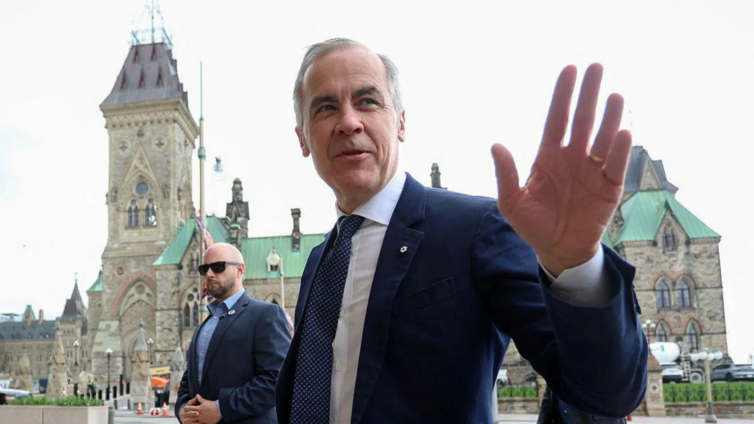
US President Donald Trump has called Canadian Prime Minister Mark Carney to congratulate him on his victory in the country's general election and the two have agreed meet in the near future.
The two countries were expected to enter talks about a new economic and security relationship after Monday's vote.
Trump's trade tariffs and repeated comments undermining Canada's sovereignty overshadowed the race, which ended with Carney's Liberals projected to win a minority government, according to public broadcaster CBC.
That result will make Carney's pressing tasks of negotiating with his US counterpart and tackling a range of domestic issues more of a challenge, as he'll need to wrangle support from other political parties.
In their first call since the election, Trump congratulated Carney on his victory, according to the prime minister's office on Tuesday.
The office also said the two leaders had "agreed on the importance of Canada and the United States working together – as independent, sovereign nations – for their mutual betterment".
The Liberals will need to rely on their support to pass legislation through the House of Commons.
They also face possible defeat in any vote of confidence in the chamber.
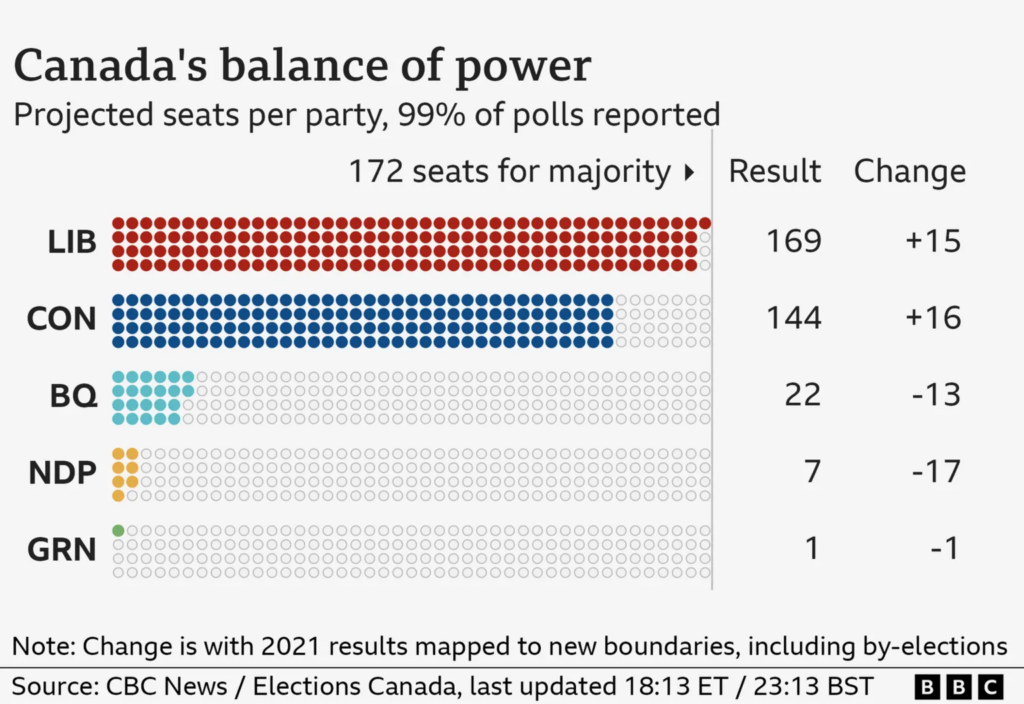
The Liberals are most likely to find willing partners with the diminished left-wing New Democrats, who have in the past supported the Liberals, and the Bloc Québécois.
The Liberals are projected to have won 169 seats, three short of the 172 needed for a majority in Canada's House of Commons.
It still marks a historic turnaround for a party that had seemed on course for collapse just months ago.
Carney, a former central banker for Canada and the UK, will continue as prime minister, having stepped into the role last month following his unpopular predecessor Justin Trudeau's resignation.
One issue where it may be easy for the Liberals to find support in the House is in passing legislation to help workers and industries affected by US tariffs - something all parties swung behind on the campaign trail.
On Tuesday morning, Bloc Québécois leader Yves-Francois Blanchet suggested Carney could benefit from at least a period of stability in the House.
Blanchet urged a "truce" among parties while Canada negotiated trade with the US, saying it was clear Canadians wanted political stability in unstable times.
He said it wasn't time for other parties to "threaten to overthrow the government anytime soon" and didn't see any scenario "other than collaboration for a period of slightly over a year".
The leader of the sovereigntist party, which only runs candidates in Quebec, did urge Carney to avoid pressing the province on certain issues, noting that collaboration goes both ways.
On Tuesday, the White House commented on Carney's win, with deputy press secretary Anna Kelly saying: "The election does not affect President Trump's plan to make Canada America's cherished 51st state."
In an interview with the BBC, Carney said that Canada deserves "respect" from the US and he will only allow a Canada-US trade and security partnership "on our terms".
Carney has told the BBC that a 51st state scenario was "never, ever going to happen".
Meanwhile, new US ambassador to Canada, Pete Hoekstra, said in a video statement that he is "committed to making progress in this great relationship".
Carney has also promised action on a range of domestic issues, including tackling the country's housing crisis and tax cuts for lower- and middle-income Canadians.
The prime minister also needs to prepare for the G7 summit in June, which Canada is hosting in the province of Alberta.
In Monday's election, both the Liberals and the Conservatives saw a significant rise in their share of the national vote compared with four years ago.
The Conservative Party came in second, on track to win 144 seats, and will form Official Opposition.
Increased support for Canada's two largest parties has come at the expense of smaller parties, particularly the NDP, whose share of the popular vote is down by around 12 percentage points.
Voter turnout for the election was 67%.
Both Conservative leader Pierre Poilievre and NDP leader Jagmeet Singh lost their seats, with Singh announcing he will step down as leader of the left-wing party.
Latest Stories
-
Ga Traditional Council, Speak Out: A looming contempt of court and cultural violation in the proposed burial of Daddy Lumba
10 minutes -
Giants of Africa builds 46th court to inspire young athletes in Ghana
26 minutes -
Afenyo-Markin urges government to reinstate dismissed workers
35 minutes -
Mugabe’s son drops bail request – what has happened to the family after losing power
1 hour -
President Mahama directs ministers to resolve Teshie Desalination Plant issues
1 hour -
Cerebral palsy awareness: The reason behind the African mentality on disability
1 hour -
MTN launches nationwide self-service SIM swap in Ghana
2 hours -
CLOGSAG strike disrupts local governance in Kwadaso – MCE
2 hours -
Bill Asamoah urges government to fast-track film legislation to boost industry
2 hours -
Shatta Wale reveals ambition to contest Ablekuma South seat
3 hours -
From cassette tapes to streaming: Grace Asare reflects on the shift in music distribution
3 hours -
MTN FA Cup quarter-finals set for explosive weekend
3 hours -
TTU registrar, co-author launch 3 books to shape higher education governance in Ghana
3 hours -
Minority condemns attack on Ghanaian Peacekeepers in Lebanon, demands full investigation
3 hours -
I have never taken even GH₵1 from Shaxi – Shatta Wale calls for gov’t support
3 hours