

Audio By Carbonatix
Every time Donald Trump has mentioned his plan to levy massive tariffs on imports into the US, there has been a widespread assumption that they will be delayed, watered down or rolled back.
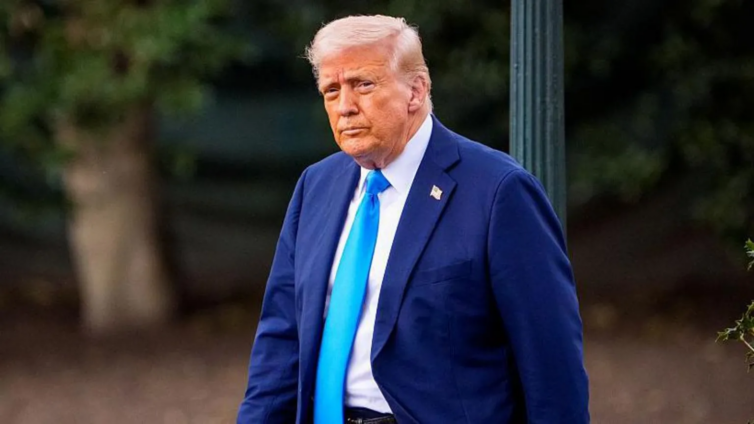
Today, he will reveal in the White House Rose Garden not just how serious he is about "the most beautiful word in the dictionary", but effectively call time on decades of economic globalisation.
And it is still possible that he will do this by launching the equivalent of a salvo of ballistic missiles into the global trading system, with a universal tariff on all imports into the USA.
The option of a 20% universal tariff is the only way to get to some of the massive revenues of trillions of dollars claimed by some of his advisers.
In recent days, President Trump has been adamant that the tariffs will be "reciprocal" and the US will be "nicer" to its trade partners.
That doesn't rule out wide-scale imposition of tariffs at 10 or 20%, if, for example, the US deems that Value Added Taxes are tariffs.
It is possible that countries could be very broadly bracketed into different levels of a basically universal tariff. As one G7 negotiator told me at the weekend, "it all comes down to President Trump".
A system such as this, with equivalent global retaliation, would see the UK economy shrinking by 1%, enough to wipe out growth and lead to pressure for tax rises or spending cuts.
The total cost around the world could, according to an Aston University Business School study, be $1.4 trillion (£1.1tn), as trade is diverted, and prices rise.
In industry, there is some expectation that the European Union will target US tech companies. There could be quite the contrast should the UK choose not just to hold back on retaliation, but offer a significant tax cut to US big tech.
Trade wars are hard to win, and easy for everyone to lose.
A universal tariff of 20%, or its equivalent, would be a historic hit to the global trading system, on a par with the infamous Smoot-Hawley tariffs nearly a century ago.
There is something bigger here, however. As the Vice President, JD Vance said in a speech last month, globalisation has failed in the eyes of this administration because the idea was that "rich countries would move further up the value chain, while the poor countries made the simpler things".
As that has not panned out, especially in the case of China, the US is moving away from this world.
If the US overplays its hand in alienating its allies today, China will be waiting. The hit to US business in Europe, for example, could be offset by cheaper electronics, clothes, and toys from the East arriving in the UK and lowering prices, diverted from the US market.
What starts later today is designed not just to reshape America, and trade, but the way the world itself has been run.
Latest Stories
-
EU to sign historic defence pact with Ghana in global security pivot
3 minutes -
Liverpool lose to Galatasaray in Slot’s 100th game in charge
11 minutes -
Iran begins laying mines in Strait of Hormuz, sources say
17 minutes -
Joey Barton refused bail after ‘attack at golf club’
23 minutes -
GH¢68.7bn gov’t arrears bombshell: Parliament orders probe over suspected fraud
27 minutes -
The public display of students’ academic results in basic schools: A case against a damaging practice
42 minutes -
GOIL jumps GH¢0.21, MTN Ghana surges past GH¢6.30 in record-breaking GSE session
56 minutes -
NAIMOS disrupts illegal mining activities at Gwira Banso-Eshiem
1 hour -
Ashesi hosts Kensei Kai Foundation’s maiden Inter-University Karate Camp
2 hours -
21 suspects arraigned in Tamale Circuit Court over narcotics offences
2 hours -
A nation that prays for political failure
2 hours -
Kumasi Mayor inspects key inner-road projects, promises major upgrade of road infrastructure
2 hours -
Manhyia South MP questions authenticity of audit report presented to Parliament
2 hours -
NAIMOS destroys illegal mining structures, immobilises 4 excavators in Amenfi Central
2 hours -
Ghana to host One Vecta AI Summit 2026
2 hours