

Audio By Carbonatix
Anger is growing in Turkey that poor enforcement of regulations contributed to the collapse of many buildings in the recent earthquakes.
The BBC has verified examples of recently built blocks that collapsed in the latest disaster.
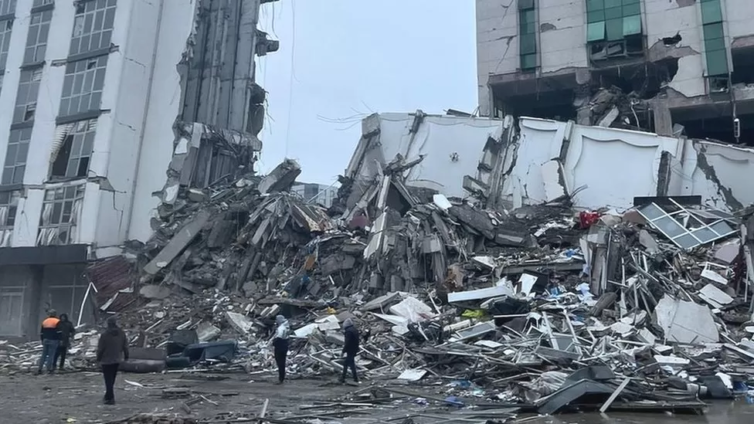
One building in Malatya (seen below) was finished last year and screenshots circulated on social media of an advert saying it was "completed in compliance with the latest earthquake regulations."
The text stated that all materials and workmanship used were "first-class quality".
There's no trace of this advert now, but a number of people had taken pictures and videos and posted them online. The advertisement matches the style of similar ones on the company website.
Another recently built apartment block in the port city of Iskenderun has been pictured largely destroyed.
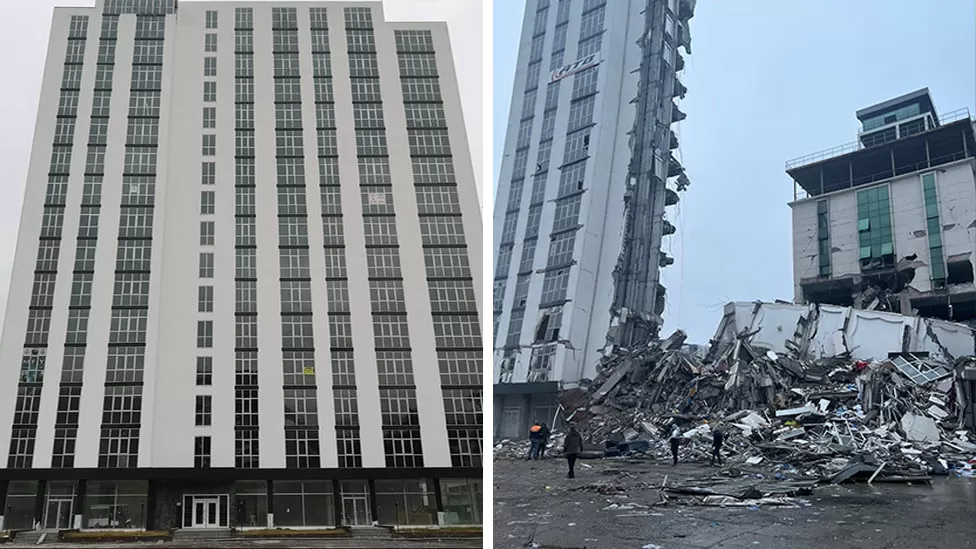
A construction company for this building posted an image showing it was completed in 2019.
The BBC has verified that the image of the destroyed building (right) matches the location of the company's publicity shot of the block (left).
We have contacted the construction company involved for comment and have not yet had a response.
Another building which was opened in Antakya in 2019 can be seen largely destroyed in a picture verified by the BBC.
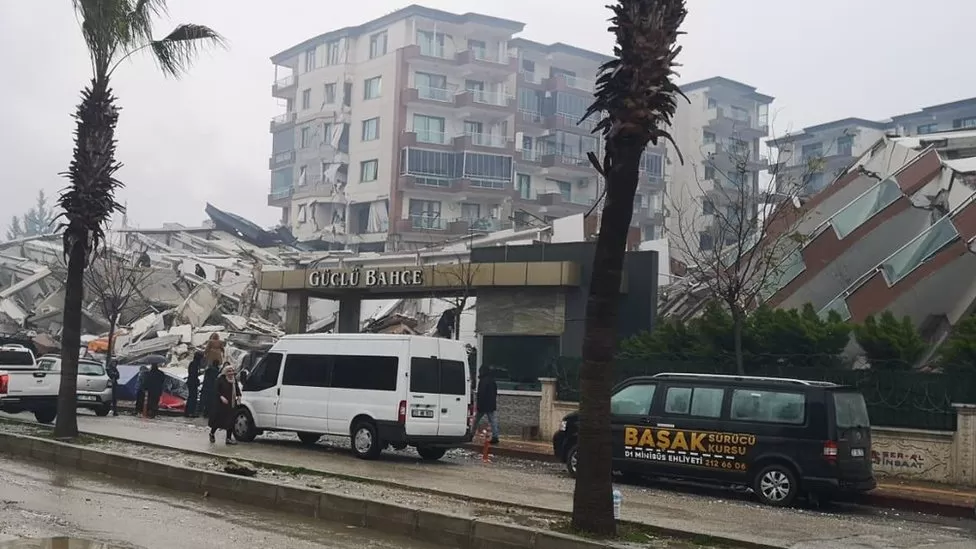
We found a video of the housing complex's opening ceremony from November 2019, in which the owner of a construction company involved says: "The Guclu Bahce City project is particularly special compared to the others in terms of its location and construction qualities."
Although the quakes were powerful, experts say properly constructed buildings should have been able to stay standing.
"The maximum intensity for this earthquake was violent but not necessarily enough to bring well constructed buildings down," says David Alexander, Professor of Emergency Planning and Management at University College London.
"In most places the level of shaking was less than the maximum, so we can conclude out of the thousands of buildings that collapsed, almost all of them don't stand up to any reasonably expected earthquake construction code."
Failure to enforce building regulations
Construction regulations have been tightened following previous disasters, most recently in 2018.
Stricter safety standards were also brought in following the 1999 earthquake around the city of Izmit, in the north-west of the country, in which 17,000 people died.
The latest rules require structures in earthquake-prone regions to use high quality concrete reinforced with steel bars. Columns and beams must also be distributed to effectively absorb the impact of earthquakes.
These laws, however, have been poorly enforced.
"In part the problem is that there's very little retrofitting of existing buildings, but there's also very little enforcement of building standards on new builds," says Prof Alexander.
Why is enforcement so weak?
The government has provided periodic "construction amnesties" - effectively legal exemptions for the payment of a fee, for those structures built without the required safety certificates. These have been passed since the 1960s (with the latest in 2018).
Critics have long warned that such amnesties risk catastrophe in the event of a major earthquake.
Up to 75,000 buildings across the affected earthquake zone in southern Turkey have been given construction amnesties, according to Pelin Pınar Giritlioğlu, Istanbul head of the Union of Chambers of Turkish Engineers and Architects' Chamber of City Planners.
Just a few days before the latest disaster, Turkish media reported that a new draft law is awaiting parliamentary approval which would grant a further amnesty for recent construction work.
Geologist Celal Sengor said earlier this year that passing such construction amnesties in a country riven by fault lines amounts to a "crime".
After a deadly earthquake hit the western province of Izmir in 2020, a BBC Turkish report found that 672,000 buildings in Izmir had benefited from the most recent amnesty.
This same report cited the Environment and Urbanisation Ministry as stating in 2018 that over 50% of buildings in Turkey - equivalent to almost 13 million buildings - were constructed in violation of regulations.
We've contacted the Environment and Urbanisation Ministry for comment about building standards in Turkey following the most recent earthquakes, who said: "No building constructed by our administration has collapsed. Damage assessment studies are continuing rapidly in the field."
Latest Stories
-
OnlyFans owner Leonid Radvinsky dies at 43
3 hours -
Nigerian police arrest 15 after viral videos of alleged sexual assault at festival
3 hours -
Ethnic, political exclusion, not theology alone drives Muslim sectarian violence in Ghana, KNUST study finds
3 hours -
Semenyo reports to Black Stars camp after Carabao Cup win
4 hours -
Journalism out loud: Defending truth in a divided world
8 hours -
Heath Goldfields partners local firm, receives new mining fleet to revive Bogoso-Prestea mine
9 hours -
Korle-Bu overcrowding driven by broken referral system, not just bed shortage – Doctors
9 hours -
MC Portfolio named red carpet host for 2026 Ghana Music Awards USA
9 hours -
Oda-Akyem Swedru road develops dangerous potholes
9 hours -
U.S. Embassy explains Visa process for Ghanaians ahead of World Cup
9 hours -
Viral video on emergency care at Korle-Bu Teaching Hospital is ‘authentic’ – Emergency Medicine Residents
10 hours -
Ahmad Abdul-Samad, Rachael Quarcoo dominate 1st quarter All Ghana Badminton Championship
10 hours -
ActionAid calls for strong partnerships to advance water, gender, and climate justice
10 hours -
DVLA begins nationwide clampdown on expired DV plates from March 24
10 hours -
Ghanaian Commonwealth Youth Leader meets King Charles III, pushes for youth economic empowerment
11 hours