

Audio By Carbonatix
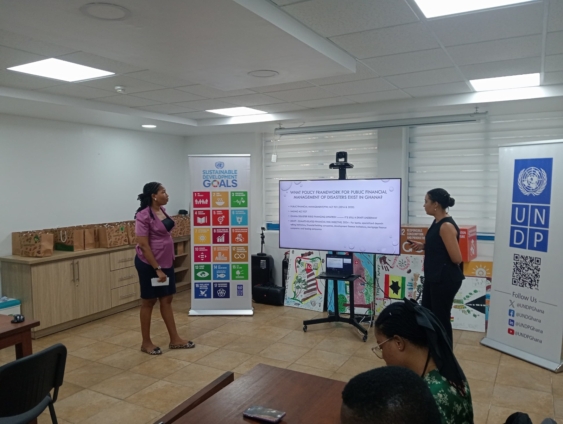
The United Nations Development Programme (UNDP), Ghana has brought together key government agencies, industry players, and risk experts in Accra to develop a national strategy that will improve Ghana’s ability to finance disaster response quickly and efficiently.
Organized through UNDP’s Insurance and Risk Finance Facility (IRFF), the stakeholders engagement workshop convened representatives from the Ministry of Finance, National Insurance Commission (NIC), National Disaster Management Organization (NADMO), Environmental Protection Agency (EPA), National Development Planning Commission (NDPC), Ghana Hydrological Authority, Ghana Meteorological Agency, Civil Society Organisations, and leading risk modelling experts.
The objective is to co-create a Disaster Management and Risk Finance Strategy Framework that will enable Ghana to access faster and more predictable financing when floods, droughts, and other natural hazards occur.
In her opening remarks, Dr. Amina Sammo, Coordinator of UNDP’s Insurance and Risk Finance Facility, described the workshop as an opportunity to shape a robust national strategy through collaboration among ministries, regulators, insurers, development partners, and technical experts.
“This initiative isn’t only about policy, it’s about real people: the waakye sellers, Koko vendors, charcoal traders in inner-cities, Zongo communities, and farmers whose livelihoods are threatened each time disasters strike,” she said.
Dr. Sammo emphasised that pre-arranged disaster finance, designed and agreed upon in advance, can save lives by ensuring quick and predictable funding in emergencies.
She highlighted innovative tools being considered for the strategy, including parametric insurance, contingency planning, risk financing, and risk-layering mechanisms.
These are aligned with Ghana’s development goals and global frameworks such as the Sendai Framework for Disaster Risk Reduction, the Paris Agreement, and the Sustainable Development Goals (SDGs).
She urged stakeholders to take ownership of the strategy and integrate disaster risk financing into national policies, budgets, and planning processes, stressing that its success depends on collective leadership and decisive action.
Prof. Asaah S. Mohammed, Lead Consultant on the project, encouraged participants to adopt flexible approaches informed by global best practices. He announced that a follow-up session will be held in the weeks to review the draft framework for validation.
The workshop is seen as a significant step in Ghana’s efforts to become a resilient, shock-ready nation capable of protecting its most vulnerable citizens in the face of disasters.
Latest Stories
-
CAF President urges faith in African football despite AFCON 2025 issues
2 minutes -
AFCON U-17: Black Starlets’ aim is to win trophy – Head Coach Prosper Ogum
6 minutes -
ENFA expands access to global capital for Ghanaian SMEs
14 minutes -
Beyond security: Why mobile payment fraud has become a customer experience crisis
15 minutes -
Former Effia MP demands full disclosure of Truedare AI deal, warns of ‘hidden risks’
40 minutes -
Joseph Cudjoe raises alarm over potential revenue loss in Truedare AI Customs deal
40 minutes -
Video: Awoshie-Anyaa Highway: Years of fatal crashes caused by faulty traffic lights
45 minutes -
No financial transactions with Ghana Card yet, says NIA
51 minutes -
Former Netherlands Fire Chief engages GNFS Tema Command on capacity building
51 minutes -
Finance Ministry defends Publican AI rollout amid stakeholder concerns
54 minutes -
Police arrest 5 in Asankrangwa robbery; cash and guns retrieved
55 minutes -
Why I joined NPP – Jeneral Ntatia
56 minutes -
Three UDS students remanded over alleged armed robbery
60 minutes -
Kudus Mohammed at risk of missing World Cup 2026 after fresh injury blow
1 hour -
Minority urges cocoa farmers to resist pressure from galamseyers
1 hour