

Audio By Carbonatix
A U.S. appeals court appeared likely on Wednesday to conclude that President Donald Trump's executive order curtailing automatic birthright citizenship is unconstitutional, though it may wait for the Supreme Court to first decide whether to narrow judicial orders that have prevented it from taking effect.
During arguments in Seattle, a majority of a three-judge panel of the 9th U.S. Circuit Court of Appeals expressed scepticism about the administration's claim that the U.S. Constitution does not extend citizenship to nearly all children born in the United States regardless of immigration status.
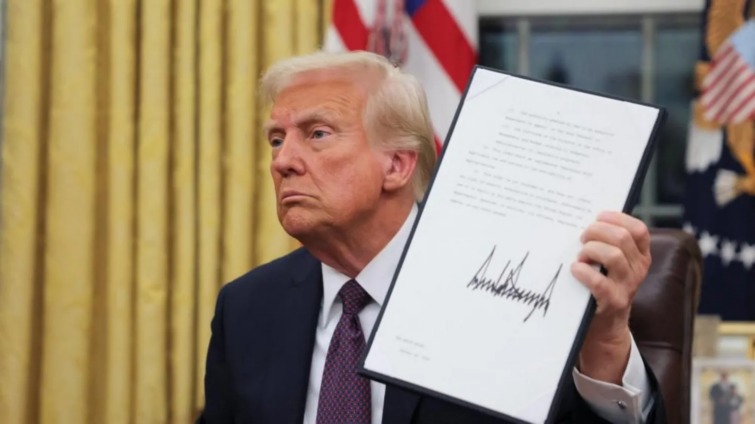
The Republican president signed the order on January 20, his first day back in office. Trump directed federal agencies to refuse to recognise the citizenship of U.S.-born children who do not have at least one parent who is an American citizen or lawful permanent resident, also known as a "green card" holder. The directive is part of his hardline approach toward immigration.
The Constitution's 14th Amendment citizenship clause states that all "persons born or naturalised in the United States, and subject to the jurisdiction thereof, are citizens of the United States and of the state wherein they reside."
Justice Department lawyer Eric McArthur argued that this language was being wrongly interpreted in a way that encourages "birth tourism" by expectant mothers traveling to the United States to give birth and secure citizenship for their children.
"It forces our immigration law to be at war with itself, prohibiting illegal immigration with one hand while inducing and rewarding it with the other," McArthur said. "The Constitution does not require those perverse results."
McArthur argued that when the 14th Amendment was ratified in 1868, congressional debates made clear that lawmakers were seeking merely to guarantee the citizenship for the freed slaves after the U.S. Civil War and aimed to only cover children born to people "domiciled" in the country who owed allegiance to it.
"I'm looking at the language of the citizenship clause," responded U.S. Circuit Judge Ronald Gould, an appointee of Democratic former President Bill Clinton. "I don't see any language in there textually that says they have to be domiciled."
U.S. Circuit Judge Michael Hawkins, also a Clinton appointee, suggested that the administration's focus on congressional debates would have earned the scorn of former Supreme Court Justice Antonin Scalia, a conservative luminary who "was widely critical of looking at congressional history."
The arguments came in the administration's appeal of a nationwide injunction issued by Seattle-based U.S. District Judge John Coughenour, who called Trump's order "blatantly unconstitutional." Federal judges in Massachusetts and Maryland also have issued similar orders blocking the order nationwide.
More than 150,000 newborns would be denied citizenship annually if Trump's order takes effect nationally, according to the plaintiffs.
Democratic attorneys general from 22 states and immigrant rights advocates in lawsuits challenging Trump's directive argued that it violates the 14th Amendment.
Coughenour, an appointee of Republican former President Ronald Reagan, has presided over a legal challenge brought by the states of Washington, Arizona, Illinois and Oregon and several pregnant women.
Washington state Solicitor General Noah Purcell during Wednesday's arguments called the Trump administration's position "radical." Purcell said the U.S. Supreme Court made clear in 1898 in the case called United States v. Wong Kim Ark that the 14th Amendment guarantees birthright citizenship regardless of the immigration status of a child's parents.
"The executive order is unconstitutional and un-American," Purcell said.
U.S. Circuit Judge Patrick Bumatay, a Trump appointee, pushed back, saying that the holding of the 1898 ruling was "limited to children of aliens that are permanently domiciled in the United States."
The Supreme Court, which has a 6-3 conservative majority, heard arguments on May 15 in the administration's bid to narrow the three injunctions.
Those arguments did not center on the legal merits of Trump's order, instead focusing on the issue of whether a single judge should be able to issue nationwide injunctions like the ones that have blocked Trump's directive.
The Supreme Court, which has not yet issued its ruling, could allow the directive to go into effect in large swathes of the country.
Lawyers on both sides of Wednesday's arguments suggested that the 9th Circuit wait until after the Supreme Court acts and then swiftly issue a decision on the legal merits of the dispute.
Latest Stories
-
GPL 2025/26: Dreams FC stage stunning comeback to hammer Eleven Wonders
1 hour -
Livestream: The Probe examines Kumasi’s looming water crisis
1 hour -
MTN Ghana gears up to lead Africa’s AI revolution
1 hour -
Philanthropist Alhaji FuZak donates Da’wah bus to Ambariya Sunni community
1 hour -
GUTA calls for suspension of Publican AI system over trade disruptions
1 hour -
TTAG raises alarm over proposed recruitment of 7,000 teachers, demands national posting roadmap
2 hours -
Civilians feared killed after reports of air strike on Nigerian market
2 hours -
Bishop Simon Kofi Appiah installed as new Jasikan Diocese Bishop
2 hours -
Trump’s Strait of Hormuz blockade threat raises risks and leaves predicaments unchanged
2 hours -
US Court backs extradition of former MASLOC CEO Sedina Tamakloe-Attionu to Ghana
3 hours -
Seven arrested as NAIMOS dismantles illegal mining camp, seizes firearms at Boin River
3 hours -
Fire erupts at Madina Ritz Junction, destroys multiple wooden structures and containers
3 hours -
Daniel-Kofi Kyereh returns from long-term injury, registers assist for Freiburg U23
3 hours -
Knifeman calling himself ‘Lucifer’ slashes three at NYC’s Grand Central
3 hours -
Brands are built from within to without
3 hours