

Audio By Carbonatix
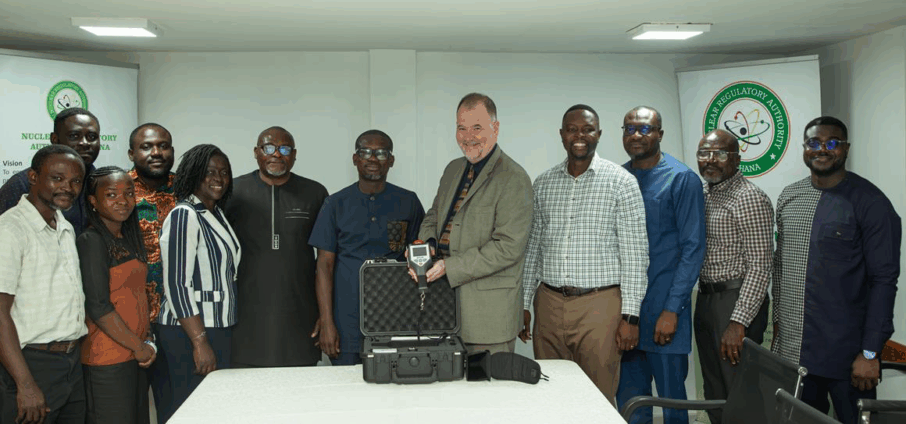
The U.S. Charge d’Affaires, a.i. Rolf Olson, on Monday, July 7, met with senior officials at Ghana’s Nuclear Regulatory Authority (NRA) to provide radiation detection equipment in support of Ghana’s nuclear safeguards program.
Ghana’s NRA regulates and controls the peaceful applications of nuclear energy to align with international standards and obligations set forth by the International Atomic Energy Agency (IAEA).
The detection equipment, the HM-5 identiFINDER, valued at $26,000, will reinforce and strengthen detection of nuclear material to support Ghana’s IAEA reporting requirements and its capacity to detect, quickly locate, measure, and identify the source of radioactive and nuclear material.
This donation is the latest support by the United States for Ghana’s civilian nuclear energy program. In January, the United States, through the Foundational Infrastructure for Responsible Use of Small Modular Reactor Technology (FIRST) Program, donated the E2 Centre at the School of Nuclear and Allied Sciences, featuring a NuScale Power small modular reactor (SMR) digital control room simulator.
Previously, the program co-sponsored study tours to the United States and Japan for Ghanaian nuclear engineers and facilitated university partnerships with the top-tier nuclear engineering department at Texas A&M University for developing SMR-related curricula at Ghanaian institutions.
The U.S. Department of Energy’s National Nuclear Security Administration (DOE/NNSA) has worked in partnership with NRA for over a decade to strengthen Ghana’s implementation of IAEA nuclear safeguards obligations.
The International Nuclear Safeguards Engagement Program (INSEP) under DOE/NNSA supports states in implementing the highest standards of nuclear safeguards by building capacity to strengthen the Treaty on the Non-Proliferation of Nuclear Weapons.
INSEP’s cooperation with NRA has included consultations on strengthening Ghana’s nuclear law and drafting nuclear safeguards regulations, conducting technical trainings on non-destructive assay measurements of nuclear material, and supporting the establishment of sustainable national safeguards infrastructure in Ghana to meet IAEA obligations.
Latest Stories
-
Briton among 19 killed in Nepal bus crash
1 minute -
IMANI Brief: The MP’s Share of the DACF a legal overreach and must stop
4 minutes -
Artificial Intelligence: Africa gov’ts must adopt, adapt, and indigenise, but don’t copy and paste
12 minutes -
CalBank delivers strong capital rebound in 2025 as profit-before-tax hits GH¢ 481.4m
15 minutes -
COCOBOD’s statutory monopoly/criminalised single-buyer system (Part I)
19 minutes -
Kotoka International Airport renamed Accra International Airport
30 minutes -
Minority raises alarm over delayed rent allowances to Ghana Prisons Service officers
32 minutes -
No ‘dumsor’ in Ashanti Region – ECG assures residents
35 minutes -
Beyond certificates: Why Ghana’s TVET revolution must prioritise employment over enrolment
41 minutes -
Miss Intercontinental Ghana winner sues organisers after title withdrawal
55 minutes -
Bioko has truly redefined my appreciation of locally made chocolate and the power of a woman’s vision
58 minutes -
Ghana moves to open key public offices to dual citizens in historic constitutional review
1 hour -
Punishment alone won’t solve student behaviour, moral guidance needed – Irene Sam
1 hour -
UK launches eVisas for Nigerians as US expands short-term travel access in Ghana
1 hour -
Viral fame vs traditional education in the republic of uncommon sense
2 hours