

Audio By Carbonatix
1. Article 20 of Ghana's Constitution protects not only physical property but also “any interest in or right over any property.”
Black's Law Dictionary defines "property" as the right to possess, use, and enjoy a specific thing such as a tract of land or a chattel (any movable or transferable property, specifically personal property such as cars, furniture, livestock or cocoa!) to the exclusion of others. It encompasses the entire bundle of rights, including the power to dispose of, transfer, or encumber the asset.
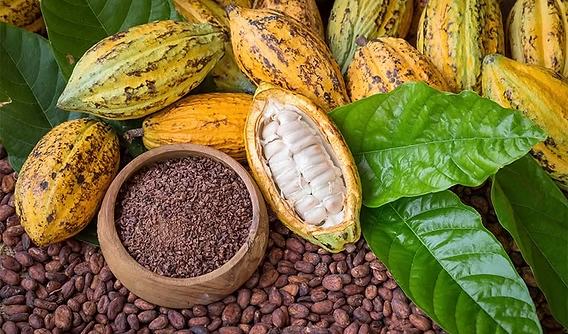
2. It follows that cocoa grown by a farmer is unquestionably the farmer’s property. Embedded in that ownership are core incidents of property namely, the right to possess, use, enjoy, and dispose of it.
3. In Ghana, the cocoa trade functions without a genuine market. The state itself is the market. At the heart of the industry is the Ghana Cocoa Board (“COCOBOD” or “the Board”), a government-controlled entity that holds exclusive legal authority to purchase cocoa from farmers. By statute, Ghanaian cocoa farmers are compelled to sell their produce (property) either directly to the Board, through its “wholly owned subsidiary”, or to a buyer authorized by the Board. In return, they receive a producer price unilaterally determined by the Board with the Trade’s minister’s approval.
4. This single-buyer system is not merely a matter of policy choice; it is codified and enforced by the state. The Ghana Cocoa Board Act, 1984 (PNDCL 81) (“the Act”) empowers the Board to fix the prices paid to producers, prohibits any person from purchasing cocoa except through channels sanctioned by the Board, restricts the marketing and export of cocoa except on the authorization of the Board, and criminalizes unauthorized transactions. A farmer who sells outside this framework, or a trader who buys without Board authorization, faces a mandatory prison sentence of five to ten years without the option of a fine (See Sections 3(a), 4(1), 4(6), and 4(7) of the Act).
5. Although the State does not physically seize cocoa without payment, the Act effectively compels farmers to transfer their cocoa (their property) to a single state-controlled buyer (COCOBOD or its agent), at a state-determined price, and prohibits sale to anyone else on the pain of imprisonment.
6. In my humble view, this amounts to a form of compulsory acquisition or compulsory transfer of personal property. If the practical effect of the law is that a cocoa farmer has no meaningful choice but to sell to the state (or its agent), then the state has, in effect, taken possession of the farmer’s property through legal compulsion.
7. Property rights, like all rights, are not absolute. But the state’s power to limit those rights is not absolute either. When the state restricts a constitutional right, it must show a clear and compelling public interest justification.
8. Under Article 20(1) of the Constitution, compulsory acquisition is permissible only where it is necessary for a listed public purpose (such as public safety, public order, or development for public benefit); and the necessity is clearly stated and reasonably justified, taking into account the hardship caused.
9. Is a criminalized single-buyer system truly “necessary” to achieve quality control, price stability, or foreign exchange management? Has Parliament clearly demonstrated why less restrictive regulatory alternatives such as licensing multiple buyers, floor pricing, or export controls would not suffice? If the monopoly is broader than necessary to achieve its stated objectives, it should fail the constitutional test of necessity and reasonable justification.
10. By criminalising private sale and export, the Act strips farmers of the essential right to dispose of their property freely in the market. What remains is a constrained right to transfer cocoa only to a designated purchaser (COCOBOD or its authorized agent) at a designated price. When the State extinguishes the owner’s freedom to choose a buyer, negotiate price, or access export markets, it effectively removes fundamental incidents of ownership protected by Article 20.
11. The Constitution is the supreme law of Ghana. Statutory arrangements, however long-standing, must yield to it if it is inconsistent with it. If the single-buyer system goes beyond regulation and crosses into compelled transfer without constitutionally compliant safeguards, then the relevant provisions of the Act should be invalidated as unconstitutional.
12. The cocoa monopoly is not merely an economic regulation, but a system of legally compelled transfer of private property to a state-controlled buyer, without the strict necessity, compensation safeguards, and judicial protections required by Article 20.
In Part II, I will examine the state’s public interest justifications for this statutory framework and argue why they will fail to withstand constitutional scrutiny.
By Nick Opoku
The writer is a lawyer with experience in legal and governance policy, strategic litigation, and corporate law. Email: nickknust@gmail.com
Latest Stories
-
Ghana explores underwater sightseeing and shipwreck tourism
19 seconds -
Association of Women Lawyers calls for national sexual offenders register to protect school children
2 minutes -
Soaring commodity prices influenced our 2026 revised growth forecast of 5.7 % for Ghana – IMF
4 minutes -
Government urged to recruit more speech therapists to support children with language disorders
7 minutes -
Chef Abbys: Feeding 50,000 people, putting food security on Ghana’s agenda
35 minutes -
Ho set to host Republic Bank–JoyNews Habitat Fair as multiple firms prepare to showcase housing solutions
43 minutes -
NPP demands public inquiry into alleged $600,000 World Cup visa fraud, wants Sports Minister, GTA CEO summoned
50 minutes -
I want my brand to be bigger than just music – Yaw Wazinga
53 minutes -
Houthi missile attack on Yemeni presidential palace kills two, minister says
54 minutes -
I hoped to win an award; I worked hard – 2026 Best Graduating Law Student
1 hour -
Fraudsters increasingly target bank customers instead of banking systems – Fraud detection expert
1 hour -
44 teacher sexual abuse cases tracked since 2015; school heads feature in 40% of recent cases — JoyNews Research
1 hour -
Unchecked imports and the Middle East crisis threaten Ghana’s fragile food inflation anchor
1 hour -
Ecobank Junior Saver Big Pitch to reward 10 winners with GH¢2,000 each
1 hour -
AMA demolishes unauthorised pigsty obstructing Agbogbloshie waste evacuation exercise
2 hours