

Audio By Carbonatix
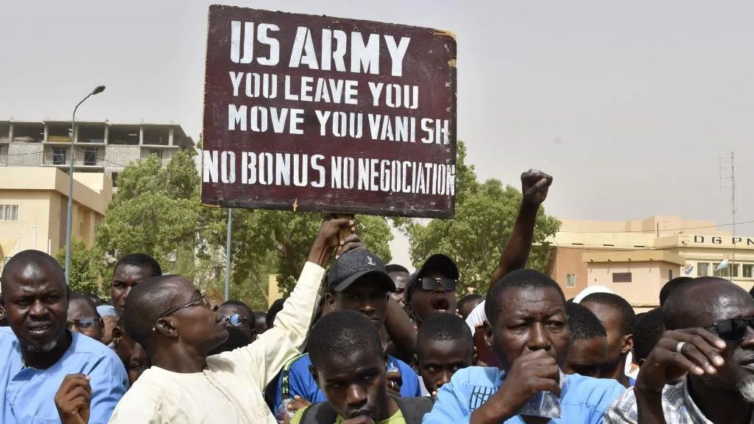
The US and Niger have agreed that American troops will leave the country "no later" than 15 September, they announced in a joint statement on Sunday.
They said the two countries had "reached a disengagement agreement to effect the withdrawal of U.S. forces, which has already begun".
The US has relied on Niger as its primary base for monitoring regional jihadist activity.
The statement commended the "joint sacrifices of Nigerien and U.S. forces in the fight against terrorism".
The statement said the withdrawal would not affect the continuation of US-Niger relations.
"The United States and Niger are committed to ongoing diplomatic dialogue to define the future of their bilateral relations," it read.
The deal was reached after marathon talks between the two countries in Niamey.
In March, Niger announced the end of its military agreement with the US. Military spokesperson Col Amadou Abdramane accused the US of raising objections about the allies that Niger had chosen.
Col Abdramane condemned the US for its "condescending attitude" and "threat of reprisals".
Tensions spiked between the US and Niger after elected president, Mohamed Bazoum, was overthrown last year.
Niger is in Africa's Sahel region, considered the new global epicentre of the Islamic State group.
American forces have used two military bases in Niger to monitor Islamist militant groups in the Sahel.
The US built a $100m (£80m) military base there six years ago in the central city of Agadez, 750km (460 miles) north-east of Niamey.
It has played a key role in the US strategy to combat jihadists in West Africa.
The US has more than 1,000 troops stationed at the base.
It is the second Western power to withdraw from Niger.
Last year, Niger expelled former colonial power France's troops, who had also been deployed to fight jihadists.
As Niger has distanced itself from the West, it has drawn closer to Russia.
Last month, Russian military instructors arrived in Niger as part of a new agreement with its military leaders.
Niger has also broken away itself from local democracies and sought stronger regional alliances with fellow junta-led nations Burkina Faso and Mali.
The trio have quit Ecowas - the West African regional body which opposed their military takeovers.
They have also quit the French-backed G5 Sahel force, saying it was ineffectual and undermined African sovereignty, and launched their own defence pact called the Alliance of Sahel States.
Latest Stories
-
Akoti Chief lauds Chirano Sefwiman Foundation, Asante Gold for new teachers’ quarters
2 minutes -
WASS teacher assault case: Court fines three GH₵4,000 each
12 minutes -
TTU makes history as first deaf student graduates with Master’s degree
13 minutes -
Ohemma Pokua Afoa Dankoto II enstooled as Queen Mother of Wenchi
13 minutes -
GhIE identifies use of mixed rock types in collapsed Accra New Town school building
24 minutes -
Ayawaso Central MCE says technical assessment delayed action before New Town collapse
28 minutes -
Weak enforcement behind New Town building collapse – Bureau of Public Safety
42 minutes -
‘Neglect is killing our people’ – NALAG President sounds alarm after Accra New Town building collapse
46 minutes -
Betty Krosbi Mensah urges young women to prepare for leadership, not wait for it
52 minutes -
Evidence collection must follow rescue, not debris clearance — GhIE President on Accra New Town buiding collapse
53 minutes -
NALAG President writes: When neglect kills in Accra New Town; preventable tragedy
1 hour -
Abandoned La Beach Towers under assessment as engineers probe unsafe structures
1 hour -
Disaster averted in Kpong as fuel tanker and articulated truck collide at filling station
1 hour -
Ga Asafoatsemei demand government intervention as McDan–GACL dispute deepens
1 hour -
Universities from Ghana and Germany exchange experiences at DAAD forum
1 hour