

Audio By Carbonatix
Investigators have uncovered a chilling discovery in the preliminary investigation into the Air India Flight 171 crash which killed 260 people in June.
Just seconds after takeoff, both the 12-year-old Boeing 787 Dreamliner's fuel-control switches abruptly moved to the "cut-off" position, starving the engines of fuel and triggering total power loss. Switching to "cut-off" is a move typically done only after landing.
The cockpit voice recording captures one pilot asking the other why he "did the cut-off", to which the person replies that he didn't. The recording doesn't clarify who said what. At the time of takeoff, the co-pilot was flying the aircraft while the captain was monitoring.
The switches were returned to their normal inflight position, triggering automatic engine relight. At the time of the crash, one engine was regaining thrust while the other had relit but had not yet recovered power.
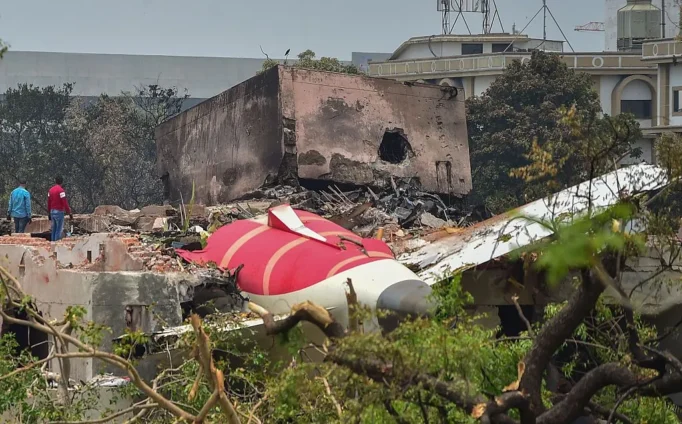
Air India Flight 171 was airborne for less than 40 seconds before crashing into a crowded neighbourhood in the western Indian city of Ahmedabad, marking one of India's most baffling aviation disasters.
Investigators are probing the wreckage and cockpit recorders to understand what went wrong just after takeoff. The Air India flight climbed to 625 feet in clear weather before losing location data 50 seconds in, per Flightradar24. Saturday's 15-page report offers early insights.
The investigation - led by Indian authorities with experts from Boeing, General Electric, Air India, Indian regulators, and participants from the US and UK - raises several questions.
Investigators say the lever-lock fuel switches are designed to prevent accidental activation - they must be pulled up to unlock before flipping, a safety feature dating back to the 1950s. Built to exacting standards, they're highly reliable. Protective guard brackets further shield them from accidental bumps.
"It would be almost impossible to pull both switches with a single movement of one hand, and this makes accidental deployment unlikely," a Canada-based air accidents investigator, who wanted to remain unnamed, told the BBC.
That's what makes the Air India case stand out.
Investigators have uncovered a chilling discovery in the preliminary investigation into the Air India Flight 171 crash which killed 260 people in June.
Just seconds after takeoff, both the 12-year-old Boeing 787 Dreamliner's fuel-control switches abruptly moved to the "cut-off" position, starving the engines of fuel and triggering total power loss. Switching to "cut-off" is a move typically done only after landing.
The cockpit voice recording captures one pilot asking the other why he "did the cut-off", to which the person replies that he didn't. The recording doesn't clarify who said what. At the time of takeoff, the co-pilot was flying the aircraft while the captain was monitoring.
The switches were returned to their normal inflight position, triggering automatic engine relight. At the time of the crash, one engine was regaining thrust while the other had relit but had not yet recovered power.
Air India Flight 171 was airborne for less than 40 seconds before crashing into a crowded neighbourhood in the western Indian city of Ahmedabad, marking one of India's most baffling aviation disasters.
Investigators are probing the wreckage and cockpit recorders to understand what went wrong just after takeoff. The Air India flight climbed to 625 feet in clear weather before losing location data 50 seconds in, per Flightradar24. Saturday's 15-page report offers early insights.
The investigation - led by Indian authorities with experts from Boeing, General Electric, Air India, Indian regulators, and participants from the US and UK - raises several questions.
Investigators say the lever-lock fuel switches are designed to prevent accidental activation - they must be pulled up to unlock before flipping, a safety feature dating back to the 1950s. Built to exacting standards, they're highly reliable. Protective guard brackets further shield them from accidental bumps.
"It would be almost impossible to pull both switches with a single movement of one hand, and this makes accidental deployment unlikely," a Canada-based air accidents investigator, who wanted to remain unnamed, told the BBC.
That's what makes the Air India case stand out.
Latest Stories
-
Nearly 400 sentenced in Nigeria for links to militant Islamists
3 minutes -
Ghana’s recovery supported by gold strength despite global oil price pressures – Standard Bank Research
10 minutes -
Kwaku Azar writes: A-G vs OSP
43 minutes -
Mfantsipim–Adisadel rivalry built excellence, not division – Sam Jonah
1 hour -
Vice President launches Mfantsipim’s 150 years of shaping Ghana’s greatest mind
1 hour -
I assure Otumfuo, Mahama will join him to commission KNUST Teaching Hospital by end of this year – Haruna Iddrisu
2 hours -
Barcelona dominate derby to extend La Liga lead
2 hours -
Gov’t to roll out free special education for persons with disabilities from July 1 – Education Minister
2 hours -
Importers and Exporters Association declares full support for Publican AI port system
3 hours -
“We used it to test our officiating officials’ readiness” – Bawah Fuseini after CAA Athletics event
3 hours -
Volleyball emerges as Ghana’s fastest rising sport
3 hours -
National Sports Fund needs strong leadership from the top – Administrator David Wuaku
3 hours -
JoySports Exclusive: Steve McLaren in talks with GFA after expressing interest in Black Stars job
3 hours -
Fire guts auto parts warehouse at Bubuashie, one fire officer injured
4 hours -
I owe my victory to coach Ofori Asare – Allotey after winning WBA Africa Gold Super Flyweight belt
4 hours