

Audio By Carbonatix
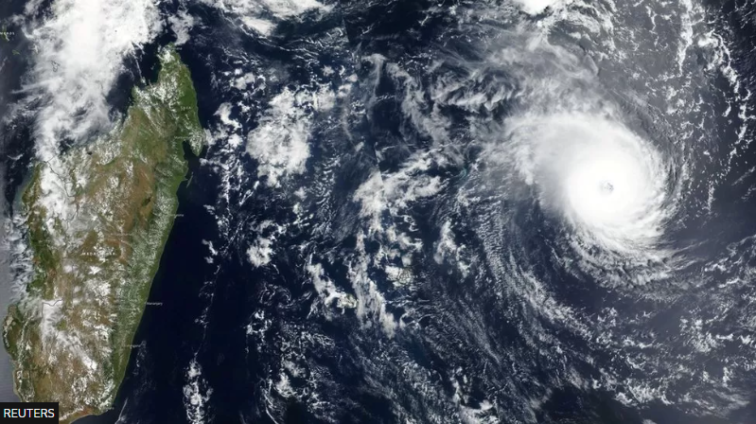
The World Meteorological Organization (WMO) will be setting up an expert committee to determine if tropical storm Freddy has broken the record for the longest-lasting tropical cyclone ever.
"The WMO Weather and Climate Extremes Archive is currently assembling a blue-ribbon international committee of scientists. Once the tropical cyclone has dissipated, these experts will begin a detailed examination of the raw data to determine if Freddy has indeed established a record as the longest-duration tropical cyclone on record.
"One question that we will be addressing is the fact that throughout its long lifetime, the storm has periodically weakened below tropical storm status. We will obviously need to address if that is a concern in our evaluation," said Prof. Randall Cerveny, WMO Weather and Climate Extremes rapporteur.
For 34 days, the cyclone was a named tropical cyclone, crossing the whole South Indian Ocean and covering more than 8,000 kilometers.
According to the WMO, the cumulative cyclone energy (index used to measure the energy released by a tropical cyclone) is equal to an average complete North Atlantic hurricane season.
“Freddy made landfall in northern Mozambique in the province of Zambezia on 11 March, according to the National Meteorological Hydrological Service (INAM). This is the second time Freddy has made landfall in Mozambique,” WMO has said.
The current record is held by Hurricane/Typhoon John, which lasted 31 days in 1994.
Large regions were affected by damaging winds, storm surges, and heavy rainfall, including Northeast Zimbabwe, Southeast Zambia, Malawi, and Mozambique.
Rainfall was forecast to reach 200 to 300 mm and as much as 400-500 mm over Mozambique's landing region and in mountainous areas, causing serious floods. This is more than double the average monthly rainfall in only a few days.
“Malawi may receive cumulative rainfall in the order of more than 300 to 400 mm in 48 hours, causing widespread flooding and flash flooding. Malawi’s Department of Climate Change and Meteorological Services advised people to move to higher ground, follow any evacuation orders and to avoid rivers. It warned of the risk of collapse of houses and pit latrines, and power lines,” the WMO indicated in a statement.
According to WMO experts, the continued downpour will worsen flooding caused by Freddy's initial passage as well as high seasonal rains, which means rivers are full and the ground is sodden.
Southern Mozambique has gotten more than a year's worth of rain in the last month, and Madagascar has received three times the monthly normal in a week.
The storm made landfall in Madagascar on 21 February, Southern Mozambique on 24 February, and tracked through Mozambique and Zimbabwe for many days, bringing torrential rainfall and floods.
According to the WMO, it then swung back into the Mozambique Channel, picking up energy from the warm waters and moving towards the southwestern coast of Madagascar, before returning to Mozambique.
Forecast and early warnings for all
With prior warnings of the storm, disaster management and humanitarian communities were able to organise ahead of time, including evacuations and pre-positioning of food supplies.
According to an OCHA report issued on March 6, four persons died in Madagascar as a result of the recent rains, increasing Freddy's death toll to at least 21 people (10 in Mozambique and 11 in Madagascar).
According to the Malawi Red Cross Society, 66 people perished in Malawi, 93 were wounded, and 16 were missing as of March 13th, despite a large search and rescue operation.
Mozambique's national disaster management agency, INGD, said 1.75 million people have been impacted, with over 8,000 people displaced.
According to Dr. Johan Stander, WMO Services Director, the death toll has been kept to a minimum thanks to accurate predictions and early warnings, as well as coordinated disaster risk reduction measures on the ground - yet even one victim is too many.
"Freddy is having a major socio-economic and humanitarian impact on affected communities," said Dr Stander.
According to him, the minimal fatality underscores the necessity of the UN Early Warnings for All projects in ensuring everyone's safety over the next five years.
"WMO is committed to working with our partners to achieve this and tackle extreme weather and climate change-related risks - one of the biggest challenges of our times," he said.
Latest Stories
-
He entered at eight. He is now 16: Ghana’s children growing up in prayer camps
1 hour -
‘Development must not always begin from Accra’ — Anwelle Foundation launched in Jirapa
1 hour -
PKO trio eye victories at Odwira Festival
4 hours -
346 Ghana Navy recruits pass out after 26 weeks of intensive training
4 hours -
Newsfile to discuss EOCO-MP arrest, drug trafficking, speech arrests and $235m water debt
4 hours -
JoyNews gets results as listeners raise GH¢40,000 to help 17-year-old student with cerebral palsy attend SHS
5 hours -
Vice President calls for stronger local pharmaceutical production to reduce medicine imports
5 hours -
The brewing tension at KNUST; Beware the Ides of October….
6 hours -
Health Ministry moves to integrate traditional medicine into mainstream healthcare
6 hours -
550 pupils in Kintampo South get educational lifeline as ‘Seeds of Hope’ reaches farming communities
6 hours -
Opoku Mensah urges Christian Council, House of Chiefs to speak up on democratic freedoms
7 hours -
Teacher unions’ strike: Minority demands immediate payment of teacher arrears, 20% deprived area allowance
7 hours -
The Accra-Kumasi Expressway: Building it right
7 hours -
Beyond gold exports: Building value and economic resilience from Ghana’s gold
7 hours -
2027 AFCONQ: Ghana under pressure as Gambia beat Somalia 2-1
7 hours