


Audio By Carbonatix
A US woman with a rare double uterus has given birth twice in two days - after a "one in a million" pregnancy and a total of 20 hours in labour.
Kelsey Hatcher, 32, delivered one daughter on Tuesday, and a second on Wednesday, at the University of Alabama at Birmingham (UAB) Hospital.
Announcing the arrival of her "miracle babies" on social media, Ms Hatcher hailed the medics as "incredible".

The girls are described as fraternal twins - with rare separate birthdays.
Hatcher said the family was now back at home and could "enjoy the holidays". She had previously expected a Christmas due date.
The mother was told at age 17 she had a double uterus (uterus didelphys) - which the UAB described as a rare congenital anomaly affecting 0.3% of women.
And the odds of becoming pregnant in both uteri - a dicavitary pregnancy - were even slimmer, at "one in a million", according to the UAB.
Reported cases worldwide are extremely rare. In 2019, a doctor in Bangladesh told the BBC a woman had given birth to twins almost a month after delivering a premature baby in her other uterus.
Ms Hatcher had three previous, healthy pregnancies. This time, she believed herself to be pregnant in only one uterus - until a routine ultrasound revealed there was also a baby in her second.
"I gasped... We just could not believe it," she recalled.
She went on to document her unusual journey on Instagram. One update at 38 weeks asked: "What the heck?! HOW have we made it this far?!"
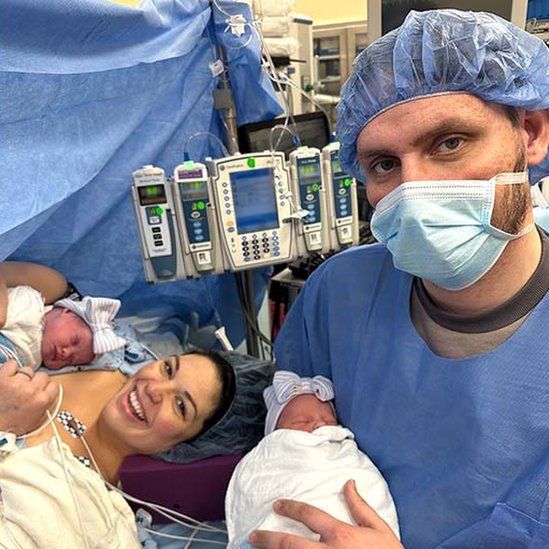
UNIVERSITY OF ALABAMA AT BIRMINGHAM
The UAB described her pregnancy as routine. Prof Richard Davis, who co-managed the delivery, pointed out that each baby had enjoyed "extra space to grow and develop".
This was because each baby had a womb to itself, he said - unlike in a typical twin pregnancy.
Ms Hatcher's labour was induced at 39 weeks and required double the monitoring and charting at the hospital - as well as double the staffing.
Her obstetrician described "a cheer from everyone in the room" when the first baby was delivered vaginally at about 19:45 local time on 19 December.
The second came by C-section more than 10 hours later, at about 06:10 the following morning.
Prof Davis said the girls could be called fraternal twins - a term used when each baby develops from a separate egg, each fertilised by a separate sperm.
"At the end of the day, it was two babies in one belly at the same time," he said. "They just had different apartments."
Latest Stories
-
BoG Governor says building buffers and lowering credit costs go together
14 minutes -
From May to December, nothing works – Tomato traders reveal harsh reality for farmers
34 minutes -
Ghanaian farmer can’t grow tomatoes because of lack of irrigation – Tomato Importers Association president
56 minutes -
Social media firms must better enforce Australia under-16 ban, watchdog says
1 hour -
King Charles should meet Epstein victims, US lawmaker says
1 hour -
Belgian ex-diplomat appeals order to stand trial in Congo’s Lumumba murder
2 hours -
Cholera aid for African countries stalled by Iran conflict
2 hours -
The Oscars are leaving Hollywood
2 hours -
Too watery, too risky – Why Ghanaian traders prefer Burkina tomatoes
2 hours -
We buy from Burkina because ours rot fast – Tomato traders defend import dependence
2 hours -
Nigeria’s giant oil refinery fails to prevent record gasoline prices
3 hours -
CAF to make changes to regulations after Afcon final fiasco
3 hours -
Council of State member demands EOCO boss apologise or face lawsuit, petitions Mahama for his dismissal
3 hours -
Otto Addo sacked!
4 hours -
‘We are tomato sufficient – Agribusiness chief pushes back on Burkina Faso export shock
5 hours