

Audio By Carbonatix
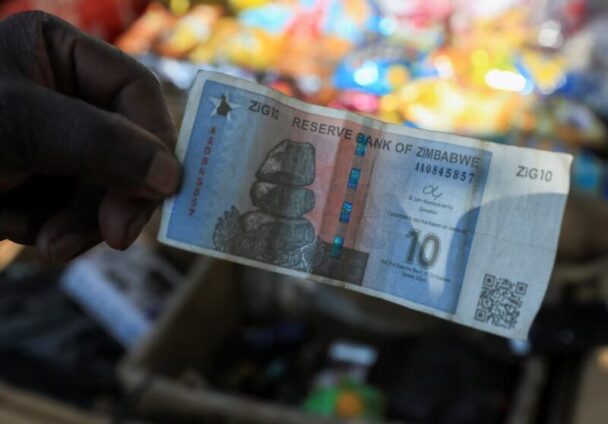
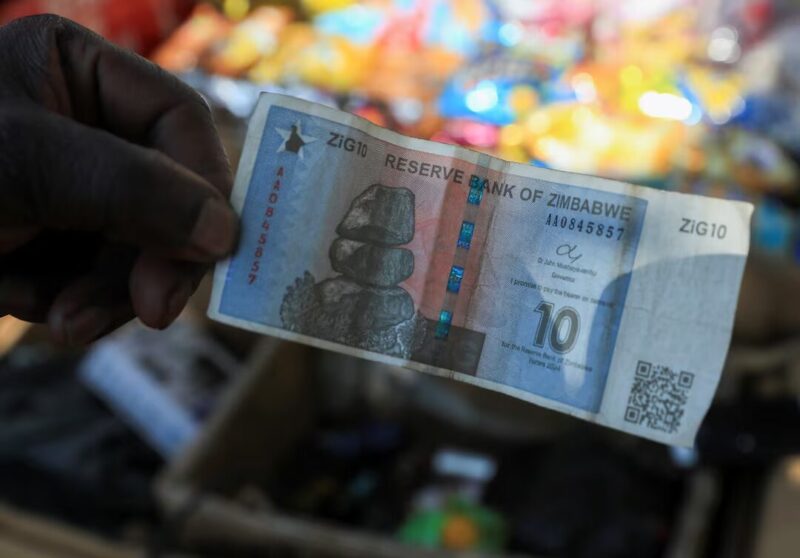
Five months after its launch, Zimbabwe's new currency is under pressure as increased grain imports eat away at foreign reserves, putting at risk the government's plan to make it the only currency in the market by 2026.
The gold-backed ZiG, which stands for Zimbabwe Gold, is the country's sixth attempt at a stable currency in 15 years. It was introduced in April at a rate of 13.6 ZiG per U.S. dollar and has since lost almost 80% of its value on the black market.
The country's central bank on Thursday said it had injected $64 million into the foreign exchange market this month to address dollar demand.
"Over the past weeks, the Reserve Bank witnessed a build-up in pipeline demand for foreign currency at banks, reflecting transitory foreign currency supply and demand mismatches, thus, exerting undue pressure on the foreign exchange market," central bank governor John Mushayavanhu said in a statement.
This was despite an injection of $50 million by the Reserve Bank in July, he said, adding that the bank would continue to intervene as needed to ensure the stability of the ZiG.
Independent economist Prosper Chitambara said the devaluation pointed to a lack of confidence in the new currency, which locals have been reluctant to embrace.
Persistence Gwanyanya, a member of the Reserve Bank of Zimbabwe's Monetary Policy Committee, told Reuters that although uptake had been slow, it was too soon to consider the new currency a failure.
Gwanyanya said the government could increase the use of the ZiG by charging more taxes in the local currency. "Government more than any other should show a preference for its own currency and there is a need for urgent intervention by injecting more foreign currency on the market," he said.
But market traders are not convinced.
"The ZiG has been getting weaker so it does not make business sense to transact with it. I do not have faith in the ZiG. We have been here before with the Zimdollar," Maynard Maketo, a street hawker selling candy and recharge cards said.
According to Pricecheck, a website that tracks the exchange rate, the ZiG is trading between 20 ZiG and 26 ZiG to $1 on the black market and 13.9 ZiG to $1 on the official exchange.
Carol Munjoma, a trader in downtown Harare who sells groceries, transacts exclusively in U.S dollars.
"Where I buy these groceries, they do not accept ZiG. So to protect my business I charge in U.S dollars. The ZiG would have to be stable to be accepted here," the mother of two said.
In July, central bank chief Mushayavanhu told Reuters that authorities would stick to promises to build trust in the new currency, a sentiment echoed by Gwanyanya.
"It is too early to consider that this may be the death of the ZiG," said Gwanyanya.
Latest Stories
-
Can prophecies go wrong?
6 minutes -
Farmers advised to document trees they plant for financial benefits
20 minutes -
Dozens of bodies, mostly infants, discovered in Kenya mass grave
22 minutes -
“Someone is not doing their job” – ACEPA slams Parliament scheduling as PAC hearing stalls
25 minutes -
Afenyo-Markin rejects ‘Akan party’ tag, warns against tribalism
28 minutes -
No FDA approval, no advert – Authority cautions media, manufacturers
31 minutes -
ACDI launched to bridge gap between research and policymaking across Africa
53 minutes -
TCC-CIMET to support the development of STEAM Clubs in the Oforikrom Municipality
59 minutes -
KAIPTC strengthens leadership in gender-responsive peacekeeping with new training initiative
59 minutes -
TCC-CIMET launches 2026 annual Innovation Challenge
1 hour -
PAC Chair accuses majority of abusing parliamentary trust over GH₵68bn audit probe stall
1 hour -
Ghana’s border crackdown and the Nigerian lesson: protection is easy, competitiveness is not
1 hour -
KAIPTC reiterates commitment to gender-sensitive peace operations
1 hour -
UN approves Ghana-led resolution declaring slavery a crime against humanity, demands reparations
1 hour -
PAC probe of GH₵68bn audit rescheduled to Monday – Abena Osei-Asare
2 hours