

Audio By Carbonatix
Government has justified the non-completion of some infrastructure projects under the Sinohydro deal with China.
According to government, the phased plan along which the projects are supposed to commence is the reason for the seeming slowdown in activity as far as the project is concerned.
The Office of the Vice President says so far, "they have done over $100 million worth of work from 2019."
"The commencement was in 2019, but other batches were in 2020. So they are all at different stages of completion. The $100 million you're talking about, they are just one and half years into construction," the Director of Special Projects and Investor Relations at the Vice President's office said on Joy FM.
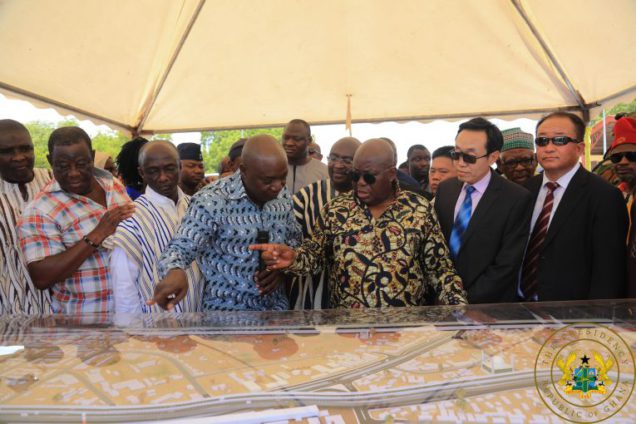
In May 2018, government signed a Master Project Support Agreement with Sinohydro for the construction of key infrastructure in exchange for the proceeds of Ghana's refined bauxite.
The $2 billion deal included the Adenta-Dodowa road was one of ten lots approved under the Chinese-sponsored arrangement and scheduled to begin in 2019.
A report by JoyNews' Evans Mensah revealed that two years on, the road remains undone, in a complete state of disrepair, with traffic congestion worsening by the day.
Per JoyNews checks, the Adenta situation is similar to many other projects earmarked for execution under the deal.
But the Director of Special Projects at the Office of the Vice President says there is no cause for worry.
Speaking on the Joy FM Super Morning Show, Dr Muntaka Alolo reiterated that the projects have been scheduled to be completed in phases.
"The rest will start by end of this year or early next year. Even the ones that have all started didn't all start at the same time," he said.
Some of the projects, according to Dr Alolo, have been completed and are being used. Others are at various stages of completion.
"Even the 10 lots that we took to Parliament, they are being done in phases," he added on Monday.
He also indicated that the projects that have already commenced, including the Tamale Interchange, are far advanced.
In November 2018, the government announced that the first tranche of $649 million from the $2 billion facility has been made available for Ghana to access.
However, three years later, only about $100 million of this amount has been released to Ghana.
Latest Stories
-
Ghana to host high-level conference on scaling education initiatives in emergencies
15 minutes -
Democracy must not be for sale: Who pays for Ghana’s politics, and how do we confront money, influence and accountability?
30 minutes -
Aburi Amanfrom landowners appeal for government support for Atwapim development project
34 minutes -
Cargill Ghana and International Cocoa Initiative celebrate 111 young graduates building skills for the future
56 minutes -
Video: Madina MP Francis-Xavier Sosu collapses while addressing students at GIMPA
58 minutes -
Hunnyboy reveals how social media landed him Shatta Wale feature
1 hour -
I am a perfectionist – Actor William Lamptey
1 hour -
No room for another false start as Ghana begin AFCON qualifying campaign
1 hour -
“We are grateful for what you have achieved” – AGI President tells Finance Minister
2 hours -
“No Nation is Inferior”: Mahama champions human dignity and security council reform at the UN
2 hours -
Manhyia South residents, NPP executives fume over botched EOCO arrest of MP
2 hours -
Mahama unveils new deal with global philanthropy
2 hours -
Daily Insight for CEOs: Building customer-centric leadership
2 hours -
Democracy must deliver food, jobs and healthcare, not just elections – Mahama
2 hours -
Capacity constraints must never be a barrier to restitution – Mahama
2 hours