

Audio By Carbonatix
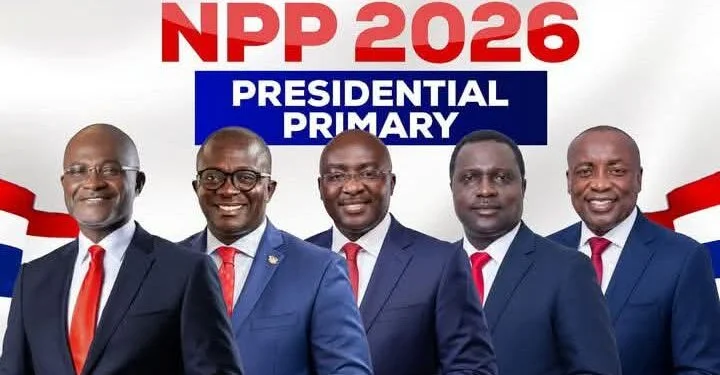
The opposition New Patriotic Party (NPP) has officially hit the reset button on its political fortunes, successfully conducting an early presidential primary on Saturday, January 31, 2026.
In a strategic masterstroke designed to provide the party with a nearly three-year runway to the next general election, the elephant party has settled on its leadership far earlier than the traditional electoral cycle.

The party hopes to capitalise on the report, which diagnosed their heavy loss to the NDC in 2024, quickly reorganise its grassroots and charge towards the next general polls.
Drawing participation from an unprecedented pool of over 211,000 delegates nationwide, the exercise concluded with a resounding mandate for former Vice President Dr Mahamudu Bawumia, who secured a landslide victory to lead the party’s charge to recapture power from the governing NDC in 2028.

The delegates have spoken and chosen to stick with the same face for a second shot at the Jubilee House for the former Deputy Governor of the Bank of Ghana and right-hand man of former President Akufo-Addo.
READ ALSO: A history of NPP flagbearer contests from 1992 to the January 31 primary
Beyond the cheers and the final tally, the primary offered a clinical look at the evolving DNA of Ghanaian politics.
Here are six defining observations from the January 31 polls:
1. Strong delegate turnout despite internal tensions
Despite a high-profile legal challenge looming in the Supreme Court (Suit No. J1/5/2020)—led by party stalwarts Prof. Kwabena Frimpong-Boateng and Dr. Nyaho Nyaho-Tamakloe—the delegates showed up in force.
The suit argues that the current "restricted" delegate system is unconstitutional and seeks to expand the voter base to all members in good standing.

The Supreme Court is yet to determine the case that could affect all political parties in the future.
However, the numbers on the ground told a story of unwavering commitment.
According to certified figures, the primary recorded a 93% turnout.
The ‘Big Four’ regions—Greater Accra, Ashanti, Eastern, and Central—which constitute the party’s electoral backbone, saw a huge participation.

This suggests that while some founding fathers may debate the law and champion reforms within the party, the members remain firmly invested in the current party machinery.
2. Statistical data reigns
The 2026 primary marked the demise of traditional, noisy campaigning and the emergence of high-precision analytics.
Before D-Day, polling and voter analytics allowed candidates, especially the eventual winner, Dr. Mahamudu Bawumia, to optimise their resource allocation and messaging.
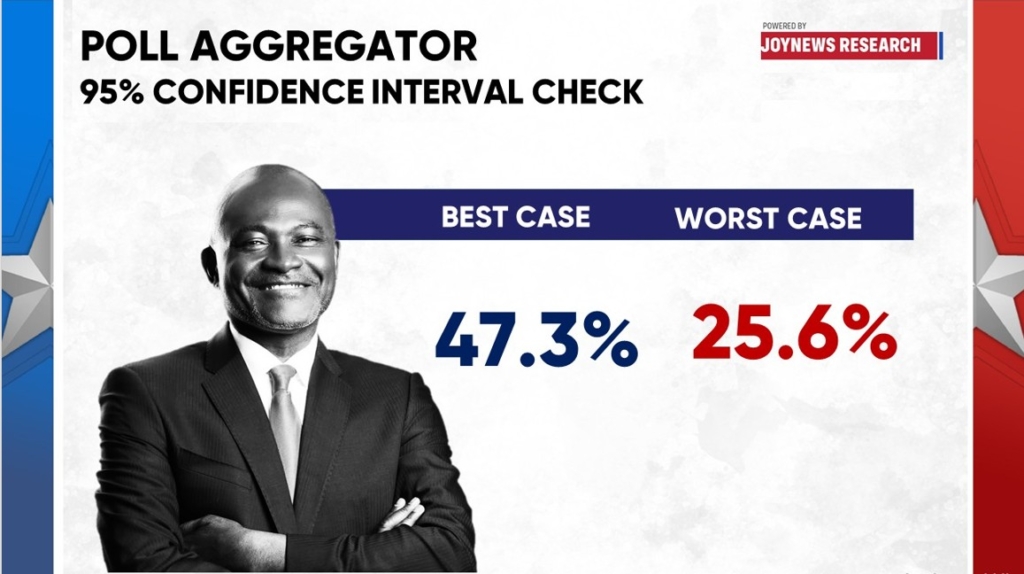
As many as nine polls were released by different institutions, including Global Info Analytics, with the majority pointing to a Bawumia win.
Five surveys were in favour of Dr Bawumia and four for Kennedy Ohene Agyapong.
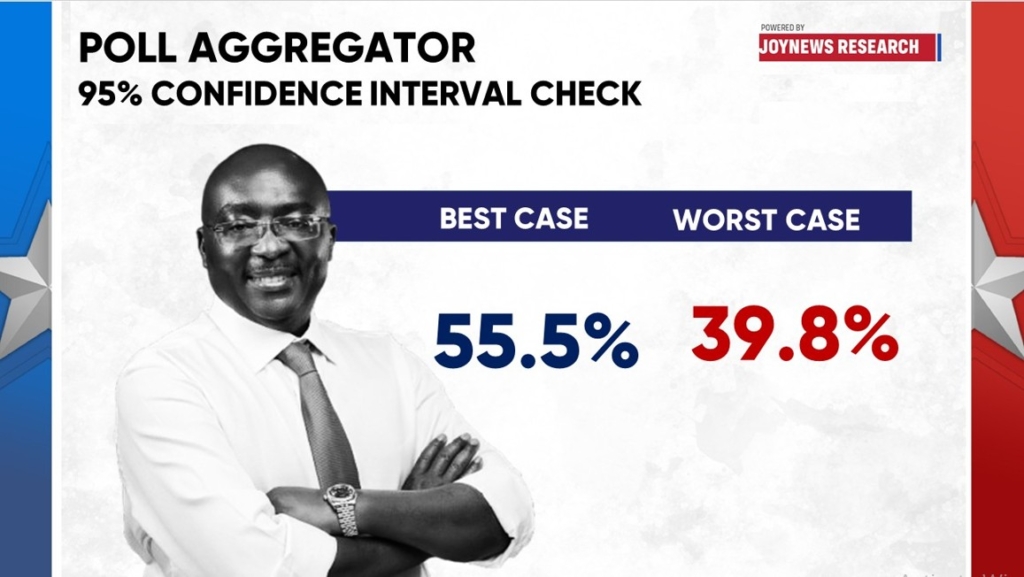
Many Ghanaians see Global Info Analytics as a leading pollster due to the accuracy of previous projections, including the 2024 general election case.
In the final week, JoyNews Research aggregated nine major polls (including that of Global InfoAnalytics, which consistently placed Bawumia in the lead throughout late 2025).
Statistical modelling replaced guesswork.
| Metric | Statistical Projection | Actual Certified Result |
| Dr Bawumia (Best Case) | 55.5% (Projected) | 56.48% |
| Kennedy Agyapong (Worst Case) | 25.6% (Projected) | 23.75% |
| Confidence Level | 95% | N/A |
| Undecided Swing | ~16,000 Delegates | Correctly Absorbed |
The final results fell within a razor-thin ±2% margin of error of the JoyNews aggregate, proving that statistical modelling has become the most lethal weapon in the NPP's arsenal.
3. Power of regional voting blocs reaffirmed
The primary reaffirmed that the road to the flagbearership runs through the Ashanti and Greater Accra regions, which together control over one-third of the total delegates.
Candidates who invested heavily in constituency-level engagement in these regions appeared to benefit significantly, reinforcing the long-held view that success in NPP primaries requires both national reach and deep roots in the party’s traditional strongholds.
A key revelation was Dr. Bawumia’s trans-regional dominance, as he swept the Greater Accra, Ashanti and Eastern regions.
He did not just win; he invaded his opponents' home turfs.
He secured massive margins in the Eastern Region (the home of third-placed Dr. Bryan Acheampong) and neutralised Kennedy Ohene Agyapong in the Central Region, where Agyapong won by only a paltry difference.
This shows Dr Bawumia’s multi-appeal beyond regional blocs and ethnic caucuses.
4. Party structures proved effective in managing a large‑scale vote
Unlike previous flagbearer election exercises marked by allegations of manipulation, logistical chaos, and bickering, the 2026 exercise was a display of order.

From accreditation, counting, collation, declaration and eventual acclamation of Dr Bawumia, the primary was largely conducted in an orderly and transparent manner, despite the sheer size of the electorate that had ballooned from just about 2000 in 1992 to more than 211,000.
The deployment of EC-trained officers and clear rules of engagement by the NPP election management committee prevented the widespread disputes that characterised previous exercises.
Early deployment of police personnel helped minimise confusion and prevent major disruptions.
While isolated challenges were reported in a few centres, they did not materially affect the credibility of the process, leading to wide acceptance of the results.
This signifies a clear improvement from the previous exercise, where aggrieved candidates expressed outrage over alleged infractions and manipulations.
The success is crucial for the party's image, signalling to the national electorate that the NPP is a disciplined organisation capable of managing national systems.
5. Reduced role of vigilantes, machomen and private security
One of the most refreshing observations across the polling centres was the near-total disappearance of vigilante groups, machomen, and unauthorised people serving as private security.
In previous elections, these elements were a common sight, often leading to intimidation, violence and bloody clashes with weapons such as guns, knives and machetes.

A firm directive from the National Executive Committee (NEC), backed by a professional Ghana Police Service deployment, ensured that not a single gunshot was fired.
The lack of vandalism and injuries marks a significant cultural shift, as the party moves to align with the Anti-Vigilantism Act.
Maintenance of law and order was largely apt with maximum professionalism by the police.
6. The ghost of 2024 and post-primary reconciliation
Reconciliation is not optional; it is survival. While the victory was a landslide, the campaign revealed deep-seated factional lines.
This points to the urgent need for post-primary reconciliation, particularly in areas where margins were tight or where local party leaders openly backed rival candidates.
History shows a clear correlation:
- Decisive victories + internal unity = national success
- Close calls + internal grudges = voter apathy and defeat (as seen in the heavy losses of 2024)
Every concession speech on Saturday night—from Kennedy Agyapong to Dr. Adutwum—carried the same theme about closing ranks being the only way back to the Jubilee House in 2028.
After the unprecedented defeat of 2024, the NPP appears to have learnt that internal grievances are the NDC's greatest campaign tool.
Final notes
has cautioned that internal divisions continue to pose the greatest threat to the New Patriotic Party’s (NPP) electoral fortunes, describing disunity as the party’s enduring “slow poison”.
The January 31 primary has provided the NPP with a head start, a popular leader, and a data-driven blueprint.
The outcome has reinforced the NPP’s reputation for internal democracy while also pointing to the practical challenges that lie ahead as the party transitions from internal competition to national campaigning.
Latest Stories
-
Gender Ministry mourns victims of Volta Lake boat tragedy, deploys support for affected families
2 minutes -
MPs undergo training on human trafficking and gender dimensions
3 minutes -
Don’t expect instant relief – COMAC CEO warns fuel price drops will be gradual
5 minutes -
GIS to unveil comprehensive plans to enhance officers’ welfare and infrastructure
23 minutes -
Right move, wrong timing? – COMAC CEO questions govt’s delay on fuel price relief
24 minutes -
IMF urges Central Banks to keep inflation in check
47 minutes -
NRSA stands firm on Toyota Voxy ban despite transport operators’ opposition
49 minutes -
H. Kwasi Prempeh raises concerns over Supreme Court’s handling of OSP constitutionality case
57 minutes -
Global childhood cancer cases soar
57 minutes -
Airline pilots fear retribution over refusing to fly in Middle East, aviators’ group says
58 minutes -
Police intensify security in Bosomtwe communities after deadly clash
1 hour -
Corporate Income Tax contributes highest to 2025 petroleum revenue
1 hour -
Ghana less exposed to global oil disruptions — Fitch
1 hour -
Property rates: Stakeholders advocate digitisation, transparency, …
1 hour -
Police officer killed in road crash at Atortorkorpe in Ada
1 hour