


Audio By Carbonatix
The last eight years have been the warmest years on record globally, according to data from the Copernicus Climate Change Service (C3S), which is run by the European Centre for Medium-Range Weather Forecasts (ECMWF).
The temperatures, greenhouse gas concentrations, and significant climate and weather events from the previous year are highlighted in the 2022 Global Climate Summary.
The executive summary reveals that several high-temperature records were broken in Europe and around the world, and other extreme events, like drought and flooding, had a significant regional impact.
The data also showed that Europe experienced its hottest summer on record and that several long-lasting, severe heatwaves hit parts of western and northern Europe.
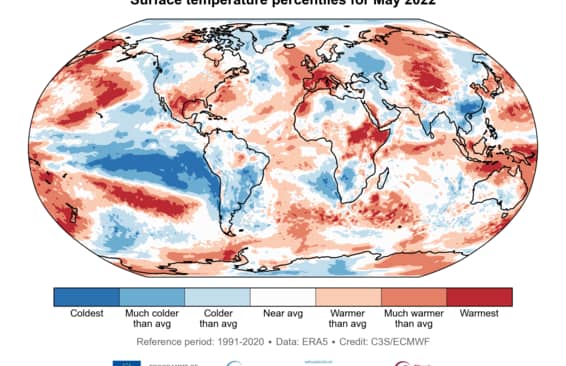
The European continent has experienced the highest rate of increase of any continent in the world over the past 30 years, according to C3S, which emphasises that ERA5 agrees with other widely used temperature datasets that show European temperatures have increased by more than twice the global average.
According to the C3S ERA5 dataset, 2022 was by a small margin the fifth warmest year on record for the entire planet.
S3C predicts that other widely used temperature datasets will likely rank 2022 slightly differently. The hottest years so far on record have been 2016, 2020, 2019, and 2017, respectively.
"The last eight years were the warmest eight on record. 2022 is one of the five coolest years of the last eight; data uncertainties prevent a reliable ranking of these five years. Average temperatures reached 3°C above average over north-western Siberia," the published data said.
South-western Europe and the Antarctic Peninsula had temperatures that were 2°C or higher above average, among other places with pronounced above-average temperatures.
Most of the tropical eastern Pacific experienced below-average temperatures, which is a sign that La Nia conditions are still present.
In 2022, eastern Australia will experience high rainfall and relatively low temperatures—features that are frequently associated with La Nia events.
As determined by satellites, the annual average global concentrations of CO2 (Carbon dioxide) and CH4 (methane) were higher than in the previous year and continue to rise.
Average annual CO2 levels were 417 ppm while CH4 levels were 1894 ppb. These are the highest satellite measurements ever made, the publication says.
"Based on additional data sources, it is also the highest in hundreds of thousands to millions of years. During the year, CO2 concentrations increased by 2.1 ppm and CH4 concentrations by close to 12 ppb.
For CO2, this increase was on par with that of the previous few years; for CH4, however, it was not as high as the record levels observed for 2020 and 2021.
A consolidated ranking based on all the significant international datasets will be released later, according to the World Meteorological Organisation (WMO).
Latest Stories
-
Counting calories doesn’t work. Try eating smarter instead
28 seconds -
Name and sanction galamsey offenders — GCAG urges Mahama to act against DCEs
3 minutes -
NACOC takes custody of 37 sacks of suspected cannabis seized by Ghana Navy
8 minutes -
Tomato prices soar as traders push for urgent boost in local production
10 minutes -
We must preserve Aŋlɔ, our history and our future — V. L. K. Djokoto
13 minutes -
University of Bayreuth marks 100 years of Black History Month with exhibition, dialogue
14 minutes -
Ethiopia launches 10-year golden visa for foreign investors
31 minutes -
Today’s front pages: Monday, March 30, 2026
38 minutes -
Evelyn Nsiah Asare: From breaking barriers in sports to doctoral excellence in logistics
44 minutes -
Cocoa Marketing Company MD engages WAMCO ahead of 50% local cocoa processing reform
60 minutes -
Students raise concerns over accommodation and road safety at UniMAC Dzorwulu
1 hour -
Paul Afoko interacts with other NPP aspirants and party executives in Jamasi
1 hour -
60 outstanding students from 14 Fanteakwa South schools receive awards inspired by Assor Foundation
1 hour -
Ghana shines at WTO MC14, secures gains for food security, industry and trade
2 hours -
Ghana, Japan, UNICEF launch US$2.3m partnership to tackle child labour
2 hours