

Audio By Carbonatix
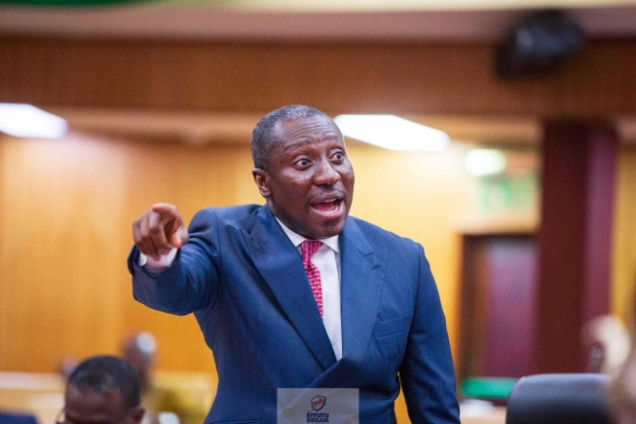
The Minority Leader in Parliament, Alexander Afenyo-Markin, has urged the government to position itself as an enabler rather than a controller of economic activity.
That, he said, was because sustainable growth was driven by private enterprises and human capital development supported by policy that translated into measurable socioeconomic outcomes instead of political rhetoric.
“The state creates conditions for production while individuals and firms generate value,” he said, grounding his argument on the ideological foundations of the centre-right tradition.
Mr Afenyo-Markin, who is the Member of Parliament (MP) for Effutu, was speaking at the launch of the University of Cape Coast (UCC) chapter of the Young Commons Forum (YCF) last Saturday.
The YCF, with a seven-member executive led by John Noble, is a platform for the youth to engage in discussions on leadership, governance, and democracy.
It also aims at inspiring young students to unearth their potential, embrace innovation in their aspirations, and make meaningful contributions to their communities.
Ideology
The Minority Leader traced the evolution of the country’s centre-right tradition from early nationalist formations such as the United Gold Coast Convention to its modern institutional expression through the New Patriotic Party (NPP).
He explained that the ideology was anchored in constitutionalism, property ownership, decentralisation, and market-led development.
According to him, successive political movements had built upon these foundations to shape democratic governance in the country, and argued that the tradition was not static but adaptive, reflecting changing developmental realities while preserving core principles.
Drawing on policy debates in historical continuity, he maintained that understanding ideology was essential to assessing governance performance and ensuring accountability within Ghana’s constitutional democracy.
“Today, the government has rather created a bureaucracy for its so-called 24-Hour Economy policy, and to our mind, this 24-Hour Economy is more of a slogan than a policy,” Mr Afenyo-Markin said.
He said that since coming into power over the past year, Ghanaians had seen a government that believed in rhetoric and that talked more than it worked.
Mr Afenyo-Markin said the government promised the people of Ghana “one job, three shifts” under the 24-Hour Economy policy, promised a Women’s Bank, and promised to increase the producer price of cocoa to GH¢6,000 per tonne.
“Today, unemployment is on the rise, and this government has failed to implement its own flagship initiative—the One Job, Three Shifts,” he said.
“The Women’s Bank has also not seen the light of day. While the government talks about inflation levels having come down, the ordinary Ghanaian is going through a crisis,” he said.
Centre-right policies
Mr Afenyo-Markin enumerated major policy interventions under previous NPP administrations as practical expressions of the centre-right model.
He cited programmes such as the National Health Insurance Scheme (NHIS), free basic education initiatives, Free Senior High School, Free TVET, the 1D1F industrial policy, Planting for Food and Jobs (PFJ), and pension reforms as evidence of ideological continuity.
“These interventions reflected a centre-right logic in the most constructive sense, because they lifted children from disadvantaged backgrounds into the human capital pipeline necessary for elite participation in economic and civil life by keeping children in school, improving nutrition, and reducing household cost burdens,” he stated.
Property-owning democracy
The Effutu lawmaker defended the concept of property-owning democracy as a development strategy that balanced economic freedom with targeted social support.
He stated that the government should create enabling conditions for entrepreneurship, industrial growth, and innovation while providing safety nets for vulnerable citizens.
Social interventions, Mr Afenyo-Markin argued, must be understood as investments in human capability rather than welfare dependency.
The Minority Leader rejected claims that such policies contradicted centre-right ideology, insisting that they strengthen participation in productive economic life.
According to him, effective governance required policy coherence, macroeconomic stability, and regulatory frameworks that encouraged investment and long-term national development.
Mr Afenyo-Markin raised concerns over rising unemployment, inflationary pressures, electricity tariff increases, and fiscal measures introduced in place of earlier tax commitments.
He also questioned progress on flagship proposals and called for measurable delivery rather than public relations campaigns.
While acknowledging the challenges of governance, Mr Afenyo-Markin urged the current administration to focus on practical solutions that would improve livelihoods.
The Effutu MP said although the National Democratic Congress (NDC) government repealed the Electronic Transfer Levy once it assumed power, the government later ended up introducing a law that charged one cedi per litre of petrol, “introduced a doomsday levy," and increased electricity by almost 30 percent.
“Above all, today, the suffering cocoa farmer is at the receiving end,” he said.
He drew a stark contrast between the social interventions introduced by the governments of the NPP and the NDC.
Contrasts
Focusing his attention on the Young Commons Forum, Mr Afenyo-Markin urged the executives not to allow ethnic and religious differences to put them and others apart.
He advised them to take a cue from the NPP flagbearer, Dr Mahamudu Bawumia, saying the former vice-president never allowed ethnicity and religion to drive division among the rank and file of the party.
The Chair of the forum, Mr Noble, called for the implementation of policies and strategies that facilitate the translation of vision into action to ensure sustainable growth.
At the end of the ceremony, the UCC Students’ Representative Council, led by Kwame Ntiamoah Ntim, presented a citation to Mr Afenyo-Markin for his sustained contribution and service to national development and his alma mater.
Latest Stories
-
Nigeria’s Ben Dancer completes 168-hour dance marathon, awaits Guinness verdict
26 minutes -
I’m now a minister of God – Actress Jumoke Odetola announces
35 minutes -
Banks accounted for 86% total enquiries for credit in 2025
37 minutes -
‘I paused for my mom’ – Kizz Daniel opens up on music break
40 minutes -
Habib Iddrisu rejects argument that court cases bar Parliament from investigating drug scandal
48 minutes -
Over 25m enquiries conducted by financial institutions for credit appraisals, others in 2025
53 minutes -
Venezuelan man shot by ICE in Texas is charged with assault
1 hour -
Eiffel Tower chief to quit after female staff replaced by men during religious visit
1 hour -
South Africa to clean up high-risk areas after 12 women killed
1 hour -
Kpandai case sets the precedent – Habib Iddrisu challenges Speaker’s rejection of drug probe
2 hours -
Habib Iddrisu questions Speaker Bagbin’s rejection of motion after Parliament recall
2 hours -
More than 400 detained as France student protests escalate
2 hours -
China adds 55% tariff to Brazil beef imports
3 hours -
Ballon d’Or Power Rankings: Lamine Yamal leads race for Golden Ball ahead of Rodri and Kane
3 hours -
‘Nothing worked for us’ – Gideon Mensah takes responsibility for Gambia defeat
3 hours