


Audio By Carbonatix
Robert Mugabe, Zimbabwe's first post-independence leader, has died aged 95.
His family confirmed his death to the BBC. Mr Mugabe had been receiving treatment in a hospital in Singapore since April.
Mr Mugabe was ousted in a military coup in 2017 after 37 years in power.
Mr Mugabe's early years were praised for broadening access to health and education for the black majority - but his later years were marked by rights abuses and corruption.
He won Zimbabwe's first election after it secured independence from the UK, becoming prime minister in 1980.
He abolished the office in 1987, becoming president instead.
His successor, Zimbabwean President Emmerson Mnangagwa, expressed his "utmost sadness", calling Mr Mugabe "an icon of liberation".
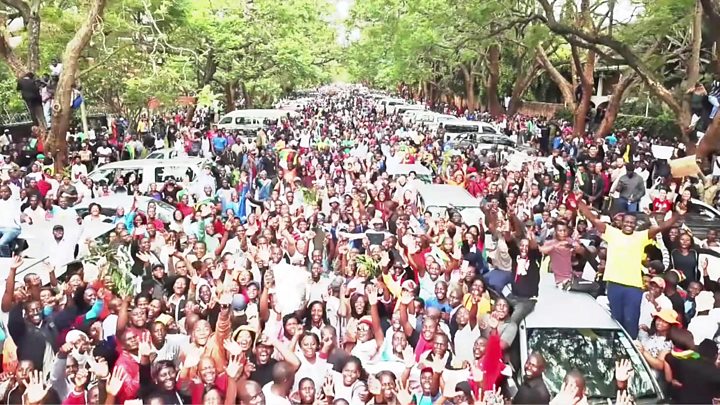 Mr Mugabe, with his high profile in the independence movement, secured an overwhelming victory in the republic's first election.
But over his decades in power that followed, the international perception of Mr Mugabe soured, with an increasing number of critics portraying him as a kind of dictator.
In 2000, facing serious political opposition for the first time, he seized white-owned farms to resettle black farmers on - causing economic disruption but boosting his popularity among his supporters.
Around the same time, pro-Mugabe militias used violence to influence political outcomes. In 2008, when he lost the first round of the presidential election, attacks on the opposition resulted in his rival pulling out of the contest.
He was forced to concede to power-sharing in 2009 amid economic collapse, installing rival Morgan Tsvangirai as prime minister.
But in 2017, amid concerns that he was grooming his wife Grace as his successor, the army - his long-time allies - turned against the president and forced him to step down.
Mr Mugabe, with his high profile in the independence movement, secured an overwhelming victory in the republic's first election.
But over his decades in power that followed, the international perception of Mr Mugabe soured, with an increasing number of critics portraying him as a kind of dictator.
In 2000, facing serious political opposition for the first time, he seized white-owned farms to resettle black farmers on - causing economic disruption but boosting his popularity among his supporters.
Around the same time, pro-Mugabe militias used violence to influence political outcomes. In 2008, when he lost the first round of the presidential election, attacks on the opposition resulted in his rival pulling out of the contest.
He was forced to concede to power-sharing in 2009 amid economic collapse, installing rival Morgan Tsvangirai as prime minister.
But in 2017, amid concerns that he was grooming his wife Grace as his successor, the army - his long-time allies - turned against the president and forced him to step down.
Mr Mnangagwa had been Mr Mugabe's deputy before replacing him.It is with the utmost sadness that I announce the passing on of Zimbabwe's founding father and former President, Cde Robert Mugabe (1/2)
— President of Zimbabwe (@edmnangagwa) September 6, 2019
Liberation 'icon'
Mr Mugabe was born on 21 February 1924 in what was then Rhodesia. The country, once a British colony in Africa, was run by a white minority. He was imprisoned for more than a decade without trial after criticising the government of Rhodesia in 1964. In 1973, while still in prison, he was chosen as president of the Zimbabwe African National Union (Zanu), of which he was a founding member. Once released, he headed to Mozambique, directing guerrilla raids into Rhodesia. But he was also seen as a skilled negotiator. Political agreements to end the crisis resulted in the new independent Republic of Zimbabwe.
Mr Mugabe, with his high profile in the independence movement, secured an overwhelming victory in the republic's first election.
But over his decades in power that followed, the international perception of Mr Mugabe soured, with an increasing number of critics portraying him as a kind of dictator.
In 2000, facing serious political opposition for the first time, he seized white-owned farms to resettle black farmers on - causing economic disruption but boosting his popularity among his supporters.
Around the same time, pro-Mugabe militias used violence to influence political outcomes. In 2008, when he lost the first round of the presidential election, attacks on the opposition resulted in his rival pulling out of the contest.
He was forced to concede to power-sharing in 2009 amid economic collapse, installing rival Morgan Tsvangirai as prime minister.
But in 2017, amid concerns that he was grooming his wife Grace as his successor, the army - his long-time allies - turned against the president and forced him to step down.
What has the reaction been?
Deputy Information Minister Energy Mutodi, of Mr Mugabe's Zanu-PF party, told the BBC it was "very much saddened" by the former leader's death. "As a government, we are very much with the family members of the Mugabe family," he said. "He was a principled man, he could not change easily over his beliefs, he's a man who believed himself, he's a man who believed in what he did and he is a man who was very assertive in whatever he said." "This was a good man."DISCLAIMER: The Views, Comments, Opinions, Contributions and Statements made by Readers and Contributors on this platform do not necessarily represent the views or policy of Multimedia Group Limited.
Tags:
DISCLAIMER: The Views, Comments, Opinions, Contributions and Statements made by Readers and Contributors on this platform do not necessarily represent the views or policy of Multimedia Group Limited.
Latest Stories
-
$30m China grant insufficient for Damongo university project – Haruna Iddrisu
5 minutes -
Food vendor recounts how she narrowly escaped New Winneba attack
9 minutes -
Military to secure James Town after massive waste evacuation – Ayariga
10 minutes -
Charlie Kirk murder suspect pleads not guilty as judge clears way for death penalty trial
13 minutes -
Signals Bureau case: ‘We were battle-ready’ – Atta Akyea fires at AG over absence of prosecution team
21 minutes -
NSA sets September 4 deadline for final rectification of biodata mismatches
24 minutes -
Gospel musician Bernice Offei reported missing
29 minutes -
IMF, former gold buyers uncomfortable with Ghana’s gold policy – Asiedu Nketia
31 minutes -
18 years, 66 plays Ebo Whyte has one more story to tell: “Honey trap”
32 minutes -
PHOTOS: McDan and Ayuda claim singles titles in 2026 JoySports Invitational
33 minutes -
IEA describes gov’t proposals on women, marginalised groups in Parliament ‘grossly insufficient’
34 minutes -
Ghana marks 2026 Children’s Day with call to amplify voices against abuse
34 minutes -
TEIN UK–Ireland engages Ghana High Commission on support for students, professionals
35 minutes -
Fire destroys five commercial containers at Kotobabi Down near Antrack Filling Station
38 minutes -
NCD Alliance Ghana urges government to accelerate action on NCDs and mental health
39 minutes