


Audio By Carbonatix
Smoke from the massive bushfires in Australia will soon circle the Earth back to the nation, says Nasa.
Massive infernos have raged along the nation's east coast for months, pushing smoke across the Pacific.
Nasa said plumes from blazes around New Year's Day had crossed South America, turning skies there hazy, and moved "halfway around Earth" by 8 January.
"The smoke is expected to make at least one full circuit around the globe," the US space agency said.
Hundreds of bushfires have burnt across Australia, killing at least 28 people and destroying more than 2,000 homes.
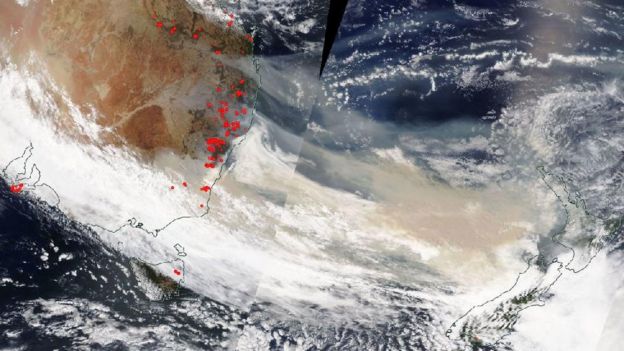 A satellite image showing smoke travelling towards New Zealand on 5 January
The agency said it was studying the effects of smoke at this altitude and whether it provided "a net atmospheric cooling or warming".
A satellite image showing smoke travelling towards New Zealand on 5 January
The agency said it was studying the effects of smoke at this altitude and whether it provided "a net atmospheric cooling or warming".
Bushfire smoke as seen near the International Space Station The unprecedented scale and intensity of the fires has been exacerbated by climate change, experts say.A fleet of NASA satellites ðŸ›°ï¸ working together has been analyzing the aerosols and smoke from the massive fires burning in Australia.https://t.co/93geNvCBnU pic.twitter.com/ZedZ199lvJ
— NASA Goddard (@NASAGoddard) January 9, 2020
How has the smoke travelled around the world?
Nasa said recent blazes had been so big they had produced an "unusually large" number of pyrocumulonimbus events - or fire-generated thunderstorms. These had sent smoke soaring into the stratosphere, with some recorded as high as 17.7km (11 miles). "Once in the stratosphere, the smoke can travel thousands of miles from its source, affecting atmospheric conditions globally," Nasa said.
A satellite image showing smoke travelling towards New Zealand on 5 January
The agency said it was studying the effects of smoke at this altitude and whether it provided "a net atmospheric cooling or warming".
What has been the smoke's impact closer to ground?
Nasa noted the smoke had changed the colour of skies in South America, and dramatically affected New Zealand, where it was "causing severe air quality issues" and "visibly darkening mountaintop snow". Large Australian cities including Sydney, Melbourne, Canberra, and Adelaide have also endured dangerous air quality levels due to smoke from nearby bushfires. On Tuesday, Melbourne residents were enduring a second consecutive day of "hazardous" air quality, prompting concerns about public health. More than 100 fires continue to burn in the nation's east, however cooler conditions in recent days and forecast rain have aided firefighting efforts.DISCLAIMER: The Views, Comments, Opinions, Contributions and Statements made by Readers and Contributors on this platform do not necessarily represent the views or policy of Multimedia Group Limited.
Tags:
DISCLAIMER: The Views, Comments, Opinions, Contributions and Statements made by Readers and Contributors on this platform do not necessarily represent the views or policy of Multimedia Group Limited.
Latest Stories
-
Only 30% of Ghanaian teachers satisfied with their jobs – CAPCOE data reveals
5 minutes -
Communities affected by construction of Akosombo Dam urge government to speed up compensation process
26 minutes -
World Cup visa scandal: Sports Ministry not shielding anyone – Sports Minister’s special aide
47 minutes -
World Cup visa scandal: Over 30 people misrepresented as GTA board members to US Embassy – Vincent Assafuah alleges
49 minutes -
Fire destroys wooden structure near Yesu Mo Villa at Bush Road
50 minutes -
NDC threatens sanctions over oversized campaign posters, gives aspirants 5 days to comply
2 hours -
Star Oil paid GH¢2.7bn in taxes, levies in nine months of 2026
2 hours -
Samson’s Take: The rule of law is cheaper before the bulldozer
2 hours -
GRA blames system failure for delay in issuing receipt over passenger’s customs duty
2 hours -
Livestream: Newsfile discusses World Cup visa scandal, beach demolitions, education strikes, BRICS bid
2 hours -
NC-PTAs welcomes end of teachers’ strike, urges parents to prepare children for Monday
3 hours -
Government procures over 2,000 transformers as Ghana’s electricity access hits 89.13% – Energy Minister
3 hours -
UTAG-UG threatens strike on October 19 over unpaid allowance
3 hours -
Let The Constitution direct Chieftaincy to deliver “All Development Is Local”
4 hours -
John Jinapor outlines renewable energy, nuclear power priorities for 2027
5 hours