

Audio By Carbonatix
The first nest of Asian giant hornets found in the US has successfully been destroyed by scientists.
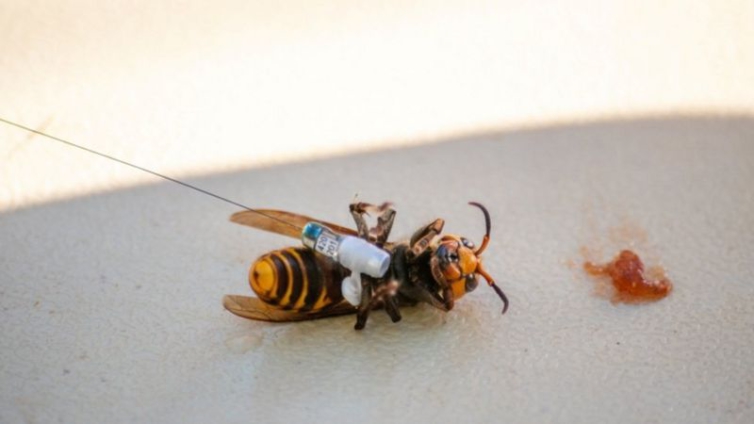
The nest, in the state of Washington, was found by putting tracker devices on the hornets and it was sucked out of a tree using a vacuum hose.
The invasive species insects, known as "murder hornets", have a powerful sting and can spit venom.
After weeks of searching, crews from Washington State's Agriculture Department destroyed the first nest of so-called murder hornets found in the U.S. The large invasive hornets can leave painful stings, but pose a bigger threat to honeybees than humans. https://t.co/L8wJWF6rSx
— The Associated Press (@AP) October 24, 2020
They target honeybees, which pollinate crops, and can destroy a colony in just a matter of hours.
The nest in Washington was found when entomologists, scientists that study insects, used dental gloss to tie tracking devices to three hornets.
The nest of around 200 insects was then discovered in the city of Blaine close to the Canadian border.
On Saturday, a crew of scientists wearing protective suits vacuumed the insects from the tree, which will now be cut down to remove any further nests.
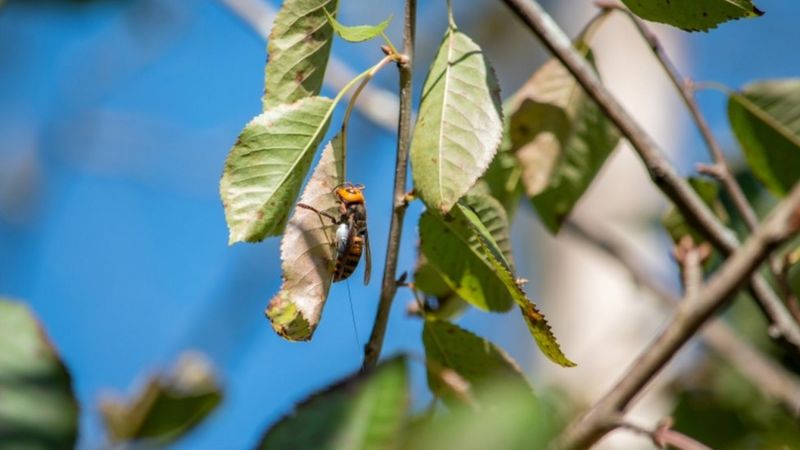
Asian giant hornets are the among the world's largest wasps - the queens can reach over 5cm (2in) long.
Their venomous sting can penetrate humans' protective clothing but the number of people they kill each year is low - about 40 annually in Asia, according to the Smithsonian museum in Washington D.C.
Normally their natural habitat is in areas of Asia from China to Japan, but in 2019 there were several sightings of single "murder hornets" in North America.
A nest was destroyed in Vancouver Island in Canada in December last year.
Globally, conservationists are deeply concerned about falling insect populations. But it can be permissible to kill some insects if they are an invasive species - one that is not native to an area and preys on other insects there.
Honeybees are under threat due to loss of food after habitat destruction, pesticides, and disease.
When an Asian giant hornet enters a honeybee colony, it begins a "slaughter phrase" in which it kills bee after bee and can destroy the colony in a few hours.
Latest Stories
-
Government has improved sanitation in one-and-a-half years — Salaga South MP
1 hour -
Nkwanta North Assembly to appear before Parliament over DACF sanitation spending
2 hours -
Mourinho prints out ‘red card’ incidents after Real lose derby
2 hours -
Atletico beat 10-man Real in feisty Madrid derby
2 hours -
Twelve Tribes of Israel Ghana to mark 40 years with anniversary celebration
3 hours -
GPL 2026/27: Hearts held by Bechem as Kotoko, Samartex share spoils
3 hours -
My Story (Kwaku Antwi-Boasiako)
3 hours -
We expect growth rate to re-accelerate in second-half of 2026 – IC Insights
3 hours -
The ungodliness and unrighteousness underlying the National Cathedral mess!
3 hours -
T-bills auction: Government fails to achieve target; yield on 91-day-bill remains unchanged
3 hours -
It’s Ghana’s shame to denigrate Nkrumah when the whole world honours him as African of the Century – Asiedu Nketiah
4 hours -
No other nationalist can compare to Nkrumah – Asiedu Nketiah
4 hours -
Collateral Registry: Foreign banks accounted for GH¢19.9bn of secured credit in quarter 2, 2026
4 hours -
This government should expect scrutiny – Asiedu Nketiah
4 hours -
Two-year-old girl dies in domestic fire at Cantonments
5 hours